At Computex 2026, Intel CEO Lip-Bu Tan outlined an enterprise AI strategy centered on Xeon 6+ processors as the host and orchestration layer for agentic AI infrastructure, rather than competing directly with NVIDIA on GPU accelerators. Key announcements included a rackscale partnership with SambaNova’s RDU accelerators, a disaggregated inference platform from Vector Core Compute incorporating both Intel and NVIDIA hardware, and vertical industry collaborations with Foxconn, Siemens, Hitachi, and biosciences partners.
The strategy positions Intel as an integrator that owns CPU orchestration while partnering for specialized accelerators. Tan also addressed consumer setbacks from Arrow Lake, teasing Diamond Rapids and Nova Lake chips, with the 18A process node underpinning both enterprise and consumer recovery efforts. Success remains dependent on future execution and manufacturing yields.
While the consumer headlines at Computex 2026 belonged to NVIDIA’s RTX Spark and Intel’s own Arc G3 gaming handheld chips, the more consequential Intel story for the company’s future came from CEO Lip-Bu Tan’s keynote and the accompanying enterprise announcements. Intel used Computex to lay out a chip-to-rackscale AI strategy built around Xeon 6+ processors, third-party accelerator partnerships, and a set of vertical industry collaborations. For a company that has spent the past several years fighting to stay relevant in the AI era dominated by NVIDIA, this was the clearest articulation yet of how Intel intends to compete: not by beating NVIDIA at GPUs, but by owning the CPU layer of agentic AI infrastructure and partnering for everything else.
Xeon 6+ : The Foundation
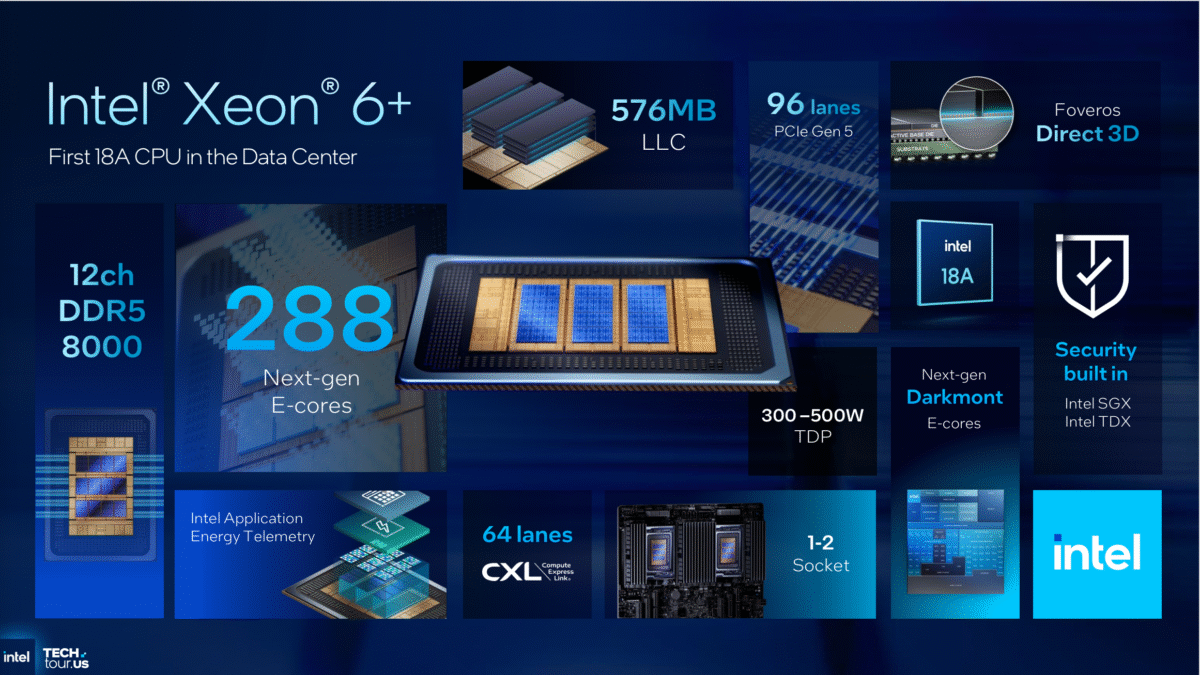
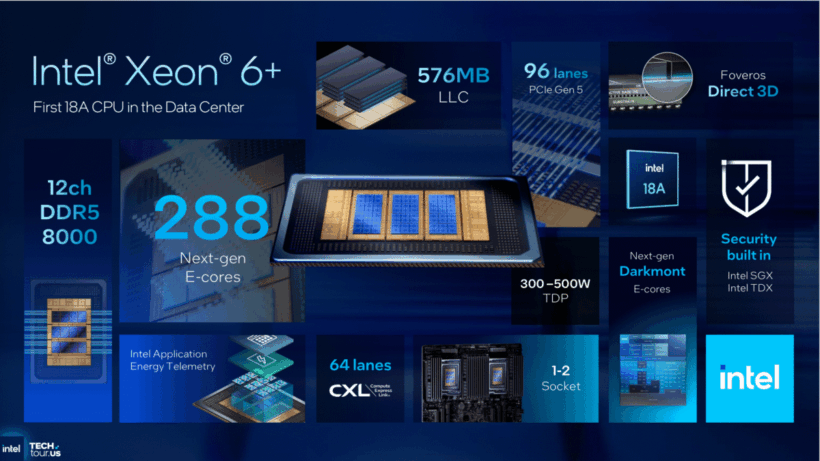
The chip-level announcement was the availability of Intel Xeon 6+ processors. Intel positions these as delivering greater performance density, power efficiency, and operational scale for cloud-native, agentic AI, and network-intensive workloads. The framing matters: Intel is not pitching Xeon 6+ as an AI training accelerator, a battle it long ago conceded to NVIDIA’s GPUs. It is pitching Xeon as the host processor layer that orchestrates AI infrastructure, runs the agentic workflows that do not require GPU acceleration, and handles the cloud-native and networking workloads that surround every AI deployment.
This is a pragmatic and arguably correct read of where Intel can win. Every AI data center, no matter how many NVIDIA GPUs it contains, needs host CPUs to manage them. Agentic AI workflows, which chain together many model calls, tool invocations, and data operations, spend significant time in CPU-bound orchestration logic rather than GPU-bound inference. As agentic AI scales, the CPU layer becomes more important, not less, and Intel wants Xeon 6+ to be the default choice for that layer.
Rackscale AI With SambaNova
The most strategically interesting announcement was Intel’s rackscale AI infrastructure pairing Xeon processors with SambaNova SN-50 Reconfigurable Dataflow Units. SambaNova is an AI accelerator startup whose RDU architecture takes a fundamentally different approach to AI inference than NVIDIA’s GPUs, using a reconfigurable dataflow design optimized for the memory-bound nature of large language model inference rather than the compute-bound nature of training.
The significance of this partnership is what it says about Intel’s strategy. Rather than insisting that customers use Intel’s own Gaudi AI accelerators for everything, Intel is presenting an open rack-scale architecture in which Xeon handles the host and orchestration layers, and best-of-breed accelerators handle inference. This is the same philosophy that underpins the broader announcement: Intel as the integrator and CPU foundation, partnering with specialized accelerator vendors rather than trying to build every piece in-house.
That philosophy was reinforced by a second partnership announcement. Vector Core Compute, a new enterprise inference cloud formed by Vista Equity Partners and Cambium Capital, unveiled a fully disaggregated inference platform running on Intel Xeon processors, SambaNova RDUs, and, notably, NVIDIA Blackwell GPUs. Intel is willing to build infrastructure that includes its largest competitor’s hardware, because the goal is to own the CPU and integration layer regardless of whose accelerators sit alongside it. Disaggregated inference, in which compute, memory, and accelerator resources are pooled and dynamically allocated rather than fixed on monolithic servers, is an emerging architecture that improves utilization and cost efficiency for variable inference workloads.
Vertical Industry Solutions
The third pillar of Intel’s Computex enterprise story was a set of strategic collaborations focused on delivering integrated vertical solutions for specific industries. Intel named Foxconn, Siemens, Hitachi, Echo Neurotechnologies, and Greenstone Biosciences as partners building industry-specific solutions on Intel processors.
The vertical strategy reflects a recognition that enterprise AI adoption does not happen through general-purpose horizontal platforms alone. Manufacturing, industrial automation, healthcare, neurotechnology, and biosciences each have specific data, compliance, latency, and integration requirements. By partnering with established leaders in each vertical, Foxconn in manufacturing and contract electronics, Siemens in industrial automation, Hitachi in infrastructure and operational technology, and the biosciences partners in their respective fields, Intel positions Xeon as the compute foundation for industry-specific AI deployments rather than competing solely on raw benchmark performance.
The Arrow Lake Context and What Comes Next
Tan’s keynote also addressed Intel’s consumer struggles directly. There is no question that Intel failed to hit the mark with enthusiasts when it introduced Arrow Lake, and the company used Computex 2026 to signal a course correction. On the consumer roadmap, Intel teased Diamond Rapids and dropped hints about next-generation Nova Lake chips, the architectures that need to restore Intel’s competitiveness against AMD in the desktop and high-performance laptop markets.
The enterprise AI strategy and the consumer recovery are connected. Intel’s manufacturing recovery, anchored by the 18A process node now shipping in the Arc G3 handheld chips, is the foundation for both. If 18A and its successors deliver competitive performance and yield, Intel can build credible Xeon processors for the data center and competitive consumer chips simultaneously. If the process technology continues to lag, neither strategy will fully work. Computex 2026 was Intel’s most coherent presentation of its recovery narrative in years, but the proof remains in execution over the coming product cycles.
What It Means
Intel’s Computex 2026 enterprise announcements describe a company that has made peace with not winning the AI accelerator war and has instead defined a role it can credibly own: the CPU foundation and integration layer for agentic AI infrastructure. Xeon 6+ as the host and orchestration processor, open partnerships with accelerator specialists like SambaNova, willingness to build infrastructure that includes NVIDIA GPUs, and vertical solutions tailored to specific industries. It is a humbler strategy than the one Intel pursued during its years of dominance, but it is realistic, and realism has been in short supply at Intel for much of the past decade.
The open question is whether the CPU layer of AI infrastructure is large enough and defensible enough of a business to restore Intel to the position it once held. NVIDIA’s dominance of the accelerator layer has made it the most valuable semiconductor company in history. Intel is betting that as agentic AI scales, the orchestration and host-processor layer becomes a substantial and durable market in its own right. Computex 2026 was the clearest statement yet of that bet. The returns will take years to measure.
Sources: Intel Corporation press release, Tom’s Hardware Computex 2026 coverage, Intel Newsroom. Reported from Computex 2026, Taipei, June 3, 2026.