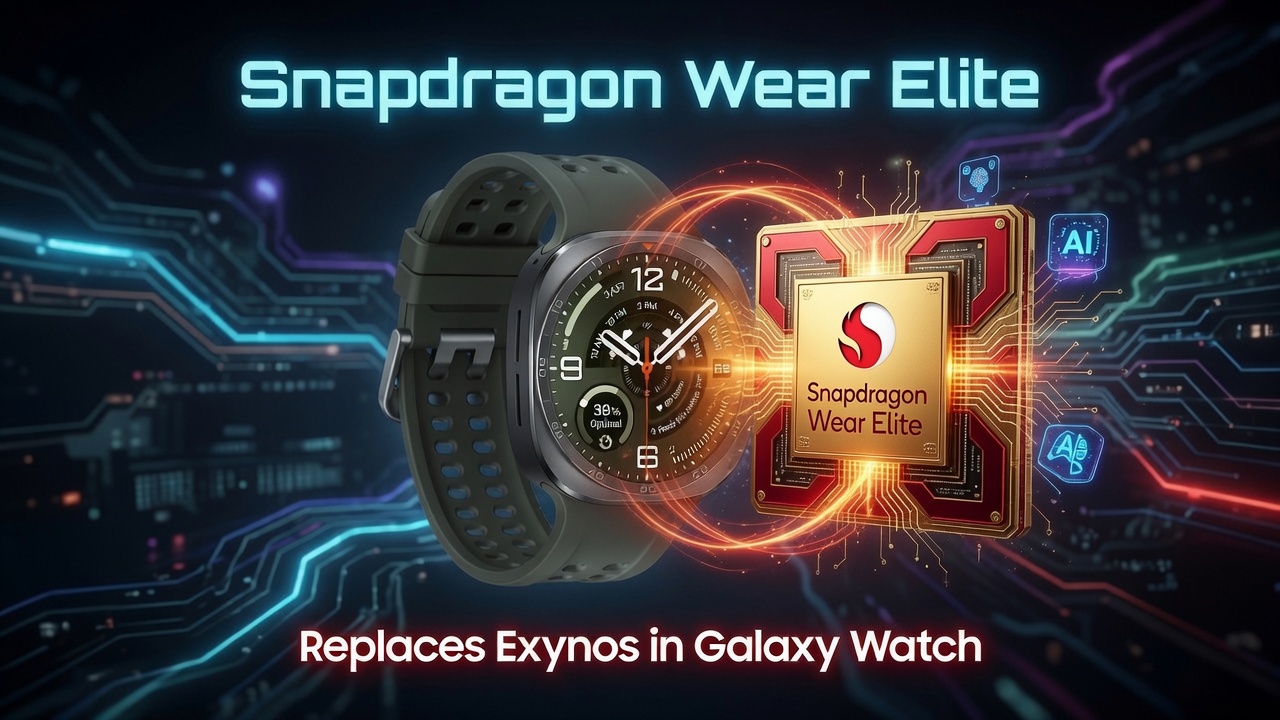
Cristiano Amon walked onto Samsung’s own stage at Old Billingsgate in London on Wednesday to say that Snapdragon Wear Elite is powering Galaxy watches, and the sentence nobody from Samsung said out loud is that the Exynos W1000 never got a successor. The Galaxy Watch 9 and the Galaxy Watch Ultra 2 are the first Samsung smartwatches running a Qualcomm application processor. Every previous one, going back to the beginning of the modern Wear OS line, ran silicon from Samsung’s own Device Solutions division.
I have been following this specific chip family for a while, and it is worth remembering how good the start was. The Exynos W920 was the first wearable processor built on a 5nm EUV node, packing an LTE modem and a dedicated Cortex-M55 display processor into the smallest package on the market at the time. It shipped inside the Galaxy Watch4, the watch that moved Samsung off Tizen and onto the unified Wear OS platform it built with Google. That was a genuine lead. Samsung was shipping a 5nm wearable chip while Qualcomm was still selling a 12nm part.
Then the cadence broke. The Exynos W1000 arrived in 2024, went into the Galaxy Watch 7 and the first Galaxy Watch Ultra, and got carried over unchanged into the Watch 8 series last year. Two full generations on one part. There is no W1100, no W2000, nothing announced, and nothing leaked. Qualcomm, meanwhile, put Snapdragon Wear Elite on the table at MWC in March, and Samsung’s Mobile Experience group took it.
What Qualcomm actually built is a 3nm part with a Hexagon NPU rated at 12 TOPS, capable of running models up to two billion parameters on your wrist, plus a separate ultra-low-power eNPU for the always-on work. Qualcomm claims up to five times the single-core CPU performance and seven times the GPU of the Snapdragon W5+ Gen 2, with roughly 30 percent better battery life and a 50 percent charge in under ten minutes. The NPU is the whole reason Samsung switched. The health and outdoor-activity features in this year’s watches need a neural block that the W1000 simply does not have, and System LSI had nothing to offer.
The naming irritates me, and I want to be clear about why. “Elite” is Qualcomm’s badge for Oryon, its custom CPU core, the thing that made the X Elite and the 8 Elite interesting. Snapdragon Wear Elite has no Oryon in it. It runs one Cortex-A78 at 2.1 GHz alongside four Cortex-A55s at 1.95 GHz, which are Arm stock cores of a vintage that was mainstream in phones around 2020. The chip is still a large step up from what it replaces, and the NPU is the real story, but stretching the Elite brand over an A78 cluster is marketing doing work that engineering did not.
Here is the part that complicates the easy narrative, and it is the reason I do not think “Samsung abandons Exynos” is the right headline. In phones this year, the flow ran the other way. The Galaxy Z Flip 7 last year used the Exynos 2500 in every market, no exceptions. The Z Flip 8 uses the Exynos 2600 in Korea and Europe while US buyers get the Snapdragon 8 Elite Gen 5, which means Samsung reintroduced a regional split it had spent years walking away from since the Galaxy S23 went all-Snapdragon worldwide. Roh Tae-moon told reporters at the event that Samsung’s strategy with strategic partners is unchanged, which is the kind of line you deliver when something has visibly changed and you would rather not discuss it.
So Exynos is not retreating everywhere. It is retreating from wearables specifically, and that is the more interesting fact, because wearables were the easy socket. Low volume, low thermal ceiling, no benchmark press cycle, a captive first-party customer. If System LSI cannot hold the one design win where nobody is checking Geekbench scores, that says something about where its engineering hours are going. My guess is that they are all pointed at the Exynos 2600 and the SF2 node the entire foundry comeback is riding on, and the wearable roadmap got sacrificed to feed it. That is a defensible call. It is also how a product line dies: not with a cancellation notice, just a generation that never ships.
I am not getting into what this does to Wear OS as a platform, or to the Pixel Watch sitting on the other side of the same Qualcomm catalog. That is its own post, and I have not thought it through properly yet.
For anyone actually buying a watch, the headline is not the chip at all. It is five years of Wear OS upgrades and five years of security patches, up from four, which is the longest support window anyone has offered on a Wear OS device and roughly double what Google promises on its own Pixel Watch. Both models ship on Wear OS 7. That is the spec that will still matter in 2030, and it only works because there is finally a processor in there with enough headroom to survive five years of software getting heavier. Qualcomm sold Samsung the runway. The awkward part for Samsung is that it used to build its own.
Sources
- The Korea Times, Samsung drops Exynos for Galaxy Watch, turns to Qualcomm, 23 July 2026
- CNET, The Real Winner at Samsung’s Galaxy Unpacked? Qualcomm and Its Snapdragon Chips, 23 July 2026
- 9to5Google, Galaxy Watch 9 and Ultra 2 are the first Wear OS watches with 5 years of updates, 23 July 2026
- CNX Software, Qualcomm Snapdragon Wear Elite wearable platform, 3 March 2026
- Qualcomm, Snapdragon Wear Elite Platform product brief