A $44 board now runs a vision model offline and closes a motor control loop at the same time, on the same PCB. That is the Uno Q, and it is the clearest signal of what Qualcomm bought when it swallowed Arduino: not a maker brand with a nice logo, but a shortcut into the one part of robotics nobody has cracked, which is getting from a working prototype to a shipping product without three separate compute boards and a research grant.
I have owned Arduinos since the Uno R3 days, so I will admit up front that I came into this skeptical. Big silicon vendor buys the beloved open hardware company, promises nothing will change, and eighteen months later the community tooling quietly rots. That is the usual script. What makes this one different is that the product actually reflects the strategy, and the strategy is more coherent than the press release let on.
Start with the deal itself. Qualcomm announced it was acquiring Arduino on October 7, 2025 for an undisclosed sum, subject to regulatory approval, and shipped the first joint product the same day. Arduino stays an independent subsidiary and keeps supporting non-Qualcomm chips, which matters because the previous flagship Uno R4 ran Renesas and Espressif parts. This was not an isolated buy either. Qualcomm had already picked up Edge Impulse, the embedded ML-ops platform, and Foundries.io for cloud device management. Arduino was the missing piece: the developer funnel. Nakul Duggal, who runs Qualcomm’s automotive, industrial and embedded IoT group, said as much when he framed the deal as completing the company’s push to scale edge experiences out to the developer community. Translation: Qualcomm has the silicon and the AI stack, and it just bought 33 million makers to put it in front of. It is another move in Qualcomm’s steady pivot beyond Snapdragon phone silicon, except this time the destination is the workbench rather than the laptop.
Marcello Majonchi, Arduino’s chief product officer, laid out the throughline in a late-July interview. He sees three eras for the company. First, democratizing electronics, the original blink-an-LED Uno moment. Then IoT and connectivity. Now, under Qualcomm, edge AI aimed squarely at automation and robotics. The pattern he keeps returning to is that robotics today feels like IoT in its early days: a swarm of startups experimenting, a few of which become the next generation of infrastructure and most of which become cautionary tales. His pitch is that cheap capable hardware is finally meeting edge AI that can actually run somewhere other than a data center, and Arduino’s job is to collapse the distance between a bench prototype and a production unit.
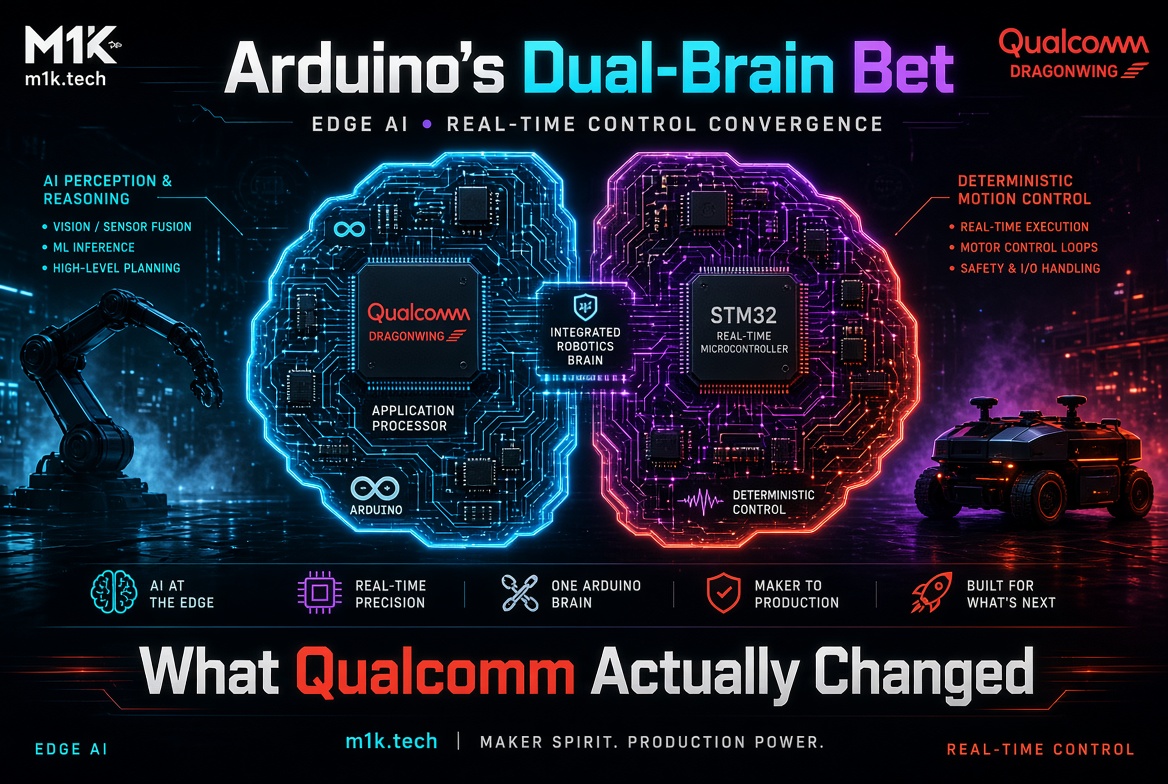
To see why that is more than a slogan, look at the problem every robotics team hits. Perception and reasoning want a fat application processor with a GPU and a neural engine. Actuation wants a boring, deterministic microcontroller that hits its timing every single cycle, because a motor loop that jitters is a motor loop that destroys itself or someone’s fingers. Historically you bolted two boards together, a Jetson or a Pi for the brains and an STM32 or similar for the reflexes, and then spent weeks getting them to talk. Arduino’s answer is to put both on one board and pretend the seam does not exist.
On the Uno Q, the brains are a Qualcomm Dragonwing QRB2210: a quad-core CPU with an Adreno GPU, dual image signal processors, and AI acceleration, capable of booting Debian Linux. The reflexes are an STM32U585, a single Cortex-M33 running up to 160 MHz with 768 KB of SRAM and 2 MB of flash, wired straight into the classic Uno pin headers up top. The Qualcomm side talks to the world through a pair of high-density board-to-board connectors on the underside for carrier boards. Entry pricing lands around $44 for the 2GB/16GB version and a bit under $60 for the 4GB/32GB one. For a board that runs Linux and a small on-device model, that is aggressive.
The Ventuno Q is where this stops being a hobby story. It ships in August, it is the most powerful board Arduino has ever built, and it is named for the Italian word for twenty-one, marking the company’s 21st year. The brains here are a Dragonwing IQ8 series part, the IQ-8275, with a 64-bit eight-core Kryo CPU up to 2.35 GHz, an Adreno 623 GPU, and a Hexagon NPU rated at up to 40 TOPS. It carries 16 GB of LPDDR5, 64 GB of eMMC with an M.2 NVMe Gen4 slot to grow it, Wi-Fi 6, Bluetooth 5.3, and 2.5 Gigabit Ethernet. The real-time half is an STM32H5. Majonchi’s framing is blunt and it stuck with me: 40 TOPS is enough to run a fully autonomous mobile robot with a robotic arm, and they demonstrated exactly that at Embedded World rather than showing a slide about it. Pricing sits under $300.
The software layer is Arduino App Lab, which retires the old IDE and handles both halves of the board in one environment: Wiring-flavored C for the microcontroller, Python for the Linux side. It ships with pretrained models you can run entirely offline, drawn from Qualcomm’s AI Hub and Edge Impulse: local LLMs, vision-language models, speech recognition, text to speech, gesture and pose estimation, object tracking. It also makes ROS 2, the robotics middleware everyone standardizes on, far less painful to deploy. That combination, deterministic real-time control plus an NPU plus a sane deployment path for ROS 2 and offline models, is the actual product. The board is just where it lives.
So who is it for? The easy read is students and hobbyists, and sure, plenty of both will buy these. But the number Majonchi dropped that reframes the whole thing is that more than 95 percent of automotive manufacturers already prototype on Arduino. BMW standardized its prototyping on it and has a public case study to prove it. Mercedes-Benz followed a similar path. That is not a maker anecdote, that is Arduino sitting quietly inside the R&D process of the most demanding hardware buyers on earth, and it is the asset Qualcomm actually paid for. If you want to win edge robotics silicon, owning the board that engineers reach for on day one of a project is worth more than a better spec sheet.
Arduino’s historic weakness is the flip side of that strength. It is a prototyping platform. Things get built on it and then rebuilt on something else for production, because the old boards could not carry a real workload and the toolchain stopped at the bench. The dual-brain boards plus App Lab plus Qualcomm’s production-grade silicon are the first credible attempt to let the thing you prototyped be the thing you ship. Whether that promise survives contact with actual manufacturing volumes is the open question, and it is the one I would not bet my own money on yet.
All of which leads to the competitor nobody at Arduino will name. The Ventuno Q at 40 TOPS for under $300 is aimed at exactly one thing, and it is not a Raspberry Pi. It is NVIDIA’s Jetson. Jetson Orin sits in the same TOPS-per-dollar neighborhood and has spent years as the default brain for anyone building a serious edge robot, with a deep CUDA software moat behind it. Arduino is not going to out-engineer NVIDIA on raw inference or on the maturity of the developer stack. What it has instead is distribution NVIDIA has never had: those 33 million developers and that 95 percent of automakers, plus a real-time microcontroller welded to the same board so you are not integrating two ecosystems. NVIDIA makes you bring your own motor-control board. Arduino ships it in the box.
Majonchi drew the Raspberry Pi comparison himself, and it is the right one to dismiss. Pi is a hardware platform. Arduino, in his telling, is a development platform that happens to sell hardware, and the Qualcomm boards now match Pi-class compute while adding the real-time layer Pi has never had. Fine. Pi was never the threat. The threat is Jetson, and Intel is now circling the same water too, having just signed on as a MassRobotics sponsor in July with an October developer workshop for startups building physical AI at the edge.
That MassRobotics thread is worth untangling, because it got garbled in some of the coverage. Qualcomm joined MassRobotics as a sponsor back on March 31, 2026, not July, and tied it to its Dragonwing Robotics Hub, which lives inside Arduino’s own Project Hub. The June follow-up event featured the Ventuno Q. So the sequence is coherent: buy the developer funnel in October, wire the silicon into a robotics developer hub, then plant a flag in the largest independent robotics startup incubator in the world so the next wave of physical-AI companies grows up on Dragonwing by default. It fits the shape of Qualcomm’s wider 2026 strategy, and it is an ecosystem land-grab: the fact that Intel showed up four months later chasing the same startups tells you the land is worth grabbing.
The IoT analogy is the part I keep chewing on. Majonchi’s IoT-inflection framing is seductive and half right. Cheap capable compute did unlock IoT, and robotics is clearly at a similar moment where the hardware finally stops being the bottleneck. But the IoT boom also produced a decade of landfill: connected devices nobody needed, security holes, abandoned cloud backends that bricked hardware the day the startup folded. If robotics rhymes with IoT, it rhymes with all of it, not just the winners. A flood of cheap capable robot brains lowers the barrier for the next Boston Dynamics and for ten thousand half-finished AMRs that never ship. Lowering barriers is Arduino’s whole mission, and it is also precisely how you end up with a graveyard.
I am not getting into the regulatory angle on the acquisition here, whether a US chip giant absorbing an open Italian hardware icon draws scrutiny in Brussels. That is its own post, and I do not have the closing details yet.
What I will say is that this is the most interesting thing Qualcomm has done in years, and it is not really about the boards. It is about who owns the moment a developer decides what silicon their robot runs on, which is the same land-grab logic behind Qualcomm’s inference-first bet on the data-center side. Arduino has owned that decision for automotive prototyping for a decade without monetizing it. Qualcomm just bought the right to convert it. The Ventuno Q is proof they are serious, and the App Lab and ROS 2 story is proof they understand the actual pain rather than the marketing of it. The Jetson comparison, meanwhile, is proof they are walking into a real fight and not a soft market. Whether the prototype-to-production bridge holds weight is the only question that matters, and Arduino has spent twenty-one years being brilliant on the prototype side and absent on the production side. Ask me again after the Ventuno Q has been shipping for six months and we can see how many of those robots actually left the bench.