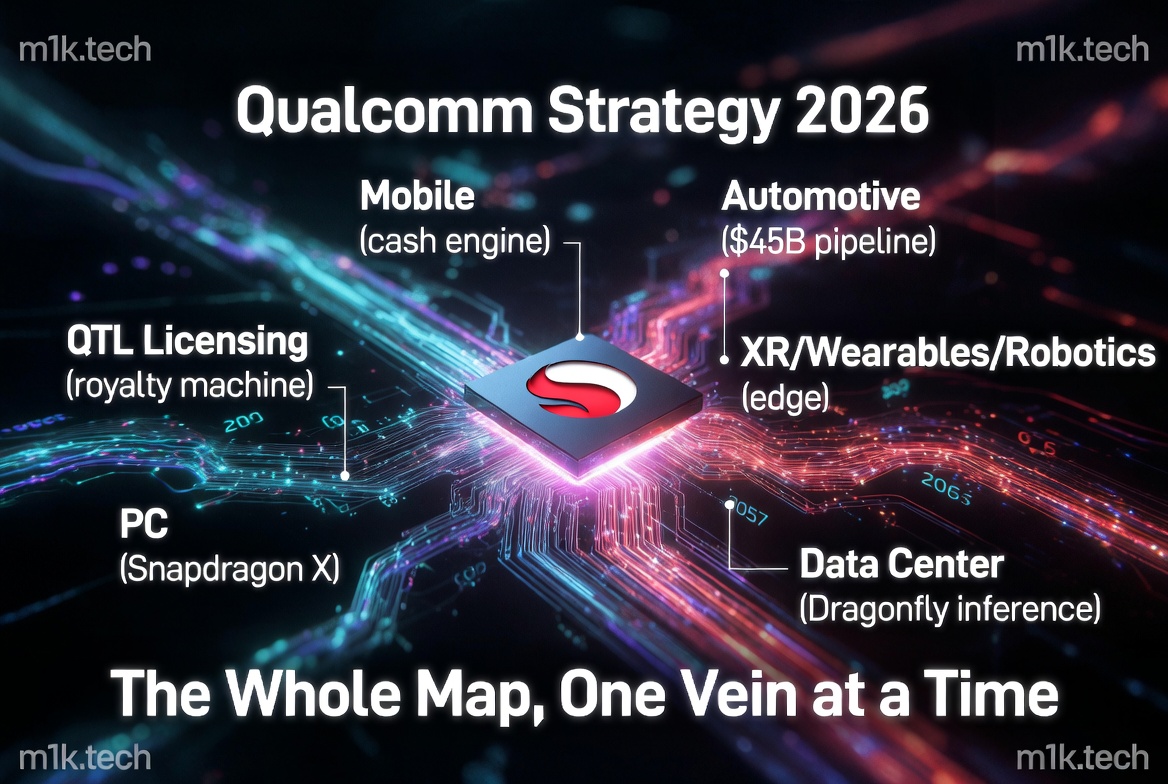
Qualcomm’s strategy in 2026 is the most aggressive reinvention the company has attempted since the first Snapdragon shipped, and I have covered almost all of it: 178 posts sitting in one category that, until now, have never been in one place. This is that place, a map of the coverage sorted into the veins that actually matter, with a line on each piece that carries a real thesis. I curated hard. Plenty of those posts are launch notes and sponsorship items that say nothing, so I kept the ones that do and left the rest.
It all comes down to one race: replace Apple before Apple finishes replacing Qualcomm. Apple has been roughly a quarter of the revenue for years, and it is designing Qualcomm out of the iPhone one modem at a time. On July 29, Amon told Reuters that Apple chip revenue will fall about half between the September and December quarters this year, sooner and steeper than Qualcomm’s own models had it, because the memory supply crunch is pulling Apple’s in-house C2 modem into the iPhone 18 Pro ahead of schedule. By 2027, that account is close to gone. Every vein below is Amon trying to grow a replacement out of a different market before the modem money runs out, and once you read the sprawl that way it stops looking like a scattergun and starts looking like a countdown.
The mobile core is the cash engine, and it is under real pressure
Everything else is funded by phones, so start here. I told the twenty-year arc in Two Decades of Snapdragon, which is the reference spine for this whole vein, from the Scorpion cores of 2007 to today’s custom silicon. The current flagship is the Snapdragon 8 Elite Gen 5, and by early 2026 it had done something Qualcomm chased for a decade: it overtook Apple on raw performance, which is why I bothered pulling apart what its NPU actually contains and covered the OnePlus 15 that launched it first. The pivot that made this possible was 2024’s 8 Elite with a fully custom CPU at 4.32GHz, Qualcomm ripping out Arm’s reference cores for its own Oryon design, which matters more for the licensing fight than for the benchmarks. Before that came the full-stack AI turn I traced through the 8 Gen 4 and the mid-tier 8s Gen 3 that quietly put on-device AI in normal phones, back through the annual Summit launches: the 8 Gen 3 in 2023, the 8 Gen 2’s move to TSMC in 2022, and the 8 Gen 1’s naming reset in 2021.
That TSMC line matters because it is the single best supply-chain lesson in the whole catalog. The Snapdragon 8 Gen 1 was a disaster on Samsung’s 4nm, ran hot and yielded badly, and pushed Qualcomm to move its flagship to TSMC and mostly stay there, which is where the 8 Elite Gen 5 sits today on N3. That dependency is the quiet risk under everything else on this page, because Qualcomm is fabless and TSMC is the whole plan. On the demand side, the picture is harder than the benchmark wins suggest. MediaTek still leads on volume, around 32 percent in the first quarter of 2026 by Counterpoint’s count, while Qualcomm owns the premium tier and the revenue lead, and even Qualcomm’s shipments slipped year over year as the memory shortage hammered the mainstream 4- and 6-series. The other pressure is captive silicon: I wrote about renewing the Xiaomi partnership the same week Xiaomi shipped its own chip, and about that chip, the XRING O1, because every large customer eventually wants to do what Apple did.
Licensing is the real money machine, and Arm is the threat to it
The part of Qualcomm that prints money is not the chips, it is the patents, and I finally sat down to explain it in the QTL royalty machine, how licensing quietly funds everything else. QTL is a high-margin toll on essentially every 3G, 4G, and 5G handset on earth, and it is the war chest paying for all the diversification in this map. The threat to that model is the same custom-core decision that made the 8 Elite competitive. When Qualcomm bought Nuvia and turned its team into the Oryon cores, Arm sued over whether the architecture license carried across, and I unpacked where that stands in the Arm fight over Nuvia, which Qualcomm won but is still grinding through appeal. The obvious hedge is RISC-V, the license-free instruction set, except I did the math in why leaving Arm would barely cut the bill and concluded the royalty was never the real reason to consider it. The origin of the whole Oryon bet, the ex-Apple architects and their gamble on Windows, sits in the Oryon deep dive.
The PC is the first diversification that had to prove itself in public
Windows on Arm is where Qualcomm bet that the phone playbook, a low-power SoC with a big NPU, could take a slice of the laptop market Intel and AMD had owned forever. The launch moment was Computex 2024, when Amon and Nadella redefined the PC as the Copilot+ machine, the payoff of Qualcomm’s argument that on-device AI would jump from the phone to the laptop. Two years on I gave it a checkup in Snapdragon X, two years in: the platform is real, but is it ready, and the blunt scorecard is Qualcomm got its 9 percent of Windows, and holding it is the hard part. The lineup filled out fast: the mainstream X Plus under a thousand dollars, the 300-dollar Snapdragon C aimed at the budget-laptop trap, and then the piece I found most interesting, the desktop X2 Elite and the quiet fork in Qualcomm’s compute architecture, which I also read as a specialization bet nobody won cleanly. Microsoft is the partner that makes or breaks this vein; the competition is now three-way with Apple’s own silicon, and I watched that fight play out again at Computex 2025.
Automotive is the diversification that is actually paying the bills
If the data center is the bet and the PC is the proof of concept, automotive is the one already turning into real revenue. The Snapdragon Digital Chassis carries a design-win pipeline Qualcomm has put around 45 billion dollars, automotive revenue crossed a billion a quarter in early 2026 and is still growing double digits, and the fifth-generation Digital Chassis ramping this September is supposed to lift the silicon content per car by an order of magnitude. The anchor story is the one I just wrote, the Qualcomm-BMW deal that locks in a decade and neither company can walk back, with BMW naming Qualcomm its lead compute silicon provider and the Snapdragon Ride Pilot already shipping in the iX3. I traced the money mechanics in the Q3 FY2025 automotive record that pays out in 2028, because auto design wins are slow and get signed years before they show up in revenue. The longer pattern runs back through the earnings, the 55 percent automotive growth in FY2024 and the 58 percent surge back in Q1 FY2023 that first proved Amon’s diversification thesis had legs. The competition here is Nvidia and Mobileye, and Qualcomm’s edge is the same low-power, single-platform pitch it makes everywhere else.
XR, wearables, and robotics are the edge spreading into everything that is not a phone
The edge is the widest and messiest vein I cover, Qualcomm trying to be the default brain for every device that is not a phone. In headsets, it made its pitch with Snapdragon Reality Elite, which I argued was the XR chip that finally solves the AI ceiling, though the reality check is that Samsung’s new intelligent eyewear runs the same AR1 chip Meta shipped back in 2023, so the silicon is ahead of the products. The platform story is Android XR and the Galaxy XR arriving as an open platform, a lineage I pushed back to Vision Pro, Quest 3, and the XR2 Gen 2. On the wrist, Samsung’s Galaxy Watch now runs Snapdragon Wear Elite and Exynos W quietly died, another captive-silicon retreat that went Qualcomm’s way. The most strategically loaded corner is robotics: the Dragonwing IQ10 robot brain, its architecture in detail, and the competitive read in Jetson Thor versus Dragonwing, where Nvidia owns the humanoid, and Qualcomm wants everything else. I put the whole spread in context twice, in how AI left the data center, from Movidius to Dragonwing, and in the full-stack edge thesis, Qualcomm buying its way to being the default edge platform one layer at a time. Even the Ray-Ban Meta glasses I covered at 82 percent market share run Qualcomm silicon inside, which is the point: the brand you see is rarely the chip.
The data center is the biggest bet, and the one with the least proof
This is the frontier, the vein I have written about most lately, and the one where Qualcomm’s market share today is essentially zero. The thesis I keep circling is that Qualcomm is an inference company walking into a market Nvidia built on training, and the whole argument lives in 768 GB per card, where Qualcomm’s AI actually lives. The strategic spine is the CUDA problem: Qualcomm’s 4 billion dollar bet on Modular is really a bet against CUDA, the software moat that is Nvidia’s actual product, which is why buying Modular meant the phone was never the point and why I set it inside the broader argument that the modular, chiplet AI hardware moat is quietly coming apart. The roadmap I called early is Dragonfly, the rack-scale bet, with its 2028 catch, and the field is filling with other outsiders in the Tenstorrent, Cerebras, and Qualcomm story where Jim Keller promises to beat everyone with boring DRAM. The software-and-services layer showed up when Qualcomm bought SAM Seamless for the telco edge. And the newest chapter, the one that prompted this whole map, is the gigafactory bet, an inference play dropped into a training program, Qualcomm signing a letter of intent into Europe’s AI gigafactories on the strength of a low-power story I think is half right. The partnership running through all of it is uncomfortable: Qualcomm reaches Nvidia’s GPUs through Nvidia’s own NVLink Fusion fabric, so even the challenger leans on the incumbent.
The money proves it is working, and geopolitics quietly shields it
Two threads hold the map together. The first is the earnings, where the diversification stops being a slogan and shows up in the segment lines. The clearest single marker is Q3 FY2025, when the AI edge thesis became financial reality, sitting on top of record quarters like the 11.7 billion dollar Q1 FY2025 and the 10.8 billion dollar Q2 FY2025, a long way from the 35.8 billion dollar FY2023 where automotive first got named as the future. The second thread is the one most people miss, and it is a real moat: export controls. While Washington throttles Nvidia’s data-center GPUs into China, I argued Qualcomm quietly built the one chip business the export regime cannot touch, because edge and mobile inference silicon sits below the thresholds that catch frontier accelerators. I ran the same logic through the Malaysia export controls and the phone in your pocket and through the H20 saga, where the reversal was never about the chip but about the CUDA lock-in underneath. In a decade of silicon as statecraft, being too low-power to regulate is an accidental advantage Qualcomm is glad to keep.
A note on the brand, the sponsorships, and what I left out
A big chunk of the 178 posts is Qualcomm trying to turn Snapdragon from an ingredient into a name you ask for, the Intel Inside playbook, because if buyers demand Snapdragon by name, then OEMs cannot swap it out on price alone. That is what the Manchester United shirt deal, the Scuderia Ferrari partnership, and the Mercedes F1 sponsorship are actually for, and it is why I spent five years inside the program. I have left the pure press-release reposts and most of the older launch coverage out of this map on purpose. If a Qualcomm post is not linked here, it is almost always because it reported an event rather than argued a point, and this page was meant to be the argument.
Pull it all together, and the shape is clear. Qualcomm is a mobile-and-licensing company sprinting to become a compute company across five fronts, funded by patent royalties and premium Snapdragon margins, sourced almost entirely from TSMC with the memory market as the sharp near-term risk, and racing a clock that Apple set. The scorecard is uneven, and I will not dress it up: Qualcomm leads mobile on revenue while trailing MediaTek on volume, holds a hard-won 9 percent in Windows PCs, leads automotive with a 45-billion-dollar pipeline, is close to the default silicon in XR and wearables, and sits at roughly zero in the data center it most needs to win. The partnership web does a lot of the work: Microsoft in PCs, BMW and Mercedes and Google in cars, Samsung and Meta at the edge, Humain and Nvidia in the data center, and that last pairing is the tell, since a sovereignty pitch that reaches the GPU through Nvidia’s own fabric carries an obvious asterisk. My read after all of it is that the diversification is real and working nearly everywhere it has had time to, and the one place it has to work biggest, the data center, is the one place it has not proven anything yet. With the Apple cliff arriving faster than Qualcomm modeled, the real question is whether the replacements grow up before the countdown hits zero.