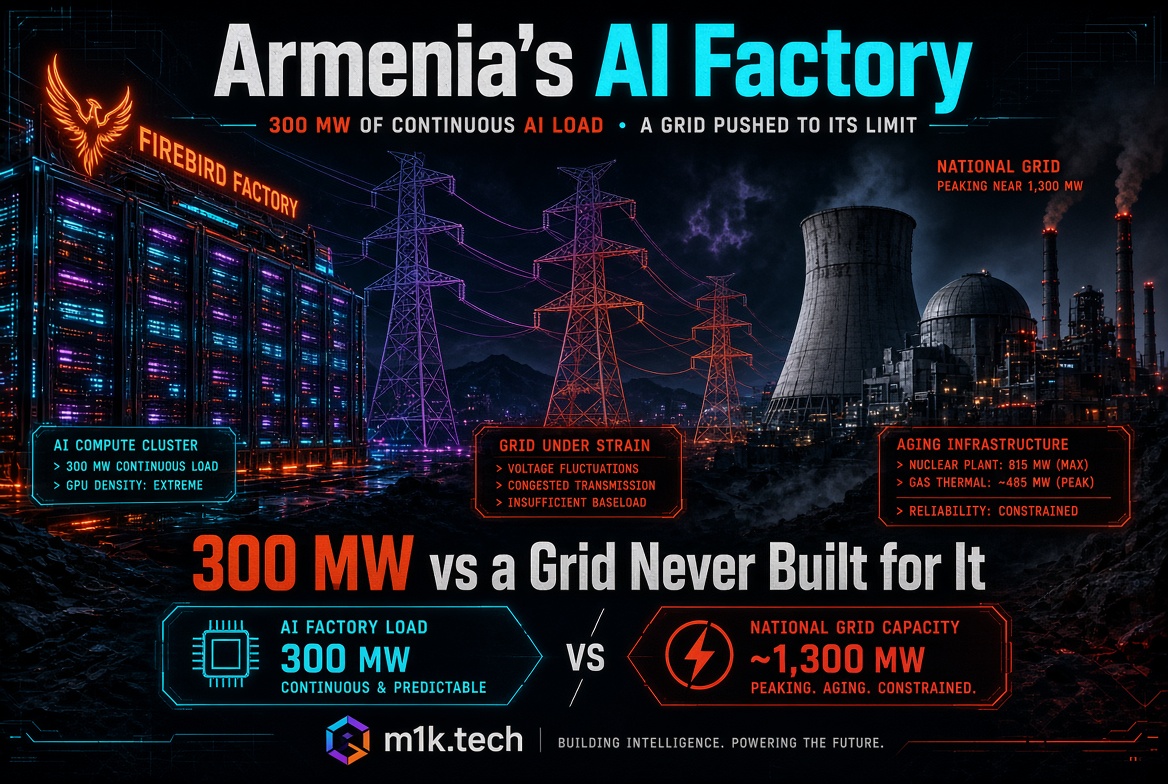
Firebird’s factory in Hrazdan opened on a weekend when roughly forty percent of Armenia’s baseload was switched off. Metsamor, the country’s only nuclear plant and the source of about a third of its electricity, went dark in April for a five-month refurbishment, the kind of outage a small grid schedules for the low-demand months and then holds its breath through. So the biggest AI factory in the former Soviet space came online in a country that was, at that exact moment, running a reactor short. Nobody at the ribbon-cutting mentioned it, and I understand why, but it is the whole problem sitting in one image.
I wrote last week about how that factory is really an export-license story, Washington signing off on frontier compute for a country pivoting hard away from Moscow. I left one thread hanging on purpose, because it did not fit the geopolitics and it deserved its own look: where the electricity actually comes from. The chips are the easy part. A Blackwell board needs a permission slip. Three hundred megawatts of round-the-clock power in a country whose entire grid peaks around 1,300 needs something no signature can provide.
What Armenia has to work with
Start with the honest inventory, because the headline capacity number flatters the country. On paper, Armenia has about 4,150 megawatts of installed generation. In practice, only around 2,880 is actually available, because roughly half the fleet is more than forty years old and a good chunk of it barely runs. Demand is small to match: the system peaks near 1,300 megawatts in winter and closer to 1,040 in summer, on annual generation of under eight terawatt-hours. Armenia is a net electricity exporter, shipping its surplus to Iran under a long-standing gas-for-power barter and trading with Georgia across the seasons. The mix is roughly 40% gas, a third nuclear, a fifth hydro, and about 5% solar and climbing.
The nuclear third is one reactor. Metsamor Unit 2 is a Soviet VVER, brought online in 1980, rated a little over 400 megawatts after successive uprates, and it is the only nuclear plant in the entire South Caucasus. It has been annealed, modernized, and extended more than once, most recently on a Rosatom contract that pushes its life to 2036, with Pashinyan floating 2046 in parliament this spring. It also sits near major fault lines in a region that has seen magnitude-8 earthquakes, which is why the EU and Turkey have spent years urging Armenia to shut it, and why Armenia, lacking a replacement, keeps refurbishing it instead. That refurbishment is the outage the factory opened during.
The rest is gas and water. The Hrazdan thermal complex, which is exactly why Firebird put its data center in Hrazdan, pairs a fleet of aging Soviet units with the newer Hrazdan-5, a roughly 480-megawatt combined-cycle plant that Gazprom built and commissioned in 2013. Add the Yerevan combined-cycle plant, and you have Armenia’s flexible backbone, except that much of that gas-fired output is not free for domestic use: a large share of it is committed to the electricity Armenia sends back to Iran under the barter. Hydropower, the Sevan-Hrazdan and Vorotan cascades plus a few hundred small plants, runs to about 1,345 megawatts and does load-following, not baseload. Solar is the growth story, with Emirati developer Masdar building utility-scale plants, but it is still around five percent, and it produces nothing at night. Siting the factory next to the thermal plants and the grid backbone was smart. It does not create a single new electron.
The number that does not fit
Now lay the factory over that grid. Three hundred megawatts, the figure Firebird gives for this site by the end of 2027, is around a quarter of Armenia’s winter peak and closer to a third of its summer peak. It is roughly a tenth of the country’s entire available capacity and about three-quarters of everything Metsamor produces. And it is the worst possible shape of load for a grid like this: flat, round-the-clock, inflexible, with none of the nights-and-weekends slack that ordinary demand gives an operator room to breathe in. A hydro-and-solar-leaning system is at its weakest serving exactly that profile. The global roadmap makes the arithmetic sillier still, because Firebird talks about roughly two gigawatts across its sites by 2028, and even the Armenian share of that would rival the whole country’s available generation.
You cannot serve that from spare capacity, because there is no spare capacity. Armenia already exports its surplus. So either the factory brings its own generation or the country builds new, and there are only four ways to find three hundred flat megawatts, each with a catch. Burn more gas, which means more Russian gas. Build new nuclear, which is a decade away at best. Scale solar with storage, which cannot yet carry a 24/7 load of this size on its own. Or import it, which runs straight into the grid-interconnection problem, the wire nobody buys their way out of quickly, across borders that do not have the spare transmission headroom to move that much power reliably. None of the four is fast, and the fastest of them is the one that deepens the dependency Armenia is trying to escape.
Whose electrons, really
Here is the part that reframes the whole triumphant pivot-west narrative. Gas is about forty percent of Armenia’s electricity and nearly all of it is Russian, piped in by Gazprom through Georgia. The nuclear third runs on fuel supplied by Rosatom, which also does the plant’s maintenance and every life extension. Put those together and something close to seventy percent of Armenia’s power is generated from Russian gas or Russian-supplied nuclear fuel. The country can host an American AI factory, but the electrons feeding the racks are, for now and for years, substantially Moscow’s.
Yerevan knows this, which is why the energy story underneath the compute story is a slow, messy attempt to cut the cord. The national distribution grid, Electric Networks of Armenia, was owned until recently by the Tashir Group of Samvel Karapetyan, a Russian-Armenian billionaire with deep Kremlin ties. After Karapetyan was arrested in June 2025, parliament passed a law that summer clearing the way to nationalize the grid; the regulator revoked the company’s distribution license in November, and the state moved through the winter to seize it outright. On the generation side, Armenia signed a Section 123 civil-nuclear agreement with Washington this spring, with the US vice president pointing explicitly at small modular reactors as the eventual replacement for Metsamor. So the wires have been pulled back from a Moscow-aligned owner, and the long-term reactor plan is being pointed at American technology. The near-term fuel has not changed at all. The uncomfortable version of this is that powering a US-aligned AI factory in Armenia, today, most likely means burning more Russian gas, which is a strange first move for a country trying to prove it has left Russia’s control over the compute, the models, and the off switch behind.
How the neighbors would do it
It sharpens the point to ask who else in the neighborhood could have hosted this, because on pure power almost all of them could have done it more easily than Armenia. Georgia sits on far more hydro than it uses, exports a summer surplus, and is building a Black Sea transmission cable toward the EU, which gives it both headroom and a cleaner path. Azerbaijan is an energy exporter with gas to spare and a growing Caspian renewables push, and it could power a campus like this without noticing, except that it is Armenia’s adversary and a very different diplomatic proposition for Washington. Iran has enormous nameplate capacity and a strained, sanctioned grid, and it is the one country in the region the US will not license frontier compute anywhere near, even as Armenia’s own barter quietly ties it to Tehran.
Kazakhstan is the instructive one, because it is Firebird’s other node. It has a far larger grid than Armenia, but a coal-heavy and strained one, the same grid that browned out during the 2021 crypto-mining surge, and it is only now breaking ground on its first nuclear plant with, once again, Rosatom holding the contract. More raw power, dirtier, and still Russia-entangled. Then there is the real tell: the Gulf. When Washington cleared Blackwell for the UAE and Saudi Arabia, those countries already had Barakah’s 5.6 gigawatts of nuclear, cheap gas, and gigawatts of solar sitting ready. Power was never their constraint. The export license was, and the moment the license opened, the compute flowed onto power that already existed. Armenia is the first node on this entire compute-diplomacy map where the sequence runs backward, where the license arrived before the electricity, and where the binding constraint is not Washington’s permission but Armenia’s own grid. That inversion is the part I keep staring at.
The honest case, and what worries me
The case for doing it anyway is better than the arithmetic first suggests. An anchor tenant this large is exactly the thing that finances generation a small grid could never fund on its own. A committed three-hundred-megawatt offtake can underwrite a new gas unit, a serious solar-plus-storage build, or eventually a Western small modular reactor, in a way that ordinary demand growth never justifies. Data centers are quietly becoming the financiers of new power everywhere, which is the whole dynamic I traced in the generator problem, and Armenia could ride that to pull forward the grid modernization and the Metsamor replacement it needed regardless. Handled well, the factory drags the country’s energy system west alongside its compute, and brings jobs, overdue transmission upgrades, and a concrete reason for outside capital to finally show up.
What worries me is the near term, where none of that has happened yet, and the only lever available is the gas one. Serving a new flat load this size in the next two years, before any new plant exists, means running the thermal fleet harder, which means more Russian gas, which is the exact thing the whole pivot is supposed to reduce. It strands a fragile grid on one enormous inflexible customer in a country where half the fleet is past forty and the baseload is a refurbished 1980 reactor near an active fault. If the compute buildout outruns the generation, something gives: either the factory underdelivers, which dents the alignment story Washington wants, or ordinary Armenians absorb the price and reliability pressure of keeping the racks fed, which is politically radioactive in a country that just nationalized its grid and holds elections with the energy question live. And the clean fix, the American SMR, is a 2030s bet carrying first-of-a-kind overrun risk, as that generator piece lays out in detail. It powers nothing this decade.
The tell to watch is not the next GPU count Firebird announces. It is what generation Armenia actually breaks ground on over the next two years, and whose reactors or turbines it buys to do it. If the answer turns out to be more Russian gas at Hrazdan, then the sovereign-AI story is running on Moscow’s fuel, and the pivot is thinner than the ribbon suggested. If it is a US small modular reactor order and a real solar-and-storage build, then the factory did something the export license alone could not, and pulled Armenia’s grid westward along with its chips. I would not bet with confidence on either yet. Armenia has signed the American compute deal and the American nuclear framework and is still buying Russian gas and running a Russian-fuelled reactor, all at the same time, which is either a shrewd hedge or an unresolved contradiction. The power question is where we find out which one it was. Ask me when I can see what they plug in.
Sources
- IEA, Armenia Energy Profile (installed capacity 4,147 MW, available 2,878.7 MW, ANPP 407 MW, Hrazdan-5, hydro 1,345.6 MW, Iran gas-for-electricity barter)
- Republic of Armenia Energy Sector Development Strategic Program to 2040 (winter peak ~1,300 MW, summer ~1,040 MW; nuclear ~39%, hydro/thermal split; 2030 export targets)
- World Nuclear Association / World Nuclear News, “Nuclear Power in Armenia” (Metsamor VVER units, 376 to 416 MWe uprate, 2036 extension, April 2026 five-month shutdown, Rosatom modernization)
- CIVILNET, “Armenia may extend Metsamor nuclear plant operation until 2046,” May 2026; Osservatorio Balcani Caucaso, “Armenia’s nuclear dilemma” (US/France/South Korea/China replacement talks; US Section 123 and SMRs)
- OC Media and Interfax, 2025-2026 (Electric Networks of Armenia nationalization: Karapetyan arrest June 2025, license revoked November 2025, seizure into 2026)
- Ember / lowcarbonpower.org, Armenia electricity mix 2024-2025 (gas ~40%, nuclear ~33%, hydro ~21%, solar ~5%); German Economic Team, “Armenia’s energy sector: current developments and challenges”