More than 50 logical qubits, on a path toward 100, with an architecture that supports scaling beyond 1,000 physical qubits. That last word carries the whole announcement, and at least one write-up of Infleqtion’s July 22 news swapped it for “logical,” which turns a reasonable engineering roadmap into a claim nobody in this industry can make yet. A thousand logical qubits would be a machine capable of breaking RSA. A thousand physical qubits is a machine that, with a good code and a lot of luck on fidelity, gets you to a few dozen logical ones.
That distinction is the entire discipline of quantum error correction, and it is why I care more about the hardware commitment here than about anything said from a podium. Infleqtion (NYSE: INFQ) will deploy its Sqale system at the Illinois Quantum & Microelectronics Park with delivery planned for 2027, and it has already opened a Chicago Quantum Innovation Center downtown. Governor Pritzker framed it as steel and rail giving way to quantum, on the ground where U.S. Steel South Works used to sit. The rhetoric is doing its job. The contract underneath it is the part worth reading.
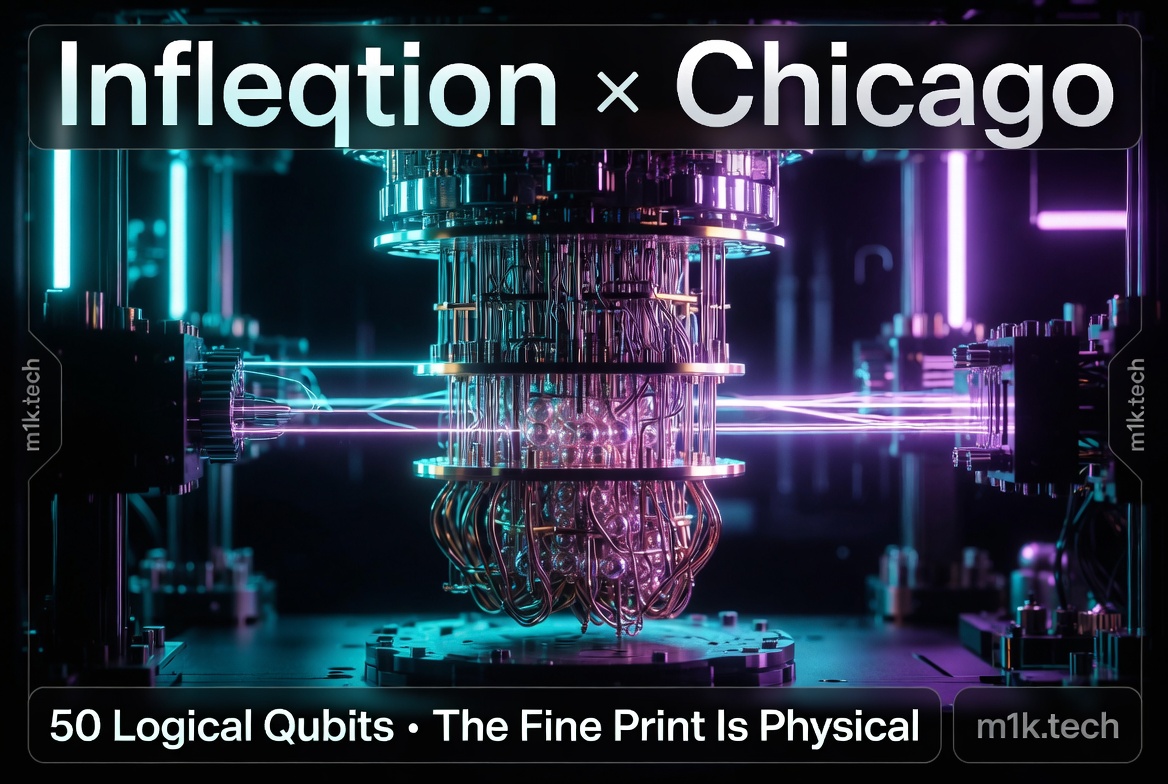
Sqale holds individual rubidium atoms inside a glass vacuum cell, pinned in place by tightly focused laser beams that physicists call optical tweezers. There is no lithography, no dilution refrigerator running at 15 millikelvin, no fabricated junction that came out of the fab slightly different from its neighbor. Every rubidium-87 atom in that cell is identical to every other one, because atoms of the same isotope are identical as a matter of physics rather than process control. That single property removes an entire category of problem that superconducting platforms spend enormous engineering effort managing: qubit-to-qubit variation across a chip.
The second property is the one I keep coming back to. Because the qubits are held by light rather than soldered into a lattice, you can move them. Optical tweezers can shuttle atoms around mid-computation, which means connectivity is reconfigurable instead of fixed to whatever the chip layout allows. For error correction that matters enormously, since the newer qLDPC codes need long-range connections that a nearest-neighbour superconducting grid simply cannot provide without expensive routing. Neutral atoms get that for free, more or less, and it is the strongest technical argument for the platform.
The costs are real. Gate operations on neutral atoms run in microseconds where superconducting gates run in tens of nanoseconds, so the raw clock speed is orders of magnitude slower. Atoms get lost from the trap and have to be reloaded, which turns into a duty-cycle problem nobody has fully solved. And everything depends on laser stability, which sounds mundane until you price the optics. Against IBM’s superconducting path and IonQ’s trapped ions, neutral atoms sit in an awkward middle: better scaling potential than the fridge-bound approach, slower and younger than the ion traps that hold the fidelity records.
Sqale ships integrated with NVIDIA’s NVQLink, and the framing everyone reaches for is “hybrid quantum-classical computing,” which tells you nothing. Here is what it is for. Error correction is not a thing you do at the end of a computation. It runs continuously: the machine measures syndrome data thousands of times per second, a classical decoder works out which errors occurred, and a correction gets applied before the errors compound. That decode loop has to close faster than the qubits decohere. On a fast superconducting machine that is a brutal latency budget, measured in single-digit microseconds, and it is one of the least-discussed reasons fault tolerance is hard.
Neutral atoms being slow turns out to help here. Microsecond gate times mean the classical decoder has proportionally more wall-clock time to do its job, which makes a GPU-attached decoder genuinely practical rather than aspirational. Pairing a slow quantum processor with a very fast classical one is not a compromise, it is the correct architecture for this platform. Infleqtion and NVIDIA also published the first demonstration of a materials science application running on logical qubits, so the collaboration has produced something beyond a logo slide.
Access comes through Superstaq, Infleqtion’s compiler and software layer, routed via the National Quantum Algorithm Center. That software stack has a Chicago origin story of its own.
Infleqtion started life in 2007 as ColdQuanta, spun out of the University of Colorado Boulder on the back of Dana Anderson’s work at JILA, the joint CU-NIST institute. For most of its first decade the company was not chasing quantum computers at all. It sold cold-atom hardware to other physicists: vacuum cells, laser systems, the unglamorous apparatus that lets a lab trap atoms without spending three years building the rig. That business is why the company survived the fifteen years before quantum computing had a funding market, and it is why its component supply chain is vertically integrated today in a way most quantum startups cannot match.
The product line grew sideways into sensing before it grew into computing. Tiqker, a rubidium optical clock. Sqywire, an atom-based RF receiver. Inertial navigation units for environments where GPS is jammed or absent. Quantum sensing gets a fraction of the press that computing does, and it is the part of the portfolio that already ships to customers including NASA and the US defense establishment. Around 230 patents issued and pending sit behind all of it.
The rebrand to Infleqtion came in 2022, and with it the acquisition that matters most for this week’s news: Super.tech, a University of Chicago software spinout, whose co-founder Pranav Gokhale is now the company’s CTO. Chicago has been in this company’s bloodstream for four years. Matt Kinsella, who led Maverick Capital’s founding investment and joined the board in 2018, took over as CEO in mid-2024 and pointed the company at the public markets.
That happened via SPAC. Churchill Capital Corp X, Michael Klein’s vehicle, announced the merger in September 2025 at a $1.8 billion valuation. It closed in February 2026, and INFQ started trading on the NYSE on February 17 with over $550 million of gross proceeds, including a $125 million PIPE. The stock opened at $14.25, touched $17.51 on day one, and settled back into the low teens. Infleqtion is now the first neutral-atom company on public markets, which is a real distinction in a field where IonQ, Rigetti, D-Wave and Quantum Computing Inc all arrived the same way.
Going public that way put a number on the company, and the number is where my skepticism lives. Roughly $29 million of revenue against a market capitalisation that has been sitting near $3 billion. That is a 100x multiple on sales, in a sector where nobody has demonstrated commercial quantum advantage on a problem anyone would pay to solve. I do not say that to be dismissive; pre-revenue infrastructure gets valued on option value and that is a legitimate way to price a call on a technology transition. But it means the equity story depends on hitting roadmap milestones on schedule, and quantum roadmaps have a poor record of that.
Illinois has committed real public money. The July 2025 agreement was structured as an expected $50 million public-private partnership over four years with IQMP and the NQAC, supported by the state’s MICRO Act programme and about $5 million in direct incentives, in exchange for Infleqtion headquartering its quantum computing operations in the state. The state’s own release at the time promised “dozens of new jobs.” Hold that number next to the one now circulating alongside this announcement: roughly 200,000 quantum roles in the Midwest over ten years, 60 percent of them not requiring a doctorate. That figure is attributed to “some involved” and travels next to a $1 trillion industry projection, while a credible outside estimate puts the entire global quantum computing market near $20 billion by 2035. Two orders of magnitude apart. One of those is a market forecast and the other is a case for public investment, and they should not be quoted in the same breath.
None of which makes the deployment fake. A machine physically installed on the South Side in 2027, running workloads through NQAC, is a verifiable event with a date attached, and it is more than most quantum announcements offer.
The Chicago Quantum Innovation Center opens with a focus on the American power grid: unit commitment, contingency analysis, nuclear fuel loading. Gokhale’s argument is that AI data centres are pulling more power than the grid was built to handle and that the classical tools are struggling. He is right about the strain. I am much less sure about the second half.
Unit commitment is a mixed-integer linear program, and commercial MILP solvers have had four decades of ferocious optimisation thrown at them. Grid operators run these problems every day at national scale on ordinary hardware, and they are not obviously waiting for new physics. Any quantum optimisation claim in that space has to beat Gurobi or CPLEX on a real instance, not on a toy graph, and that comparison is where most quantum advantage claims have historically gone to die. Infleqtion is at least doing the work in public: an ARPA-E award for the ENCODE project, a partner slot on the NQAC Grand Challenges energy award led by Fred Chong at UChicago alongside Constellation Energy and EPRI, and three project wins under the Department of Energy’s Genesis Mission. Contingency analysis and fuel loading may be better fits than unit commitment, since both have combinatorial structures that classical heuristics handle less gracefully.
I am not getting into the export-control and national-security angle on neutral-atom hardware here, which is its own post and increasingly its own diplomatic problem, particularly given how nervously Europe is now guarding its quantum companies.
Qubit counts are marketing. Two-qubit gate fidelity is the physics, and Infleqtion’s forward-looking statements name “anticipated improvements in entangling gate fidelity” as a risk factor, which is the most honest sentence in the entire press release. The company already has systems operational in the UK, including the National Quantum Computing Centre’s 100-physical-qubit machine, and in Japan, so this is a proven ability to ship hardware rather than a first attempt. That track record is exactly why the fidelity question is the right one to ask.
Chicago has been quietly stacking quantum infrastructure for years now, from the university labs to the entanglement research nobody outside physics noticed, and a working fault-tolerant machine on the South Side would be the first piece of it a non-physicist could point at. Ask me in 2027 whether the thing is decoding syndromes in real time at better than break-even fidelity. Until then, 50 logical qubits is a target, not a result, and I would rather see the error rates than the ribbon-cutting.
Sources
- Infleqtion to Deploy Fault-Tolerant Neutral-Atom Quantum Computer in Illinois (Business Wire, 22 July 2026)
- Infleqtion Adds 50 Logical-Qubit System To Chicago Quantum Hub (Forbes, Karl Freund, whose firm counts Infleqtion as a client)
- Gov. Pritzker Announces Infleqtion to Accelerate Quantum Computing in Illinois (IQMP, July 2025)
- Infleqtion Becomes First Neutral-Atom Quantum Company to Go Public (Infleqtion, February 2026)
- Quantum computer company Infleqtion plans IPO (Crain’s Chicago Business)