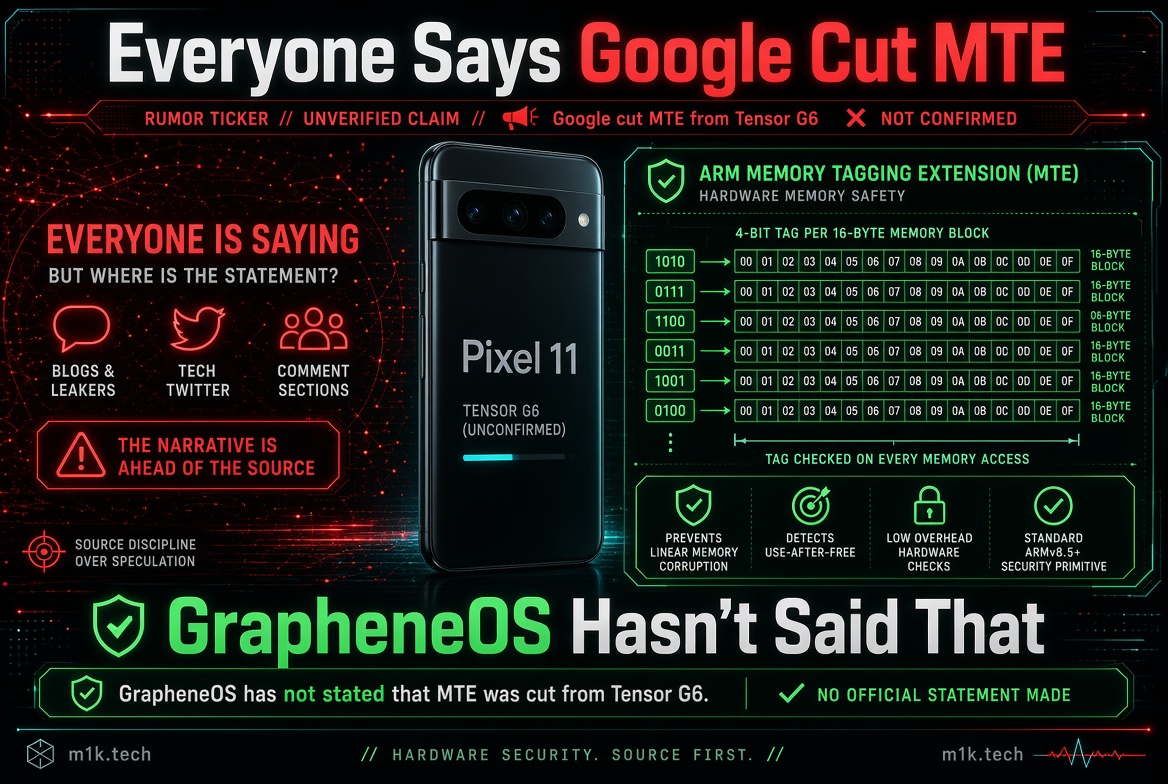
Six days before I sat down to write this, GrapheneOS’s own account posted that it still plans to support the Pixel 11 series. That line is currently being read as the exact opposite: that Google quietly stripped hardware memory tagging (MTE) from the Tensor G6 to save die space, and the Pixel 11 MTE gap is why GrapheneOS can’t finish the port. I spent most of a day trying to find where that second version of events actually comes from, and I came up empty. Not hard to find. Empty.
MTE is the reason this argument has real stakes: ARM’s memory tagging extension slaps a 4-bit tag on every 16-byte block of physical memory and a matching tag inside the pointer that references it. Touch memory with the wrong tag on the pointer and the CPU faults immediately, before a use-after-free or a heap overflow gets anywhere near becoming an exploit primitive. It’s a hardware check on every load and store, not a software mitigation you can route around with patience. GrapheneOS didn’t wait around after Pixel 8 shipped with the first ARMv9 Tensor cores in October 2023; they had it live in production about a month later, running across the kernel and nearly the entire base OS rather than a token subset. The changelog backs that up with actual bug catches, not marketing copy: a Broadcom Wi-Fi driver double-free and a Samsung TEE DMA heap use-after-free, both caught the moment the corruption happened.
Stock Pixel Android has had that same hardware since 2023 and still hasn’t turned it on for anything that matters, just Bluetooth, NFC, the SecureElement process, plus whatever slice Advanced Protection Mode adds in Android 16. Apple did the opposite calculus with MIE on the iPhone 17: always-on, built on FEAT_MTE4, running in the strictest mode across the kernel and a big chunk of userspace. Credit where it’s due: that’s just MTE implemented properly and left switched on, and it’s still rare enough in 2026 to be a headline feature.
Set that against the actual Tensor G6, which drops to seven cores from eight, keeps the same PowerVR GPU lineage that’s been the Pixel’s weak point since the Tensor G5, and saw the Pro and Pro XL base configs cut from 16GB to 12GB of RAM. Against a Snapdragon 8 Elite Gen 5 device, the gap runs about 40% on single-core and clears 100% once you get to the GPU, with multi-core landing somewhere in between, depending on who’s running the benchmark. The one real security upgrade Google actually shipped is the Titan M3, and I wrote about that the week the phones launched, specifically the ML-DSA post-quantum signing it does at the boot ROM level, the same signature-size math that broke Europe’s real-time settlement rails when they ran the equivalent scheme through production traffic. Boot integrity is genuinely stronger this generation. Nobody’s arguing that part.
Here’s where I get stuck. The claim going around is that the Tensor G6’s ARMv9.4 cores are MTE-capable at the instruction-set level, but Google didn’t wire the feature into silicon, the same move that kept MTE off the Pixel 6 and 7 before Google licensed the newer core generation, which is always a judgment call about whether the Arm license they’re paying for is worth fully using. That’s a real lever chip vendors can pull; MTE has been optional in every ARM revision that defines it since Armv8.5, so nothing about the mechanism is implausible. What’s missing is anyone showing their work: no feature-register dump or teardown, and none of the leaked spec sheets I’ve read on the CPU, GPU, modem, and ISP mention it either way. GrapheneOS’s own thread from six days ago, the one confirming Pixel 11 support is still planned, spends its words on Motorola instead: Snapdragon 8 Elite Gen 5 finally has usable MTE, the non-Elite chip’s version is broken, and the next Snapdragon needs to do better before Motorola hardware clears the bar. Not one line about the Tensor G6 lacking it. Their own device-support forum was still asking three days ago whether the Pixel 11 clears the minimum requirements at all, with no dev reply either way.
I want to be fair to the other reading here. GrapheneOS grandfathered the Pixel 6 and 7 in without MTE for years before the bar rose for new devices, so “we’re still adding Pixel 11 support” and “the Pixel 11 doesn’t have MTE” aren’t actually contradictory. A partial port that boots and updates but ships without the flagship exploit mitigation is exactly the kind of thing that gets summarized online as “Google cut memory tagging” by the second or third retelling. Plausible. Not confirmed. I’m not writing it as settled fact when the newest primary source I can find doesn’t say it, and I’m skipping whether this changes GrapheneOS’s Motorola math too; that’s its own piece.
None of that changes my buying advice. Google gutted the AOSP reference target back in June 2025, stripped the Pixel device trees, squashed the kernel history, and every port since has gotten measurably harder regardless of what’s happening with MTE specifically. The Pixel 10 already has the same base security posture at a lower price. I called Motorola’s opening in this space back in February, before the partnership was even public, and the flagship Snapdragon device GrapheneOS is actually building toward is still more than a year out. If someone eventually posts the register dump and Google really did strip MTE off the Tensor G6, I’ll be the first to say I told you so.