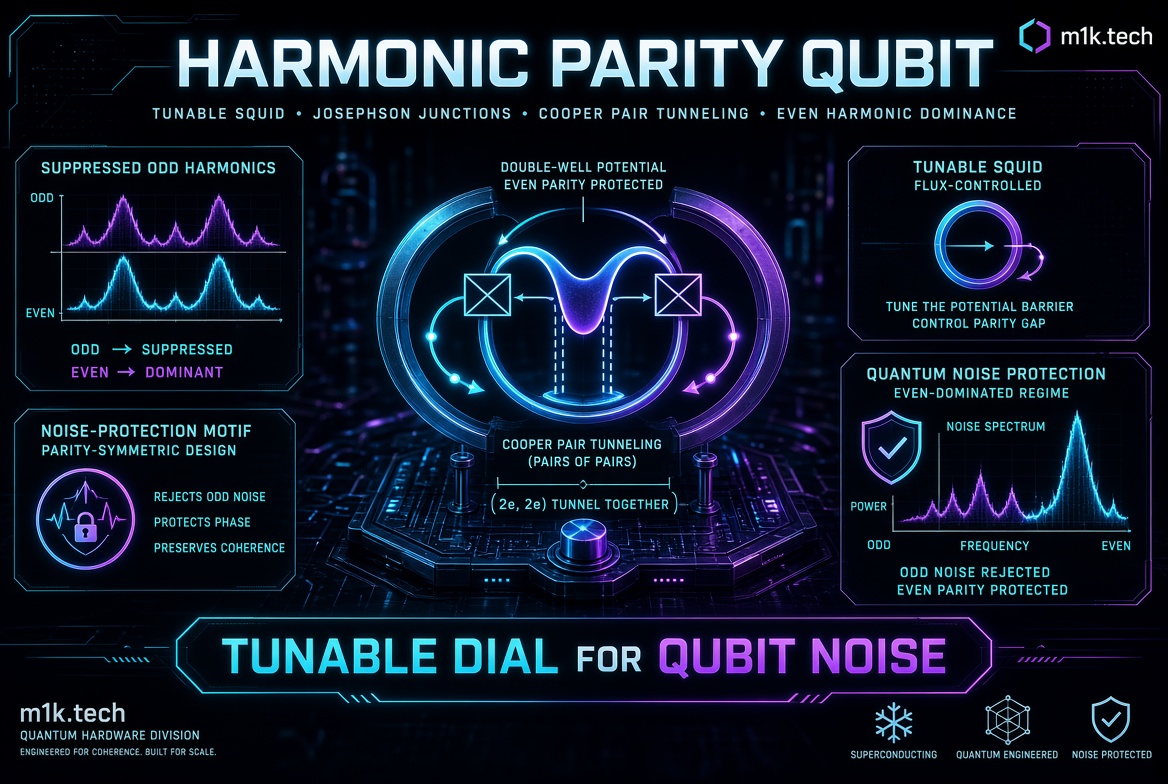
Eighty-five gate voltages. That is how many settings a team spanning the Center for Quantum Devices in Copenhagen and CU Boulder stepped through to watch the odd harmonics of a Josephson junction fall by two orders of magnitude, and the thing they built to do it, a harmonic parity qubit, is really the proof that this knob exists at all. No product sits on top of it, and there is no coherence record either, which I will come back to, because that absence tells you more than the headline does. What they have is a tunable dial for a property of a superconducting circuit that until now was mostly frozen in at fabrication and awkward to reach once the chip was cold.
Let me back up to why anyone would want to turn odd harmonics into a control parameter, because the payoff is not obvious unless you know what the junction is actually doing.
A superconducting qubit gets its nonlinearity, the ingredient that makes it a usable two-level system instead of an evenly-spaced oscillator, from the Josephson junction. The textbook version is a clean cosine of the phase across the junction, cos(φ), and that term describes Cooper pairs tunneling one at a time. Real junctions carry more than that. The energy-phase relation is a Fourier series: cos(φ), then cos(2φ), then higher terms, and each harmonic cos(kφ) is k Cooper pairs tunneling together in one correlated hop. The second harmonic is two pairs at once. Normally those higher terms are a small contamination you either ignore or calibrate away.
The regime worth chasing is the inverted one, where the even harmonics dominate and the odd ones disappear. When the potential is governed by cos(2φ), the circuit only changes state when a full pair of Cooper pairs moves coherently, so single-charge fluctuations and stray quasiparticles stop coupling to the qubit. That is what people mean by parity protection, and it is a fix written into the Hamiltonian rather than scrubbed out of the materials. You are not making the environment quieter. You are making the qubit deaf to a whole channel of it.
Getting into that even-dominated regime has been the hard part. Past attempts leaned on complicated multi-junction layouts or fully hybrid designs, and they tended to produce either fragile balance or only a faint even contribution. The Copenhagen and Boulder device is deliberately plain by comparison: two aluminum-oxide tunnel junctions wired in parallel with a single gate-tunable InAs/Al nanowire junction, together forming a SQUID. Sweep the gate, park the loop at half a flux quantum, and the odd harmonics drop by up to a hundredfold relative to the even ones. The potential turns into a double well with its minima sitting near plus and minus π/2, and close to that transition the single-pair supercurrent is suppressed enough that transport runs primarily through pairs of Cooper pairs. Four electrons moving as a unit, set by one voltage on one gate. The whole point is that harmonic parity became something you tune rather than something you hope for.
None of this appeared from nowhere. The direct ancestor is a 2020 Copenhagen result on a parity-protected superconductor-semiconductor qubit, which used a symmetric interferometer of two nanowire junctions gate-tuned into balance at half flux to synthesize a cos(2φ) element, and reported relaxation suppressed roughly tenfold inside the protected regime. Before that, Devoret’s group had shown a superconducting circuit protected by two-Cooper-pair tunneling, which is the same idea from the all-metal side. A 2024 result out of the same Copenhagen orbit demonstrated voltage-controlled synthesis of higher harmonics in hybrid junctions, and the group’s own companion paper on higher Josephson harmonics in a double-junction transmon landed in Physical Review Letters at the end of July. András Gyenis, one of the authors here and now at Boulder, helped build the 0-π qubit and co-wrote the field’s manifesto on moving beyond the transmon into noise-protected circuits. This is a long program with a lot of parents, and the harmonic parity qubit is the compact, tunable, hybrid entry in it. Alice & Bob’s cat qubits are the other big bet on protecting a qubit in hardware rather than in the error-correction layer, coming at it from the opposite direction.
Here is where I want to kill a number that keeps showing up in the coverage. You will see it written that this beats transmons “limited to about 100 nanoseconds by charge noise,” and that is just wrong. The transmon won the last decade precisely by being charge-insensitive: crank the Josephson-to-charging energy ratio and the charge dispersion flattens out. Modern transmons live in the hundreds of microseconds. Google’s Willow chip ran a below-threshold surface code with a mean T1 around 68 microseconds and a T2 near 89, and the best lab devices, on tantalum or on high-resistivity silicon, are now pushing relaxation times past a full millisecond. The incumbents are scaling that transmon roadmap hard, and IBM’s billion-dollar quantum push is the clearest version of it. Whatever the harmonic parity qubit is for, it is not for beating a transmon on raw lifetime today.
What it is for is the other axis, and this is the section I actually care about. A protected qubit is not chasing a T1 shootout at all; the goal is to make the qubit exponentially insensitive to a noise channel so that its physical error rate drops, and physical error rate is the lever that sets error-correction overhead. A logical qubit is built out of many physical ones, anywhere from ten to well over a thousand depending on how good the underlying hardware is, and a surface code of distance d eats d-squared physical qubits to protect against a handful of errors. Lower the physical error rate, and you need a smaller code for the same logical fidelity, which means fewer physical qubits per logical qubit, which is the difference between a useful machine needing a hundred thousand qubits or a million. This is the part that gets waved past in the qubit-count press releases, and it is exactly the fine-print-is-physical problem that surfaces the moment anyone counts logical qubits instead of physical ones. A circuit that is intrinsically deaf to charge noise is a bet on bending that overhead curve years before the curve matters. The result is European science with an American partner, Copenhagen doing the hybrid materials it has owned for a decade, and it lands against a backdrop where Europe is suddenly very anxious about keeping its quantum hardware close to home. France has been the loudest on that, racing to keep its quantum startups from being bought out before they scale.
So what is missing, and why do I keep flagging the absence of a coherence number? The paper is a spectroscopy result: they reconstructed the energy-phase relation across those 85 gate settings and showed they can dial the harmonic parity and see the second-harmonic transport signature. They did not build a protected qubit out of it and measure how long it lives. Until someone does, the harmonic parity qubit is a demonstrated building block, not a demonstrated qubit, and the gap between those two things is where a lot of promising superconducting circuits have quietly died. Hybrid semiconductor-superconductor devices carry a real yield problem too. The aluminum-oxide junctions are the mature, boring, reproducible part; the gate-tunable nanowire is the finicky part, and finicky does not scale into the thousands of matched elements a processor needs. The next steps are the unglamorous ones. Someone has to build a real qubit in the protected regime and measure how long it actually lives, then show that number holds across a batch of devices instead of on the one hero sample that made it into the figure, and somewhere after that comes getting two of them to talk to each other. That is the two-or-three-years-out work, and it is why this reads as a roadmap ingredient rather than an announcement.
I am leaving one thing on the table on purpose. The same device also shows a gate-tunable Josephson diode effect, a supercurrent that flows more easily one way than the other, reaching efficiencies around 30 percent off non-collinear magnetization and spin-orbit coupling in the leads. That is a separate story about non-reciprocal superconducting electronics, and it deserves its own post rather than a paragraph buried inside a qubit piece, so I am not getting into it here.
What I keep circling back to is whether the tunable knob is the real advance or whether hybrid nanowire is a detour, and the honest answer is that I do not know yet. The all-metal Fourier-engineering crowd is chasing the same cos(2φ) target without any semiconductor in the loop, and their yield story is easier even if their tuning is stiffer. The harmonic parity qubit is the more elegant demonstration and the harder thing to manufacture, and elegance has lost that trade before. Show me a coherence time on a real one, and I will care a great deal more. Ask me in three years.