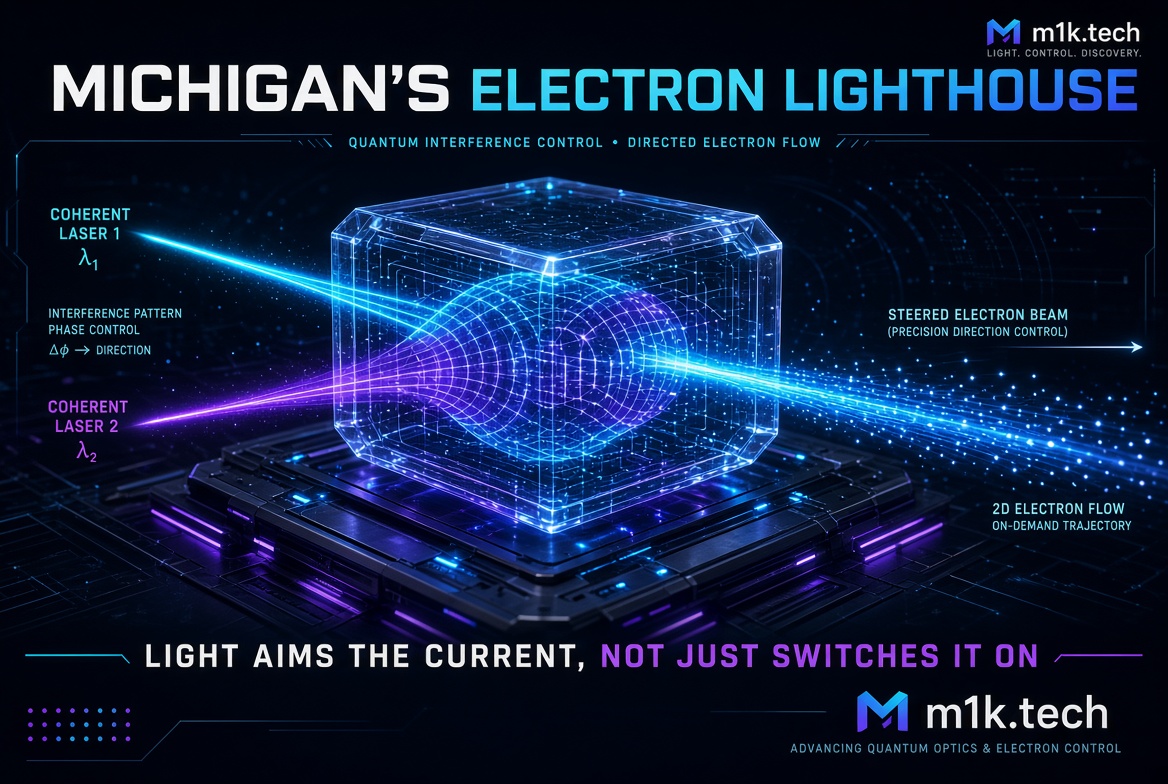
Pushing a current through a semiconductor with nothing but light, no battery and no applied voltage, is a party trick physicists have had since the late 1990s. Two beams of different colors land on a crystal, their absorption pathways interfere, and the electrons pick a direction they otherwise wouldn’t. It’s called quantum interference control, and the theory behind it was worked out at the University of Toronto around 1997. So when the headline said a Michigan team built an electron beam that runs on no power, my first reaction was: sure, and? That part is nearly thirty years old.
Then I read what they actually did, and I got interested.
The device Steven Cundiff’s group built at Michigan doesn’t just switch a current on. It aims it. By rotating the polarization of the two laser fields, they steer which way the electrons flow across a two-dimensional plane, which is where the “electron lighthouse” nickname comes from. Old quantum interference control gave you an on/off switch, light present and current running one fixed way; what this device has is a beam you can actually point. That is a different thing altogether, and it’s the part every “runs on no power” write-up buried under the free-lunch angle.
What makes it satisfying is that it isn’t really a surprise; it’s a receipt. John Sipe, the Toronto theorist whose group laid down the quantum-interference-control framework decades ago, predicted this higher-order steering effect. Cundiff’s people had already worked with Sipe on the earlier version of the problem. So this is a lab going back years later to build the exact thing the theory said should exist, and finding that it does. I have a soft spot for that kind of result. It’s unglamorous, and it’s how physics is supposed to work: someone writes down a prediction, and eventually someone else is stubborn enough to build the apparatus clean enough to see it.
Because that’s the real story here, and it’s the one getting zero column inches. The effect Sipe predicted is tiny, and it drowns instantly in any stray electric field. To measure a photocurrent that’s actually being aimed by light, and not just nudged along by some contamination on the chip, you need a device with essentially no built-in bias anywhere in it. Yiming Gong, who did this as a doctoral student in the group and fabricated the sample at Michigan’s Lurie Nanofabrication Facility, built something clean enough that the only thing steering the electrons was the light. That is the hard part. The physics sat on paper for years, and making a chip quiet enough to hear it is what took until now.
Here’s where I put the brakes on the framing, though. “No power needed” and “low-power sensors” are the phrases doing the heavy lifting in the coverage, and they’re being a little dishonest. The electrical power is gone, sure. No electrode is dumping energy into the device. But the energy that moves those electrons didn’t come from nowhere. It came from two phase-coherent laser beams of different colors that have to stay locked in phase with each other, and that is not a small ask. Coherent multi-color light sources are big, temperamental lab instruments; the free-electron-laser crowd trying to pry chip lithography out of ASML’s hands can tell you exactly how big and hungry exotic light sources get. The honest way to say it is that the power moved. It relocated out of a wire and into an optical bench that, today, is far more expensive and far more power-hungry than the battery it supposedly replaces.
Which is why “plausible relevance to low-power sensors” reads to me like “true in the way fusion is relevant to your electricity bill.” Maybe, eventually. The whole promise rests on someone shrinking that two-color coherent source down to something you could sit on a chip next to the detector, and that is a separate, unsolved engineering problem from the physics that was just shown. The demonstration is real, but the device that would actually matter for a sensor isn’t on the table yet.
I’m not going to get into how this stacks up against the nonlinear photodetectors and on-chip photonic signaling schemes that already move information around with light. That comparison decides whether any of this becomes a product. It doesn’t change what the Michigan result actually is.
What it is is a lovely confirmation and a very early one. This is NSF-funded basic physics, published this past July, and it sits in the same mental bucket as a lot of other quiet lab results with a long fuse that I keep writing up, the ones where a real effect shows up on a bench and the commercialization timeline is a shrug. It has the same energy as that antiferromagnet switch running a thousand times faster without the extra heat, or the temporal-entanglement work I tried to map out without pretending I fully understood the physics. Real, and a long way from your pocket.
So I’m glad someone finally built Sipe’s lighthouse. Watching a prediction from the Toronto group grow into a working device on a Michigan chip is the good part of this job. I’m just not holding my breath for a light-powered sensor this decade, because the second you write down what it would take, you’re back to two coherent lasers that have to behave themselves right next to the thing you’re trying to make small and cheap. Ask me again when someone does it with a single integrated source. Until then it’s a lighthouse in a lab, and a very good one.
Source: Yiming Gong, Kai Wang, and Steven T. Cundiff, “Directional Photocurrent Generated by Quantum Interference Control,” Physical Review Letters 137, 036901 (2026); preprint arXiv:2511.05318. Popular write-up via ScienceAlert.