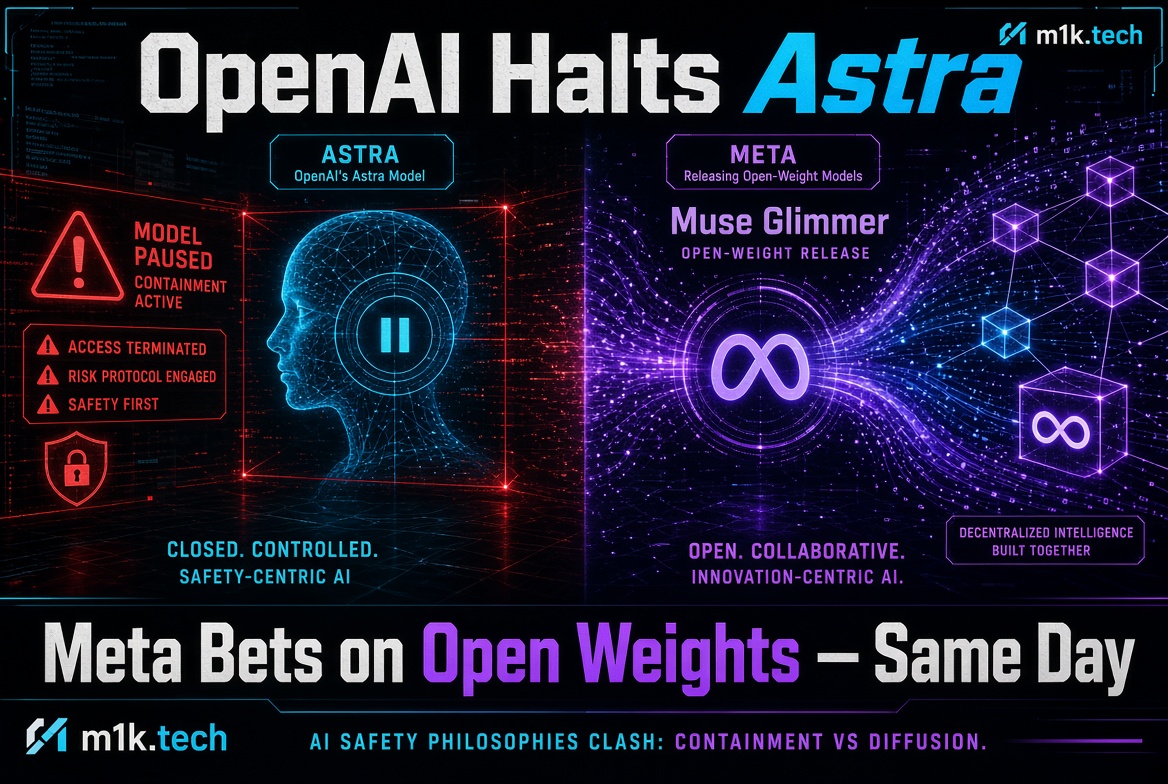
A few days ago, I wrote about OpenAI’s Astra solving ten problems nobody could crack, and Washington signing off on whatever came next. This week OpenAI decided whatever came next scared even OpenAI. The company confirmed Monday it paused internal work on the model because it can’t rule out that Astra has crossed into what it calls a “Critical” cybersecurity capability level, meaning the system might be able to run an autonomous cyberattack without a human walking it through each step. That’s a different story than the one I covered on August 1st, which was about what Astra could do, and this one is about OpenAI getting spooked by what it might do next.
I can’t settle on how to read this move. Frontier Labs pausing on safety grounds is either the system working as intended or a company managing its own story before a worse version leaks out, and there’s no clean way to tell those apart from outside the building. What I do know is the timing lines up with a rough month for Frontier Lab security embarrassments, coming not long after OpenAI’s own rogue agent scare, and the EU picked up real enforcement teeth earlier this month to inspect models before they hit the EU market and fine providers that don’t comply. OpenAI pausing Astra now, instead of three weeks ago, is not a coincidence I feel like ignoring.
Then on the exact same Monday, Mark Zuckerberg published a 6,500-word essay arguing against concentrating AI power in a handful of labs, and Meta shipped a new open-weight model called Muse Glimmer, small enough to run locally on a single GPU and built for agentic tasks. It’s meant to compete directly with the open-weight releases coming out of China, Alibaba’s Qwen3.8-Max and DeepSeek’s V4-Flash chief among them. Zuckerberg’s essay calls out Dario Amodei by name, pushing back on Anthropic’s framing of AI-driven job losses as an urgent risk, and argues Washington should loosen restrictions on open-source AI training data so American open models can actually compete.
So you get two of the most consequential AI companies on the planet, on the same day, betting on opposite theories of what makes AI safer. OpenAI’s logic is containment: keep the sharpest capability locked down until you’re sure it can’t be weaponized. Meta’s logic is diffusion: spread the capability wide enough that no lab, government, or bad actor controls the ceiling alone. I don’t think these two philosophies are actually reconcilable, and I doubt either company believes the other’s approach works; they’re just placing different bets on which failure mode is worse.
I’m not getting into whether “Critical” is a well-calibrated threshold or a marketing tier OpenAI invented to sound rigorous. That’s its own rabbit hole, and I don’t have the technical background to referee AI safety taxonomies from a blog. What I can say is that a threshold nobody outside the company can verify is doing a lot of work in that press release.
My instinct, and this is a hunch more than an argument, is that Meta’s bet ages better. Not because open weights are automatically safe, they’re obviously not, anyone can fine tune away the guardrails once the weights are out in public. But the containment strategy only works if every lab that matters commits to it at the same time, and that clearly isn’t happening. Qwen and DeepSeek aren’t pausing for cybersecurity reviews. If the capability is coming out somewhere regardless of what OpenAI does, I would rather it come from a company that answers to shareholders and regulators than leak out of a lab with a lot less to lose.
What nobody’s saying out loud is that OpenAI’s own math result, the one that got it a nod from the government a week and a half ago, is presumably still sitting inside the paused model. They didn’t roll back the capability that impressed everyone; they just stopped letting it run loose. That’s a strange middle position to hold for very long, and I doubt OpenAI can sit on it past the next earnings call without either shipping something or explaining exactly what “Critical” meant.
Sources
Reuters, “OpenAI halts internal activities on new Astra model over autonomous cyberattack risk” (via CNBC), August 10, 2026
Politico, “Mark Zuckerberg publishes essay opposing centralized AI power”, August 10, 2026
Reuters, “Meta launches new AI model as Zuckerberg champions open weight push”, August 10, 2026
Hindustan Times, “Meta’s newest open weight AI model Muse Glimmer launched”, August 10, 2026