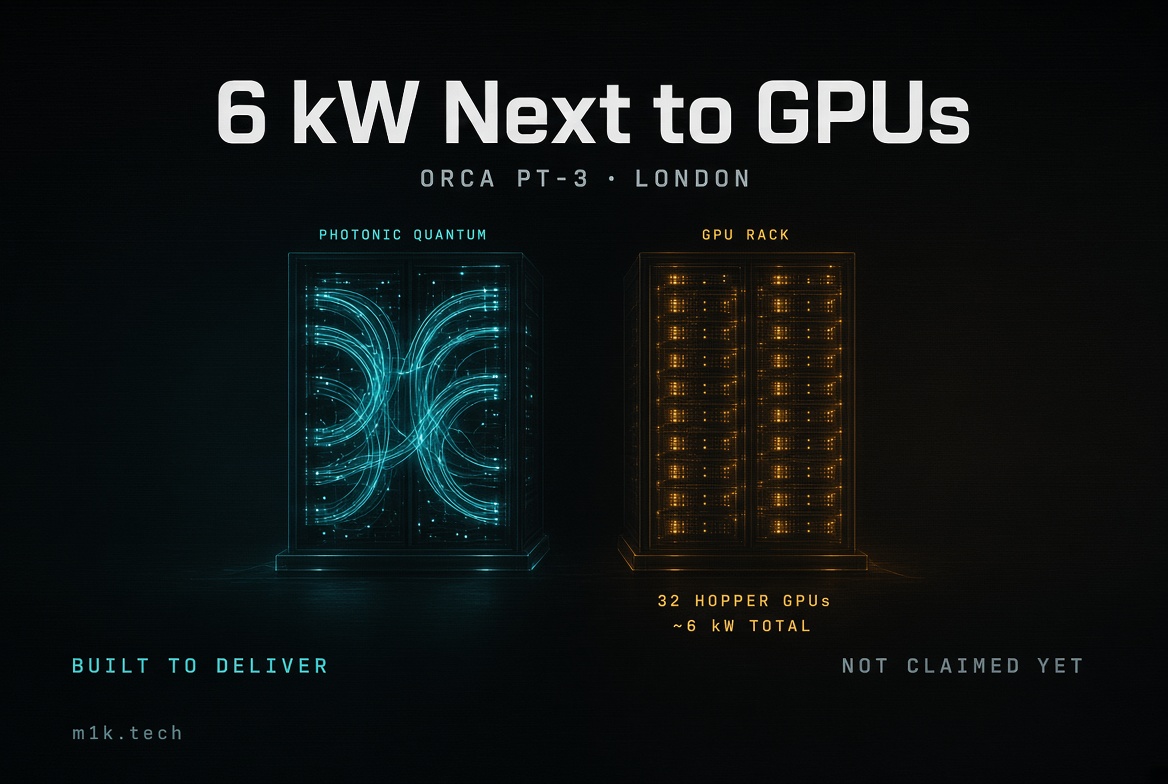
Two racks in Digital Realty’s LHR19 building in London Docklands draw about 6 kW between them. A single eight-GPU Hopper server is rated for more than that on its own, and ORCA Computing is leading with a new PT-3 photonic quantum computer trained on 32 Hopper GPUs. The quantum half of this launch is the easy half to power.
ORCA, the Oxford spin-out founded in 2019, switched on the PT-3 today in the Digital Realty Innovation Lab, cabled it into Nvidia-accelerated servers, and calls it the first quantum system built to deliver commercial quantum advantage. Installation took three hours and the machine was fully running inside a day, which matters more to a data center operator than any qubit count. ORCA says it now has 11 PT Series systems in customer data centers, works with more than 35 customers and partners, and sells each system for about $2 million. At a roundtable ORCA hosted in London yesterday, CEO Richard Murray said the PT-3 is ready for quantum advantage, but ORCA isn’t claiming it has reached it.
“Built to deliver” is doing all the lifting in that headline.
The PT-3 is not a general-purpose quantum computer, and ORCA has never pretended otherwise. The PT Series are boson samplers: single photons travel down fiber in alternating time bins, programmable fiber loops act as beam splitters that let a photon in one time slot interfere with a photon in another, and detectors at the end record where each photon comes out. Nvidia’s own CUDA-Q documentation describes the ORCA target exactly that way, delay lines included. What comes back is a sample from a probability distribution that becomes brutally hard for a classical machine to reproduce as photon counts grow, which is what Scott Aaronson and Alex Arkhipov proved in 2011 and why boson sampling became the first quantum advantage playground for photonics. ORCA’s founding trick, out of co-founder Ian Walmsley’s work at Oxford, was using quantum memories to hold photons and release them on demand, so the machine can be built from telecom-grade fiber parts at room temperature instead of inside a dilution fridge. The PT-3 run used 64 photons spread across 128 optical modes, which ORCA calls qumodes. On paper that’s a big jump. It also can’t run Shor’s algorithm, can’t error-correct anything, and can’t do most of what the words “quantum computer” make people picture. It samples, and everything ORCA sells is built on what you can do with good samples.
What I can’t find anywhere in the launch material is the number that decides whether those 64 photons mean anything: loss. Photonic systems leak photons at every coupler, delay line and detector, and boson sampling with heavy loss slides back toward something a classical computer can simulate. The spec sheet also skips whether the detectors resolve photon numbers, how many of the 64 photons survive a typical shot, and the sample rate. ORCA itself simulates its circuits on Nvidia’s cuTensorNet library, which tells you GPU tensor networks are a serious opponent at some size. I’d trade the whole press kit for one loss figure.
The headline benchmark is protein design. ORCA plugged the PT-3 into Proteína, Nvidia’s generative model for protein backbones, as what Murray described as a prior layer near the start of the network, and trained the quantum and classical parts together on those 32 Hopper GPUs. The hybrid improved the share of useful designs by 20% over the classical baseline and produced a wider spread of secondary structures. The word “useful” needs a footnote, because in the Proteína line of work designability is a computational test: you design a sequence for each generated backbone with ProteinMPNN, refold it with ESMFold, and check how close the refolded shape lands to the original. Computer Weekly’s write-up describes these as real-world quality checks, which oversells it, and ORCA hasn’t said any PT-3 design has been synthesized. The earlier PT-2 work with the Technical University of Denmark is the one with wet-lab confirmation: roughly twice as many strong peptide binders as a classical model, plus 49% more valid molecules on the QM9 chemistry benchmark.
I like the idea underneath it more than I expected to. Murray argues that AI for science runs out of training data fast, since nobody has a dataset of therapies that don’t exist yet, and that a physical quantum system carries structure the model would otherwise have to learn from scratch. He also said quantum and AI are two quite different kinds of computers that don’t marry naturally, which is a strange and refreshing thing to hear from a CEO selling the marriage. Flow-matching models like Proteína start from random noise and learn to bend it into proteins; my reading is that the prior layer swaps plain Gaussian noise for a trainable quantum distribution, which is a far more modest and testable claim than “quantum speeds up AI.” Murray added that the model hops between quantum and classical hardware so often during training that it runs much worse over a remote link. That one remark explains the business model. ORCA isn’t selling cloud minutes; it’s selling a $2 million box that has to sit in the rack next to your GPUs, which is why Nvidia’s NVQLink interconnect and a landlord like Digital Realty sit at the center of this launch.
Asked how much time the PT-3 saves on protein design, Murray said he wasn’t sure ORCA had measured it.
The second workload is energy scheduling, the unit commitment problem of deciding which generators to switch on, and when, at the lowest cost. Earlier this year ORCA, the Japanese software firm JIJ, bp and the UK’s National Quantum Computing Center published a white paper benchmarking hybrid solvers on it. The PT-3 now runs the 25,755-variable instance in about an hour, more than 12 times faster than the PT-2, with solution quality the white paper put level with a commercial solver. Level with, not ahead of. The comparison that would settle it- how long that commercial solver needs on the same instance- isn’t in the launch numbers. This is also the most crowded corner of the market. Nvidia, ORCA’s partner on the protein work, gives away cuOpt, its own GPU-accelerated optimization engine, and D-Wave has been selling annealers on this exact pitch for years: its August investor deck counts more than 100 customers in the first half of 2026, with over 65% of revenue from commercial accounts. Clem O’Rourke of Origami Labs, who has worked with ORCA for about four years, said at the roundtable that some problems suit the machine and others don’t, same as with classical methods.
In August I wrote about a Regensburg study that put the share of quantum computing papers a stranger could reproduce at around nine percent. Every number in this launch is supplier-run or white-paper work, and the 20% protein figure comes from a single test, a caveat Computer Weekly printed in the same article as the headline. Murray seems to know it. “As with all quantum advantage claims, we’re getting ready for a lot of counter-claims,” he said yesterday. Good. I’m more interested in those counter-claims than in anything in the press kit.
The energy pitch deserves more scrutiny than it got in the room. Murray argued that moving work from GPUs to a 6 kW quantum machine shifts it to near-negligible energy use, and next to Nvidia’s Kyber racks, specced at around 600 kW, which I dug into when I wrote about ternary computing and AI’s power wall, 6 kW looks like a rounding error. The PT-3 didn’t replace anything in the protein run, though. It sat in front of 32 Hopper GPUs, and if those are SXM parts at 700 W each, that’s roughly 22 kW of GPU power before you count CPUs, networking, or cooling. The defensible version of the energy claim is better results per watt, maybe, not fewer watts.
The rest of photonic quantum computing is betting on the opposite timeline. Xanadu, the Toronto company that listed on Nasdaq and the TSX on March 27 through a SPAC, reported about $686 million in available capital at the end of June and a roadmap aimed at 1,000 logical qubits by 2031, built on GKP-encoded photons and qLDPC error-correcting codes. It also lost $42.1 million in the second quarter alone.
PsiQuantum, the other giant, is building in my own city, on the old U.S. Steel South Works land at the Illinois Quantum and Microelectronics Park, the site I described in August as buying a seat for every qubit modality at once. It raised over $1 billion in its Series E last September, moved its delayed Australian build from Brisbane Airport to an old paper mill site in Moreton Bay this year, and has been run by interim CEO Victor Peng since February. Both companies are chasing fault tolerance first and usefulness after. ORCA flipped the order: sell a limited machine that already fits in a rack, learn what customers do with it, upgrade it in the field. I think that’s the smarter commercial bet and the weaker science story, and I can’t tell yet which one investors will reward.
In Europe the closest rival is French. Quandela builds gate-based photonic machines around its own quantum-dot single-photon sources, a different route to the same physics. Its 12-qubit Belenos system is installed at CEA’s TGCC supercomputing center as Lucy, it’s on OVHcloud’s quantum platform, and in June it validated a low-latency NVQLink link to Nvidia GPUs, which is the same integration story ORCA is telling today. In July, I wrote about why Paris is nervous about foreign buyers picking off its quantum startups, and a London rival with 11 systems in the field is the kind of competitor that makes that nervousness rational. QuiX Quantum in the Netherlands announced Carina in July, a universal photonic architecture for customer data centers, built under Germany’s DLR Quantum Computing Initiative, after it picked up Luminar Semiconductor for $110 million earlier in the year.
Q.ANT in Stuttgart will land on the same shortlists even though it isn’t a quantum company at all. Its thin-film lithium niobate processors do classical analog math with light; it raised an $80 million Series A, runs a production deployment at the Leibniz Supercomputing Centre and opened a U.S. headquarters in Austin this year. A buyer shopping for a low-power photonic accelerator to park next to the GPUs won’t always care which side of the quantum line the physics sits on. China is pushing too: QBoson opened a factory in Shenzhen last year to mass-produce room-temperature photonic machines.
British industrial policy isn’t my lane, but the shape is clear enough. The UK government has committed £1 billion to quantum over the next four years, the National Quantum Computing Center is both a customer and a co-author on ORCA’s energy work, and Nvidia’s UK package last September named ORCA alongside Imperial College London and Poland’s Poznań Supercomputing and Networking Center on hybrid quantum neural networks. Look at the customer list: much of it is already in the EU, Poznań and DTU among them. Digital Realty, meanwhile, hosts ORCA in London and is building a quantum-AI center with Oxford Quantum Circuits in New York, which looks less like picking a winner and more like a landlord renting to every tenant with a cooling preference.
The money backdrop explains the urgency in that room. McKinsey’s 2026 Quantum Technology Monitor counted $12.6 billion invested in quantum start-ups in 2025, 6.3 times the 2024 total, with about 60% of it landing in ten deals and the public share dropping from a third in 2024 to 3%. Quantum computing companies passed $1 billion in combined revenue for the first time, and McKinsey sizes the whole quantum technology market at $60 billion to $100 billion by 2035. ORCA’s last priced round I can find is a $15 million Series A in 2022 led by Octopus Ventures; investor databases list it at a later stage without a disclosed figure. Cordelia Tahany of Unicorn Asset Management, an ORCA backer, told the roundtable that valuations will follow revenue as investors tire of 100-times-sales multiples. Run that against the installed base. Eleven systems at today’s $2 million price would total $22 million, and most are earlier PT generations whose price ORCA hasn’t disclosed. That’s about half of what Xanadu lost in one quarter.
I came in expecting another quantum-AI press release and left thinking ORCA has the most grounded product strategy in photonics, backed by a benchmark package that isn’t ready to carry the word advantage. The 20% needs someone other than ORCA or Nvidia to rerun it, and the loss figure needs to show up on the spec sheet. Until then, the PT-3 is a cheap-to-run sampler with promising homework. Two racks, 6 kW, $2 million. The 32 Hoppers are sold separately.
Sources:
- ORCA Computing: PT-3 launch press release
- Computer Weekly: ORCA launches PT-3 quantum computer in London datacentre
- TechJournal.uk: ORCA launches room-temperature PT-3 (roundtable coverage)
- DCD: Orca deploys PT-3 at Digital Realty’s LHR19
- Quantum Computing Report: PT-3 architecture and benchmarks
- NVIDIA CUDA-Q: photonic backends (ORCA)
- JIJ: unit commitment white paper with ORCA, bp and NQCC
- D-Wave Q2 2026 investor presentation
- Xanadu Q2 2026 results
- Quantum Computing Report: Xanadu roadmap to 1,000 logical qubits by 2031
- Quandela newsroom (NVQLink validation, CMC sandbox)
- HPCwire: QuiX Quantum unveils Carina
- Quantum Computing Report: Q.ANT expands to the U.S.
- McKinsey: quantum investment surge
- NVIDIA and the UK quantum ecosystem, Sept 2025
- ORCA Computing: $15M Series A (2022)