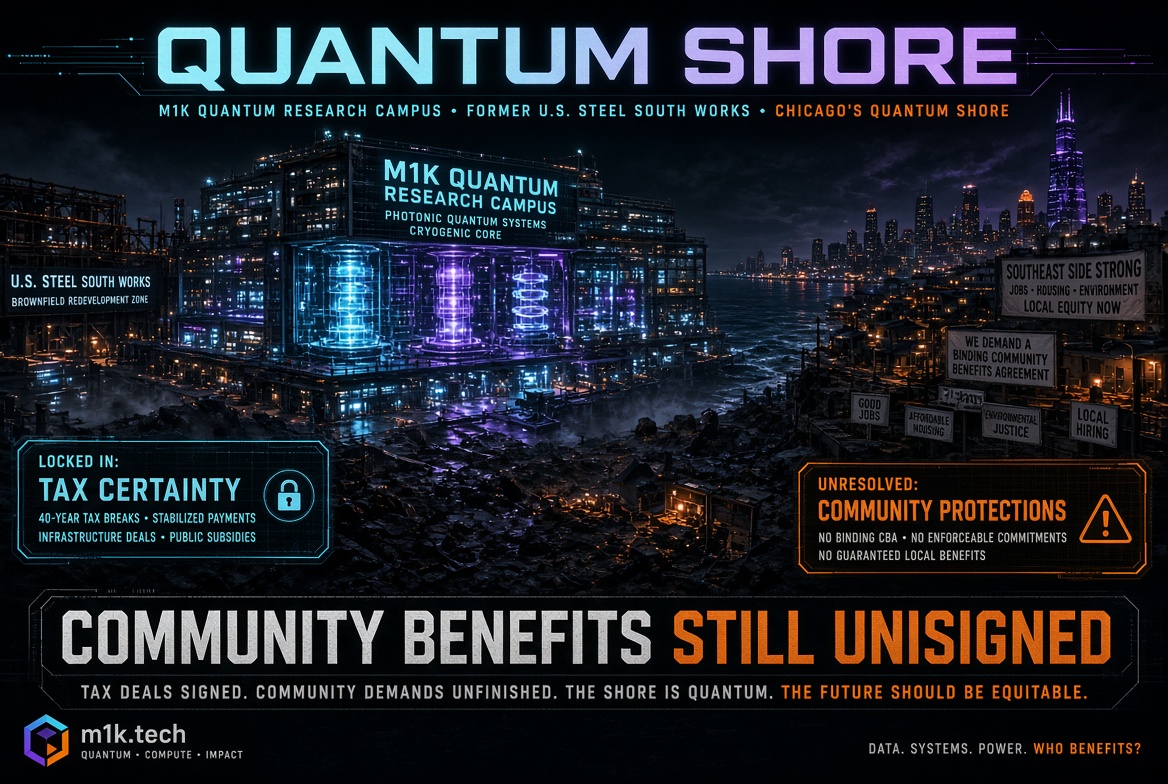
Three of the five petroleum hot spots on the old U.S. Steel South Works site, twenty-eight acres of them, sit south of 87th Street and east of DuSable Lake Shore Drive. That is the exact patch of ground where PsiQuantum is pouring the foundation for what everyone keeps calling America’s first utility-scale quantum computer. The dirtiest corner of a century-old steel mill, capped with asphalt and ringed by nearly two miles of slurry wall, is where the qubits go. I’ve written about this quantum park twice already, both times from the top down, all capital and qubits. A sixteen-month podcast investigation that landed in the Tribune this month finally made me look at it from the ground up, and the view is different down there.
The podcast is “Quantum Entanglements,” from the Chicago outfits Respair and AirGo, and its thesis is blunt to the point of being uncomfortable: that South Side communities are being poisoned, pushed out, and policed by a nine-billion-dollar machine on the shore of Lake Michigan. I don’t reach for that framing lightly, and I don’t fully buy every load-bearing word. But once you line up what’s actually on paper, each of those three verbs has a document behind it, and that’s what I didn’t appreciate when I was busy being impressed by photonic error correction.
A century of steel, then a generation of broken plans
To understand why this neighborhood reacts the way it does, you have to know what came before, because the pattern is old and the residents have watched it repeat. South Works opened in the 1880s, became part of U.S. Steel at the turn of the century, and at its peak employed more than 20,000 people. A large share of the 440 acres isn’t natural land at all: it’s slag fill, steelmaking waste packed into the lake to extend the shoreline, which is the literal ground the quantum computer now sits on. The mill closed in 1992, and what followed wasn’t redevelopment. It was a very long silence.
Every plan to break that silence fell apart. The big one was Chicago Lakeside, a McCaffrey Interests and U.S. Steel joint venture that the Plan Commission approved back in 2010: an award-winning Skidmore, Owings & Merrill master plan for 13,575 homes, a 1,500-slip marina, a new high school, and 17.5 million square feet of commercial space, a $4 billion neighborhood meant to house 150,000 people over several decades. They even built the Lake Shore Drive extension through the site. Then in 2016, a cash-strapped U.S. Steel declined to proceed, and the whole thing died. A second developer, Emerald Living, took a run at it and quit in 2018, citing the “significant challenges” of the site’s industrial heritage, which is a polite way of saying the dirt. So when residents hear that outside developers are finally moving in with a transformative plan, they are not hearing it for the first time. Stephanie Williams, a 7th Ward resident, put the neighborhood’s memory plainly: “The game plan never changes. If it is detrimental, it’s immediately into the Black neighborhoods.” A generation of scrapped site plans earned that skepticism honestly.
What finally broke the silence wasn’t the market. It was the state.
The thirty-year number
The money is the least ambiguous part. Every story I’ve run on this park has centered the same figures: $500 million from Illinois in 2024, another $200 million earlier for the Chicago Quantum Exchange, a Blue Owl Capital affiliate buying the 440 acres for $75 million and financing the build, Related Midwest and CRG developing, PsiQuantum anchoring a 300,000-square-foot operations center. What I skipped past every time is the tax structure underneath it.
Cook County’s Class 8 MICRO incentive drops the property tax rate on quantum-computing parcels from 25 percent to 10 percent, and it holds that rate for thirty years. It’s tied to the state’s MICRO Act, Manufacturing Illinois Chips for Real Opportunity, Springfield’s answer to the federal CHIPS money and the national scramble to land semiconductor and quantum investment. Add the county breaks up and you’re looking at roughly $175 million in forgone tax over three decades, on top of a $1.25 billion city housing-and-development bond, with the initial phase still projected to throw off about $125 million in new property tax even after the rebate. One detail I actually like: unlike a normal Class 8, the MICRO version can’t be renewed. Somebody in the county building understood that a thirty-year giveaway is already generous enough.
The ownership structure tells you what kind of project this really is. The land is held by an affiliate of Blue Owl Capital, a $284 billion private-credit house that is also financing the vertical construction, and it leases the whole thing to the developers, who lease to the tenants. This is a financial instrument with a quantum computer sitting on top of it, and I mean that as a description, not an insult. It’s just worth knowing who the counterparties are before you weigh anyone’s community promises.
Whose neighborhood the track runs through
Now hold that thirty-year number next to what the neighborhood is asking for. The Coalition for a South Works CBA, which folds in Southside Together, Friends of the Parks, ETHOS of South Shore, and the Alliance of the Southeast, wants a legally binding Community Benefits Agreement. Their asks run from anti-displacement protections and local-hire guarantees to pollution limits and a community credit union that could fund home repairs and small businesses. Buried in that list, past the jobs language, is a request for a resident tax break that mirrors the thirty-year deal the campus is getting. That is the whole fight in one line. The computer gets thirty years of tax certainty in a signed contract. The people two blocks away are asking for the same thing in writing and being told, in effect, to trust the process.
They have seen exactly what “trust the process” is worth, a couple of miles up the same lakefront. In South Shore, where the Obama Presidential Center is rising in Jackson Park, residents spent years demanding binding protections and mostly didn’t get them; rents there have climbed more than 40 percent and home prices well past 100 percent in recent years. South Shore is 92 percent Black, roughly three-quarters renters, carries one of the highest eviction rates in the city, and has about one in six houses sitting vacant, which is precisely the profile speculative capital reads as a buying opportunity. The city eventually stretched its Woodlawn anti-displacement ordinance into parts of South Shore, but only after the damage was already moving. The residents around the quantum park are watching that film in real time and asking to skip the sequel.
The fear isn’t only about rent, and this is where the reporting got darker than I expected. Capital B documented a moment this past winter when a South Shore landlord allegedly called federal immigration agents on his own tenants to force a building of Black and Hispanic renters out. Set that against a Department of Defense research campus going up down the street and you get the specific dread one resident described: people already afraid to leave their homes, and a military-funded supercomputer being built in the same few blocks. You can find that framing overheated, but you cannot call it baseless, not in this neighborhood, not this year.
I want to be fair about the split, because it’s real and flattening it would be a lie. Not everyone on the Southeast Side opposes this. A rival group, Southeast Neighbors for Quantum, is made up of residents and business owners who don’t want the South Side’s one shot at this kind of investment to walk away, and their argument isn’t stupid: the neighborhood has been starved of capital for a generation, and here is capital. The developer’s pitch isn’t nothing either. Related Midwest is bringing a $300 million, 53-bed Advocate hospital, more than 100 acres of new and improved parkland, and paths reconnecting residents to Steelworkers Park and the lakefront they’ve been walled off from for decades. Those are real amenities. But a hospital and a bike path are not a displacement clause, and that distinction is exactly the one the coalition keeps drawing. When Southside Together tried to put an advisory referendum on the March ballot to halt the project, the Board of Election Commissioners tossed it on a technicality about asking more than one question, which tells you both that the opposition is organized and that the machinery is not especially eager to hear from it. The community is not of one mind. But the loudest, most consistent demand across the coalition isn’t “kill it.” It’s “sign something.”
The dirt, and the permit nobody has to file
“Poisoned” is where the engineering and the environmental history collide, and it’s messier than either side wants it to be. The developers’ own remediation plan concedes that about 6.5 percent of the site is contaminated beyond modern cleanup standards, mostly from that slag fill plus arsenic and petroleum hydrocarbons left by a century of heavy industry and demolition. The mitigation is real engineering: horizontal caps of asphalt, concrete, or clean soil across the whole site, and slurry walls meant to keep contamination out of Lake Michigan and the Calumet River. The Illinois EPA conditionally signed off in late 2024 but wanted more soil and groundwater testing before issuing updated “no further remediation” letters.
Then a group of University of Chicago-affiliated scientists calling themselves Science for the People ran their own analysis and asked the state to halt construction. Their argument is that rising flood risk along that lakeshore could pull the buried contaminants toward the water no matter how good the cap is, and that the dust-mitigation plan doesn’t take the disturbance of all that slag seriously enough. When the people who understand the physics of the machine are the ones asking you to slow down on the dirt, that carries more weight with me than any press release about carbon-free electricity.
The water story is quieter and, to me, more revealing. PsiQuantum’s quantum computer runs on a closed loop, cooled cryogenically with helium and nitrogen down to the two-to-four-kelvin range its photon detectors need, and the company is right that this is a genuinely low-impact machine next to a water-hungry AI data center. The state even funded a $200 million cryogenic plant on that promise. But the campus is not just the quantum computer. It’s a 440-acre district that Related Midwest is marketing as Quantum Shore, with IBM, Infleqtion, Diraq, and future tenants nobody has named yet, and IQMP has not published a water-use estimate for the whole thing. It plans to draw cooling water from Chicago’s municipal system, which is Lake Michigan water by another name; Illinois holds a singular 1967 Supreme Court right to divert 2.1 billion gallons a day from the lake, and a campus like this is exactly the sort of new draw that quietly eats into that allocation.
Here’s the part that made me sit up. Because PsiQuantum cools with gas instead of water, it sidesteps the federal NPDES discharge permit, the one that would have forced public-comment hearings on environmental impact. The cleanest cooling technology on the campus is also the one that removes the neighborhood’s clearest legal seat at the table. No health impact assessment has been done at all. I don’t think that’s a conspiracy. I think it’s just how these things always go, and that’s the problem.
The machine breaks encryption. That’s the whole point.
Then there’s “policed,” the part I expected to roll my eyes at and didn’t. DARPA sits physically on this campus as the Illinois-DARPA Quantum Proving Ground, announced a week before PsiQuantum was even named the anchor tenant. And PsiQuantum is one of two finalists, alongside Microsoft, in the final stage of DARPA’s Quantum Benchmarking Initiative, the government program built to separate quantum hype from reality and see who can reach utility-scale by 2033. In July, the company signed an expanded $125 million tasking with DARPA, on top of a $100 million CHIPS Act letter of intent with the Commerce Department in the spring. This is, among other things, a defense research site.
Why that matters isn’t abstract. The entire premise of PsiQuantum’s machine, an error-corrected computer with something like a million physical qubits, is also the exact definition of a cryptographically relevant quantum computer: the kind that can run Shor’s algorithm at scale and break the public-key encryption sitting underneath banking, messaging, and effectively every secure system on the planet. I’ve already written about the defensive side of this, Europe stress-testing post-quantum cryptography through its €2-trillion-a-day settlement rails, so the harvest-now-decrypt-later problem, where adversaries hoard encrypted data today to crack it once the machine exists, isn’t new to me. It reads differently when the machine in question is a Pentagon research partner going up in your ward. You don’t have to believe the campus is a surveillance apparatus to notice residents being asked to host the tool, with no say over what it eventually gets pointed at. The podcast calls that being “policed.” I’d have picked a softer word, and I’m no longer sure the softer word would be more accurate.
Whether the thing even works on schedule
All of which assumes the machine actually arrives, and this is where my day-job skepticism kicks back in. PsiQuantum’s bet is genuinely different from the pack. Instead of superconducting qubits like IBM’s or trapped ions like Quantinuum’s, it encodes quantum information in single photons moving through silicon-photonic chips fabricated on standard CMOS lines at GlobalFoundries. The pitch is that photons resist heat and radiation, so you can build the thing more like a data center than a physics experiment, leaning on semiconductor manufacturing and telecom fiber instead of exotic one-off hardware. The catch nobody puts on the poster is that the machine still runs cold: its superconducting photon detectors need two-to-four-kelvin cooling, which is why a $200 million cryogenic plant sits on site. And a million physical qubits sounds absurd until you remember that error correction is brutally expensive: thousands of physical qubits are spent to protect a single reliable logical one. The million-qubit number isn’t ambition; it’s overhead.
The timeline is the tell. PsiQuantum’s million-qubit target has already slid from 2025 to 2027 to a soft 2028, maybe 2029, and IBM has pushed its own large-scale error-corrected system from 2028 out to 2030. Quantum timelines slip; that is the one iron law of this field, and DARPA’s own benchmarking chief will only say it “now seems likely” someone will build a utility-scale machine by 2033, without naming who. The research scaffolding around the park is real, to be clear. The Chicago Quantum Exchange, anchored at the University of Chicago, ties in UIUC, UIC, Northwestern, and the Argonne and Fermilab national labs; IBM is bringing a Quantum System Two and a National Quantum Algorithm Center; Infleqtion is working on neutral-atom qubits and D-Wave silicon-spin ones a few doors down. This is not vaporware. It is a research bet with a public subsidy attached and a delivery date written in pencil.
I’m not going to litigate whether Illinois out-maneuvered Maryland, Colorado, and New Mexico for the quantum lead here; that’s the horse race I usually write, and it’s a different post. The podcast made me notice that the horse race has a track, and the track is somebody’s neighborhood.
The asymmetry between what’s certain and what isn’t is the thing I keep snagging on. Whether the quantum advantage shows up at all is a question; the timeline keeps slipping; the local job count is soft, and PsiQuantum’s own near-term projection of roughly 150 jobs in five years sits strangely next to the “thousands of jobs” every politician who’s touched a shovel here keeps promising, IBM’s tenancy included. None of that uncertainty attaches to the tax break, the slurry walls, or the thirty years, which are all locked. The $250,000 PsiQuantum put into South Chicago classrooms this summer is real, and against $175 million in tax relief and a $9 billion campus, it is also a rounding error with a ribbon on it.
If the quantum advantage arrives late, or arrives smaller than the brochure, the neighborhood is still living next to a capped brownfield and a thirty-year carve-out it never signed. A Community Benefits Agreement is the cheapest insurance anyone has proposed against that outcome. The fact that it’s the one thing still not in writing, on a site where the tax rate, the financing, the remediation caps, and the DARPA contracts are all very much in writing, tells you exactly whose risk this project decided to leave uninsured.