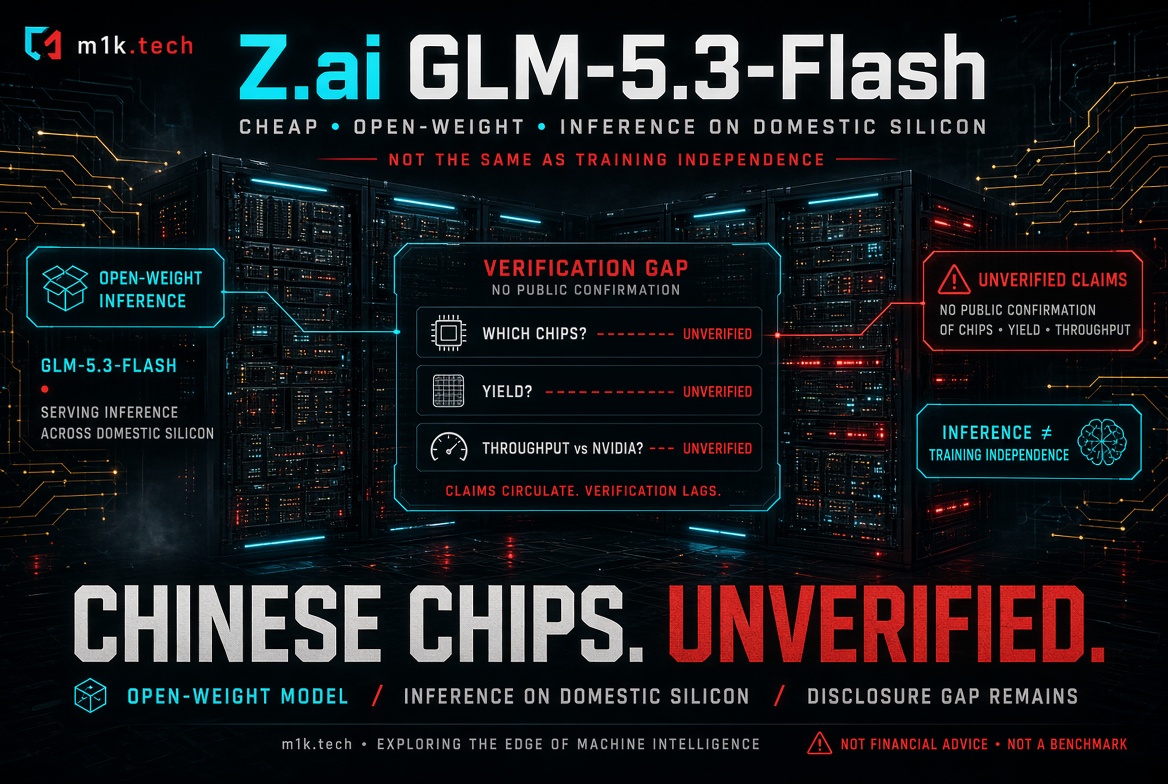
Z.ai spent five days letting the internet guess who built Ox Alpha, the anonymous open-weight model that landed on OpenRouter on August 20 and promptly topped the platform’s usage rankings. On Wednesday, the company stopped pretending: Ox Alpha is now officially GLM-5.3-Flash, the cut-price version of Z.ai’s flagship line, and the claim attached to the reveal is what actually matters. Z.ai says the model runs entirely on domestically made chips, roughly 100,000 of them, handling every inference request since launch.
Nobody outside Z.ai can verify that. CNBC asked and got a company that declined to share details on which chips it was using. That’s a meaningful gap, because the claim does a lot of narrative work with very little disclosure: which chips, what yield, and what throughput compared to Nvidia hardware doing the same job. Running inference is also the easy half of the chip-independence argument. It takes a fraction of the compute that training a frontier model requires, so a company can credibly serve a cheap, mid-tier model on domestic silicon well before its training stack looks the same way. I’ve written about how far Chinese labs will go to keep training runs on Nvidia hardware even under export restrictions, which this announcement doesn’t touch.
The market reaction still tells you something real. Z.ai’s Hong Kong-listed shares climbed more than 8 percent on the news, part of a run that has taken the stock up over 800 percent since its January IPO. Rival MiniMax gained about 3 percent the same day after reporting a 283 percent jump in first-half revenue, even as its losses more than doubled to $293 million. Whatever is happening with the underlying chip supply, investors are pricing Chinese open-weight labs as a genuine track separate from the US frontier labs, not a discount imitation of one.
That track has been building for months. DeepSeek’s V4-Flash undercut Anthropic’s pricing by two orders of magnitude back in August. Alibaba’s Qwen3.8-Max claimed frontier-adjacent benchmarks the same week, open weights promised but not yet delivered in full. Even Mistral’s own architecture choices this month leaned so heavily on DeepSeek’s published design, and on hosting GLM’s own weights, that the line between European sovereign AI and repackaged Chinese open weights is getting hard to find. GLM-5.3-Flash’s ranking, tenth on the Artificial Analysis Intelligence Index and ahead of DeepSeek’s own V4 Pro Max, fits neatly into that same pattern: cheap, fast-following, and good enough for the coding and agentic workloads that make up most real usage.
What I don’t buy yet is the framing that this is China solving chip independence. It’s China proving that the cheapest, least compute-hungry layer of the stack, serving an already-trained model to users, can run on whatever domestic silicon Huawei and its peers can currently produce. That’s a genuinely useful data point for Beijing’s self-sufficiency push, and it’s worth the stock pop. It is not the same claim as training the next GLM generation on the same hardware, and Z.ai’s own silence on which chips it used is the tell that the harder version of this story hasn’t happened yet.
Sources
- CNBC, Z.ai shares surge 8% after releasing new AI model running only on Chinese chips, August 27, 2026
- TechCrunch, Surprise: Z.ai is the AI lab behind the mysterious Ox Alpha model, August 26, 2026
- Bloomberg, China’s Z.ai Made Ox Alpha, Stealth Model That Rivals DeepSeek, August 26, 2026