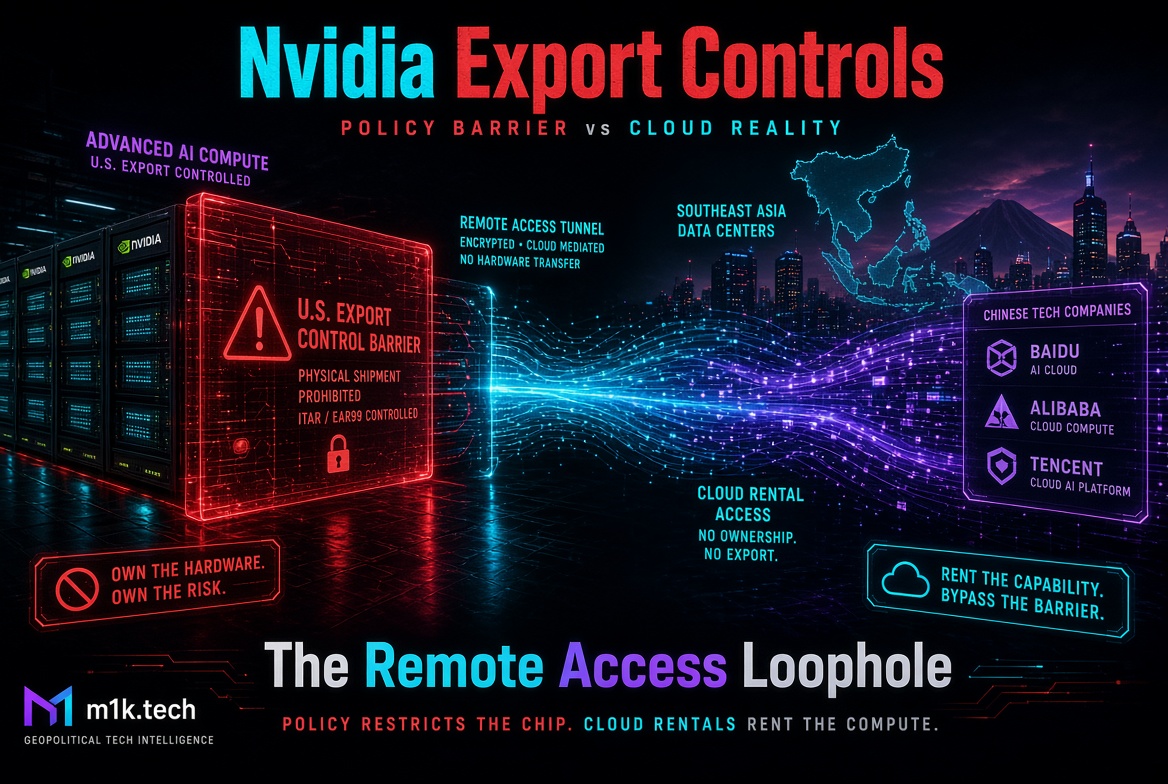
Less than a week after Moonshot AI shipped a new model in July, White House official Michael Kratsios accused the company of running it on Nvidia GB300 chips it had no legal right to own. Moonshot never touched the hardware. It rented compute from a facility in Thailand, and that turns out to be the whole trick: Washington restricts who can own Nvidia’s most advanced AI chips, not who can rent time on them from someone else’s data center on the other side of the export line.
Cassia King, a researcher at the Institute for AI Policy and Strategy, put it about as plainly as I have seen anyone put it: the export control regime “controls physical AI chips. It does not cover remote access to those chips.” ByteDance, Alibaba and Tencent have all reportedly been pulling GB300 compute through data centers in Thailand, Malaysia and Japan, legally, while their access to the physical chips inside China’s own borders stays exactly as restricted as Washington intended. This is the same porous geography I found when Malaysia became an AI chip corridor a year ago, except the workaround has gotten more brazen since then, not less.
ByteDance’s own arrangement reportedly runs through Aolani, a Singapore-headquartered cloud provider operating in Malaysia, first reported back in March and apparently still running. Aolani’s statement to CNBC that its customers have “no ownership, potential future claim or physical access to the chips” is not really a denial. It precisely describes why the loophole works. Real estate firm JLL expects global data center capacity to roughly double to 200 gigawatts by 2030, and 31 planned data centers above 100 megawatts already exist across Malaysia, Indonesia and Thailand, up from two today. That is not a workaround anymore. That is infrastructure.
Congress has a fix sitting in front of it, sort of. The Remote Access Security Act would extend export controls to cover remote cloud access, not just ownership, and it passed the House back in January. It has not moved in the Senate since. Even if it does, Michelle Nie at the Center for a New American Security told CNBC that passing RASA only gives the government authority to write a rule, and Washington would still need to decide what compute counts, who gets barred, and how cloud providers verify who is actually on the other end of a rented GPU. The Bureau of Industry and Security could reportedly move fast, in a matter of days with White House backing, but cloud providers are already signaling they will fight the compliance burden, and I do not think a know-your-customer regime for rented compute gets built quickly no matter how much political will sits behind it. I am not going to try to guess how BIS actually writes that rule; that is a policy-drafting rabbit hole for whenever a real draft exists to read.
What makes this strange is what happened on the physical side of the border the same week. Small batches of actual H200 chips, not rented compute, started landing in mainland China. ByteDance and Tencent have each picked up around 10,000 of them. Except Beijing itself is keeping most of that volume out of the mainland, telling companies to route the hardware through Hong Kong instead so China’s own chipmakers don’t get undercut. I found the same asymmetry when Apple got caught testing memory chips from a Chinese supplier Washington had flagged as a military risk: the line everyone assumes is enforced from one direction turns out to be managed unevenly by both governments, for their own separate reasons, at the same time. Meanwhile China’s own chip exports keep surging in the opposite direction, so nobody involved here is playing pure defense.
So you have the front door, physical chip ownership, where enforcement is porous enough that Beijing itself does not fully want the shipments landing at home. And you have the side door, remote compute access, which was never covered by the rules in the first place and is currently the more reliable route into frontier-scale training for anyone with a corporate card and a data center lease in Bangkok. China’s foreign ministry spent the same week publicly rejecting reports that Washington will ask dozens of countries to pick a side in the AI race outright, while a separate congressional advisory report was warning that China’s real long-term edge might not be chips at all but the physical-world data its manufacturing base generates. Everyone is negotiating over the door everyone can see. Qualcomm, for what it is worth, built an entire edge silicon business around staying on the right side of that same visible line, which only works because the line is visible.
I do not think RASA passing the Senate fixes this, even in the best case. Rental arrangements are easier to restructure than a shipping manifest, and a rule built around today’s Thailand-Malaysia corridor will just push the same compute one hop further away the day it takes effect. The chips were never the chokepoint. The server rack location was.
Sources
- CNBC, The U.S. banned Nvidia’s best chips from going to China. Now it’s trying to close a crucial loophole, August 19, 2026
- Reuters, Nvidia H200 chips reach China in small shipments, FT reports, August 19, 2026
- Reuters, US advisory body says China’s data dominance gives it AI advantage, August 18, 2026
- Global Banking & Finance Review (Reuters wire), China urges respect for digital sovereignty in AI race, August 19, 2026