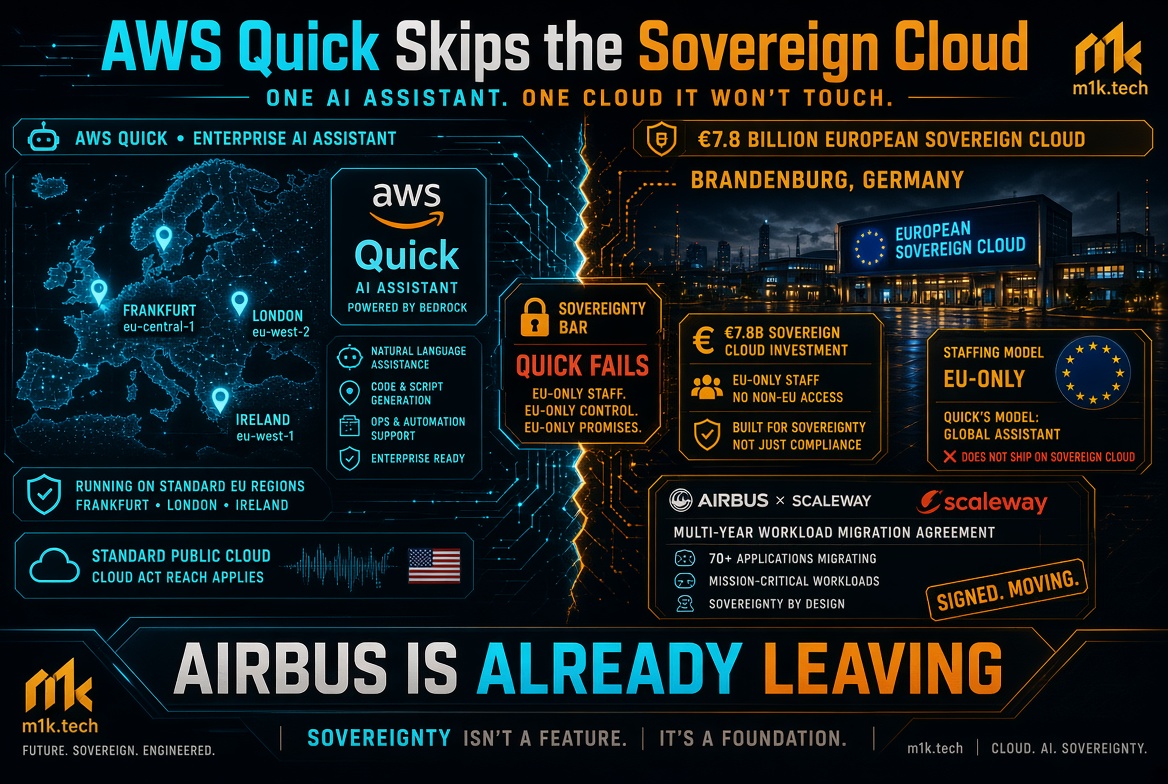
Amazon just made Quick, its enterprise AI assistant, available across desktop on Windows and macOS, pitched squarely at the shadow AI problem: employees pasting confidential data into ChatGPT because IT never gave them a sanctioned alternative. Quick keeps EU inference in Frankfurt, London, or Ireland depending on where a customer sits, which sounds like exactly the governed, in-region AI tool European compliance teams have been asking for. Check AWS’s own European Sovereign Cloud instead: the €7.8 billion, EU-only-staffed region it opened in Brandenburg back in January specifically to court sovereignty-anxious customers, and Quick isn’t on the service list.
That’s not a gap in the announcement. It’s the tell. AWS drew a line between “runs in the EU” and “meets our own sovereignty bar” when it built the Sovereign Cloud, complete with an EU-only board and EU-only staff to satisfy customers who wouldn’t accept anything less. Its newest flagship AI product landed on the wrong side of a line the company invented. I’ve been skeptical of the whole “sovereign AI stack” vocabulary since I watched Nvidia and Palantir slap the label on what’s mostly a compute-reseller deal. AWS just handed me a cleaner example of the distance between the marketing and the architecture: a product built explicitly to solve a governance problem, unavailable in the one place AWS itself defined as fully governed.
Airbus isn’t waiting to find out whether that gap closes. The aircraft maker is moving 70 of roughly 900 applications off AWS to Scaleway, the French cloud provider, in a contract reportedly worth more than €50 million, explicitly to get those workloads out of reach of the US CLOUD Act. I flagged Airbus’s exit from AWS back in August when it was still a side note to a Ryanair story about doing the opposite, betting bigger on Google Cloud instead. Now there’s a number attached, a named vendor, and a specific application count, and it reads less like a hedge and more like a company that ran the actual legal exposure and didn’t love the answer.
The pattern by now is familiar enough that I almost passed on writing this up. AXA walked back a Copilot rollout over the same governance anxiety. Mistral just raised €3 billion with Samsung, ASML, Capgemini, and Amadeus all committing to buy “European Compute Units” specifically to keep sensitive workloads inside EU-controlled infrastructure, chasing a full gigawatt of sovereign capacity by 2030 against a continent that hosts under 5 percent of global AI compute today. What makes the AWS story different is that it isn’t a European company hedging against an American vendor. It’s the American vendor’s own product roadmap admitting the hedge is rational, from the inside.
I don’t think keeping Quick anchored outside the Sovereign Cloud is necessarily a mistake on AWS’s part. Sovereign-region products are expensive to build and slower to ship features into, and Quick only just launched; there’s a real chance AWS adds it to the Sovereign Cloud roster within a year once the desktop rollout stabilizes. Until that happens, though, every enterprise AI pitch AWS makes to a European compliance officer carries an asterisk AWS put there itself, and Airbus’s €50 million bet says at least one very large customer isn’t waiting around to see whether it gets removed.
Sources
- The Next Web, Amazon Quick is now available on desktop, with a new mobile activity feed, September 11, 2026
- Traders Union, citing Financial Times, Europe weighs AI infrastructure push to balance growth and sovereignty, September 11, 2026