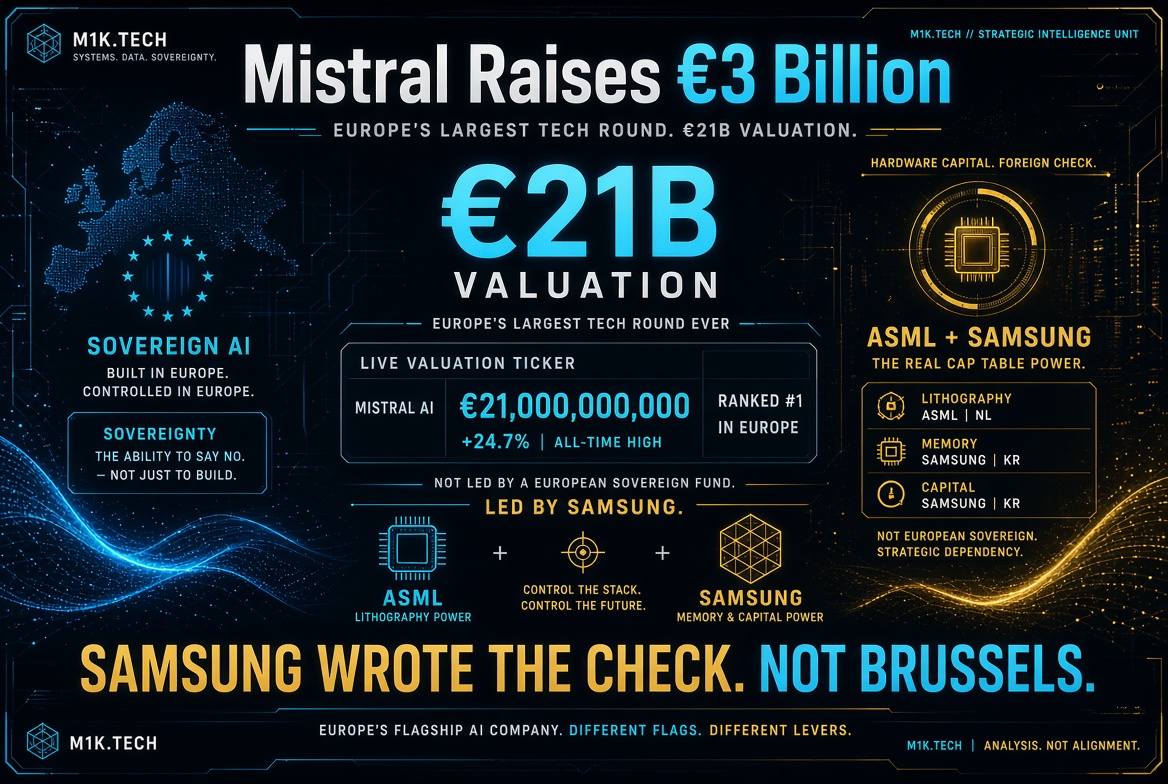
Mistral’s funding round closed today at three billion euros, pushing its valuation past twenty-one billion and making it, by euro amount, the largest single round any European technology company has ever raised. Three years after launch. I keep rereading that number because it would already be a big story on its own, and the number isn’t even the part that got me.
Samsung Electronics led the round. Not a European sovereign fund, not Bpifrance doubling down on its existing stake. A Korean conglomerate that makes memory chips, phones, and appliances just wrote the largest single check behind Europe’s flagship answer to American and Chinese AI dependency. Scaleup Europe Fund, EQT’s vehicle, and PSG Equity co-led alongside Samsung, and the rest of the syndicate reads like a list of everyone who might eventually want to sell Mistral compute, chips, or cloud capacity: Advent and BlackRock came in fresh, Luxembourg’s government joined as a new investor too, and the existing roster, a16z, BNP Paribas, Bpifrance, DST Global, General Catalyst, Index Ventures, Lightspeed, Nvidia, and Salesforce Ventures, all reupped.
Here’s the detail that actually stopped me. Mistral’s two largest funding rounds were led by ASML and Samsung. Not sovereign funds, not European industrial champions in the political sense the term usually implies. Two of the most important hardware companies on the planet: one holding a monopoly on the lithography machines every leading-edge chip on Earth depends on, the other one of two companies capable of making the memory those chips need to run anything at scale. If you wanted to draw the org chart of who actually controls whether sovereign AI gets built at all, ASML and Samsung sit closer to the top than any government in Paris or Brussels.
Mistral’s own pitch for what sovereign means is specific: data that stays inside an organization’s boundaries, models that stay controllable and customizable, compute that’s private and predictable, and production systems that are fully auditable. That’s a real definition, and it’s a different claim than European ownership. It’s the same distinction I made writing about Mistral hosting DeepSeek’s own architecture under its own infrastructure: control over the stack matters more to this company’s sovereignty pitch than the passport on the cap table. Fair enough. But it’s worth sitting with what that framing conveniently sidesteps. A Korean chaebol and a Dutch lithography monopolist now have real influence over the company that’s supposed to be Europe’s proof that AI power doesn’t have to run through Washington or Beijing. The dependency didn’t disappear. It just moved to a different set of foreign capital, one Brussels apparently finds more comfortable than the alternative.
I don’t think that makes the raise fake or the sovereignty pitch dishonest. Mistral now operates across 20 countries and counts Airbus, ASML itself, and HSBC among its 125-plus enterprise customers, and building the full stack- models, infrastructure, and the compute underneath- the way Mistral says it’s doing is a different bet than what OpenAI or Anthropic are running. What I can’t get past is the timing. This raise closes the same week I’m still thinking about AXA calling a Microsoft Copilot rollout a sovereignty move and Denmark quietly building a sovereign AI control layer that keeps the model layer American on purpose, not far from where the EU’s seven AI gigafactories are supposed to eventually sit. Everyone’s definition of sovereignty conveniently excludes whichever dependency they’ve already decided to live with.
Twenty-one billion euros buys Mistral a lot of runway to prove its version is the real one. I’d just watch what happens the first time Samsung’s board wants something from that seat at the table that Mistral’s engineers didn’t sign up for.
Sources
- Mistral AI, Mistral raises €3B to make sovereign, open-weight AI the technology frontier, September 8, 2026
- Reuters, French AI company Mistral hits $24 billion valuation in funding round, September 8, 2026
- Euronews, Mistral AI raises record €3 billion in Samsung-led funding round, September 8, 2026