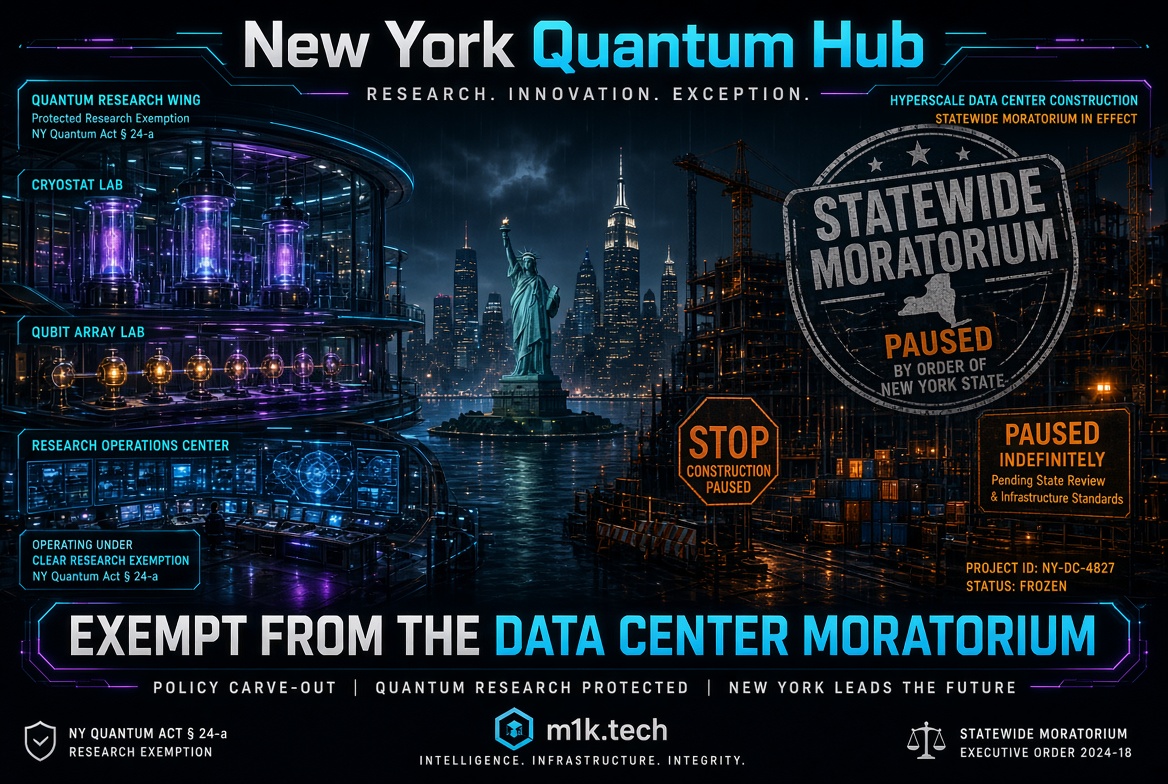
Four weeks before New York Governor Kathy Hochul opened a $60 million quantum computing hub race, she signed the country’s first statewide ban on new hyperscale data centers. Any facility pulling 50 megawatts or more now needs a waiver just to break ground in New York, a response to a power grid straining under AI training clusters and utility bills residents are already furious about. Then on August 12, the same governor put $60 million on the table for up to four Regional Quantum Technology Commercialization Hubs, up to $15 million each, applications due October 14. Read those two moves next to each other, and it looks like whiplash. It isn’t.
Quantum computers, even the advanced ones, draw a fraction of the power a hyperscale AI cluster needs to train a frontier model. Superconducting qubits run at roughly 15 millikelvin, colder than interstellar space, but keeping a handful of dilution refrigerators that cold costs nothing like keeping tens of thousands of GPUs fed and cooled around the clock. Hochul isn’t torn between two incompatible bets on the future. She’s restricting the technology straining the grid right now while funding a technology whose commercial payoff is still years, maybe a decade, out. Different problem, different clock.
The new hubs sit on top of a foundation New York already built. Back in September, the state committed $300 million to a Stony Brook quantum research facility, 150,000 square feet, opening in 2029, that will house a hybrid quantum data center and a quantum education consortium. The commercialization hubs add the connective tissue: shared lab access, mentorship, and industry partnerships for startups that can’t afford to own cryogenic hardware. It’s aimed squarely at what researchers call the Valley of Death, the gap where a scientifically sound quantum result dies because the public grant runs out before a customer shows up willing to pay for it.
Compare that to what Illinois built a few hundred miles west. Illinois spent big to land anchor tenants directly, PsiQuantum, IBM, and Infleqtion, all inside a single purpose built park, an approach I’ve written about as buying the whole table rather than picking one winner. New York is trying something closer to the opposite. Instead of one park with a few giant tenants, it’s funding a network of smaller commercialization hubs open to any 501(c)(3) nonprofit that can show real quantum R&D chops, explicitly designed for startups that will never be the next PsiQuantum but might still be the next real customer. Neither approach is obviously right. They’re just different bets on where the bottleneck actually sits.
New York isn’t running this race alone, and the coincidence of timing this week is hard to ignore. Utah’s governor signed an executive order the same week creating a statewide Utah Quantum Initiative and a Quantum Coordination Council. DARPA gave Qunnect a contract on August 13 to harden the entanglement distribution hardware already anchoring live quantum networks in New York City, Albuquerque, Montana, and Berlin, without needing cryogenics on the receiving end. None of these three things were coordinated. All three landed in the same seven days anyway, which tells you where the policy attention is right now.
The money backing all this is real and growing fast. Quantum computing companies pulled in more than a billion dollars in global revenue in 2025, and total investment in the sector jumped to $12.6 billion, better than six times what it was the year before. Government commitments worldwide hit roughly $10 billion in cumulative public funding by last spring. The UK alone is putting about $2.5 billion behind its own quantum program. That’s the context Hochul is spending into, not a speculative bet on a technology that might never work, but a scramble to avoid being the state that funded quantum research for a decade and then watched some other jurisdiction’s hub capture the companies actually built on top of it.
None of this changes the physics. Quantum computers today are still what researchers call NISQ machines, noisy and error-prone, capped at a few hundred to a thousand physical qubits without full error correction. They can’t yet break encryption or simulate a real drug molecule at the scale that would matter. The applications making money right now are narrower than the headline promises, and I’d bet most of what these commercialization hubs end up funding looks more like optimization software and hybrid classical quantum workflows than anything resembling a cryptography-breaking algorithm running for real. That’s fine. A Valley of Death bridge doesn’t need to fund the endgame to be worth building. It just needs the startups on the other side of it to still exist in five years.
Sources
- Tech Times, New York Opens $60M Quantum Hub Race to Bridge Industry’s Commercialization Gap, August 14, 2026
- Office of Governor Kathy Hochul, Governor Hochul Announces Launch of Selection Process for Regional Quantum Technology Commercialization Hubs, August 12, 2026
- Office of Governor Spencer Cox, Governor Cox Launches Utah Quantum Initiative, August 2026
- PR Newswire, DARPA Taps Qunnect to Strengthen the Reliability and Resilience of Quantum Networks, August 13, 2026
- McKinsey & Company, Quantum Technology Monitor 2026: A Commercial Tipping Point