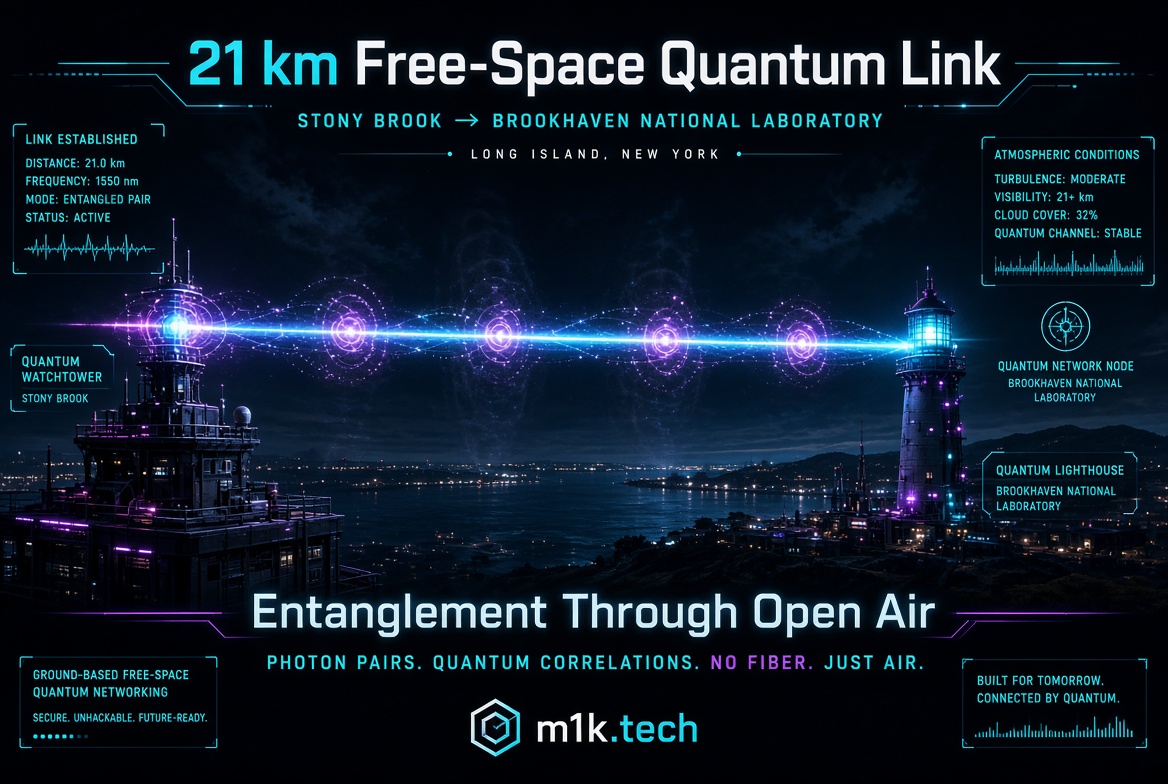
Eden Figueroa’s team pointed a laser off the roof of a building at Stony Brook University, aimed it across twenty-one kilometers of Long Island air at a receiving station on the Brookhaven National Laboratory campus, and on August 21st sent quantum states of light across that gap instead of through a fiber buried in the ground. A few hours later, once the sun went down, they ran it again and pushed entangled photon pairs across the same link. That second run is the part I keep coming back to, not the distance, which is respectable but nowhere near a record, but the fact that entanglement survived a beam sitting in open, turbulent, bug-and-dust-filled air instead of a sealed glass core built to keep exactly that kind of noise out.
Brookhaven and Stony Brook have spent the last few years building the country’s longest fiber-based quantum network: a 161-mile loop threading eight nodes across Long Island. Fiber is the safe choice for this work for the same reason it’s the safe choice for the regular internet: the glass shields the signal, the loss per kilometer is well characterized, and telecom-grade equipment already exists at every wavelength that matters. What fiber doesn’t do well is reach somewhere new. Trenching new conduit is slow, it’s expensive, and it locks you into whatever right-of-way you can negotiate. The open-air link connects a rooftop instrument the team calls the Quantum Watchtower to a receiving station at Brookhaven nicknamed the Quantum Lighthouse, and neither name is much of a stretch: astronomical telescopes and quantum photon receivers turn out to want a lot of the same things, precise pointing, tight collection optics, and a clear line of sight.
“People think of telescopes as tools for looking up into space,” Justine Haupt, the Brookhaven engineer who helped build the receiving optics, said of the project, “but the same technologies that allow astronomers to precisely collect and control light are essential for these quantum experiments.” That’s not a throwaway line. The photon source behind this whole link is a single strand of optical fiber five microns wide, about a tenth the width of a human hair, and getting a beam that thin to land on a receiver twenty-one kilometers away without smearing across a wall instead of a window is a telescope problem before it’s a quantum problem.
Here’s why anyone bothered building a wireless leg onto a network that already works over fiber. Telecom fiber is tuned to the C-band, the wavelength window around 1550 nanometers where glass loses the least light per kilometer, and every amplifier, splice, and switch in the commercial fiber world assumes you’re operating there. Quantum hardware doesn’t care about telecom economics. Trapped-ion systems, nitrogen-vacancy centers in diamond, and a handful of other qubit platforms emit and absorb at wavelengths that have nothing to do with 1550 nanometers, which means connecting them to a fiber network means converting the photon’s wavelength first, and every conversion step bleeds fidelity. “In our new quantum wireless links,” Stony Brook Quantum Institute director Eden Figueroa said, “we are exploring the use of infrared wavelengths that are native to quantum processors and related technologies.” Skip the conversion, skip the loss. A free-space link lets you pick whatever wavelength the hardware on each end actually wants.
I’ll admit I went into this expecting the open-air angle to be a stunt, the kind of press-friendly demo that reads better in a headline than it holds up as engineering. Free-space quantum links aren’t new in the abstract: China’s Micius satellite has been doing quantum key distribution from orbit to ground stations since 2016, and various ground-to-ground optical links have been demonstrated at shorter range going back further than that. But satellite links solve a different problem. Once light leaves a satellite pointed at the ground, it spends most of its path through near-vacuum and crosses the thick, turbulent part of the atmosphere only in the last few kilometers near the receiver. A horizontal link at ground level, rooftop to rooftop, spends the entire twenty-one kilometers in that turbulent layer, dealing with heat shimmer, humidity, and every truck that kicks up dust along the way. That’s a harder atmospheric problem per kilometer than the satellite case, even if the total distance is shorter, and it’s the reason ground-based free-space quantum networking has lagged behind the satellite work by years.
What this buys, if it scales past a two-tower demo, is a quantum network that behaves the way the classical internet does, not the way people assume it does. Nobody trenches fiber to every building; the backbone is fiber and the last stretch to a lot of endpoints is wireless, because wireless is fast to deploy and doesn’t care about property lines. A quantum network built the same way, fiber backbone for the long, stable, high-value hauls and free-space links for connecting new nodes or bridging hardware that fiber can’t talk to natively, is a much more plausible path to something you’d call a quantum internet than assuming every new node gets its own trench. It also means two labs that happen to have line of sight and rooftop access can join a network in weeks instead of negotiating conduit access for years, which matters more than it sounds for how fast this field can actually grow.
It’s worth setting this next to what Chicago has been doing with the same ambition. Illinois bought 128 acres of a dead steel mill and is building physical infrastructure to host four incompatible qubit architectures under one roof, betting that co-location itself is the advantage. Brookhaven and Stony Brook are making the opposite bet: that the advantage is connective tissue between sites that never have to be co-located, as long as two rooftops can see each other. Both bets can be right at once, and I think they probably need to be. A physical hub like Infleqtion’s Chicago buildout still needs a way to talk to whatever gets built next door or across town without waiting on a trenching permit, and that’s exactly the gap a free-space link is built to close.
The honest caveat, and it’s a real one, is that a two-node daytime-then-nighttime demo is a long way from a functioning multi-node free-space mesh. Weather alone is a serious constraint: fog, heavy rain, and even bright ambient daylight all degrade a free-space optical link in ways fiber simply doesn’t experience, and the team’s own choice to run the entangled-photon test at night rather than during the day tells you something about where the current limits sit. I’m also not getting into the quantum key distribution and encryption implications of any of this, whether a wireless quantum link changes the threat model for eavesdropping versus a buried fiber, because that’s a separate piece and I don’t want to bolt it onto this one as an afterthought.
What I’ll say instead is that the fidelity number nobody has published yet matters more here than the distance. I’ve made this argument before about a headline fidelity number missing the point, and it applies again: twenty-one kilometers through open air sounds impressive on its own, but the number that determines whether this becomes real infrastructure is how much entanglement quality survives the trip compared to the equivalent stretch of the existing 161-mile fiber loop. Brookhaven hasn’t published that comparison yet. Until they do, this is an important proof that the physics works outside a sealed conduit, not yet proof that it works as well as the boring, expensive, already-built alternative. Quantum infrastructure spending keeps climbing past the billion-dollar mark elsewhere in the field, and a technique this cheap to deploy, relative to trenching, is exactly the kind of thing that gets funded fast once the fidelity numbers show up. I’d bet they show up within the year. I just don’t know yet whether they’ll be good enough to matter.
Sources
- Interesting Engineering, Quantum signals escape fiber, travel 13 miles in open air in New York, August 23, 2026
- Brookhaven National Laboratory and Stony Brook University Quantum Institute, project statements from Justine Haupt and Eden Figueroa