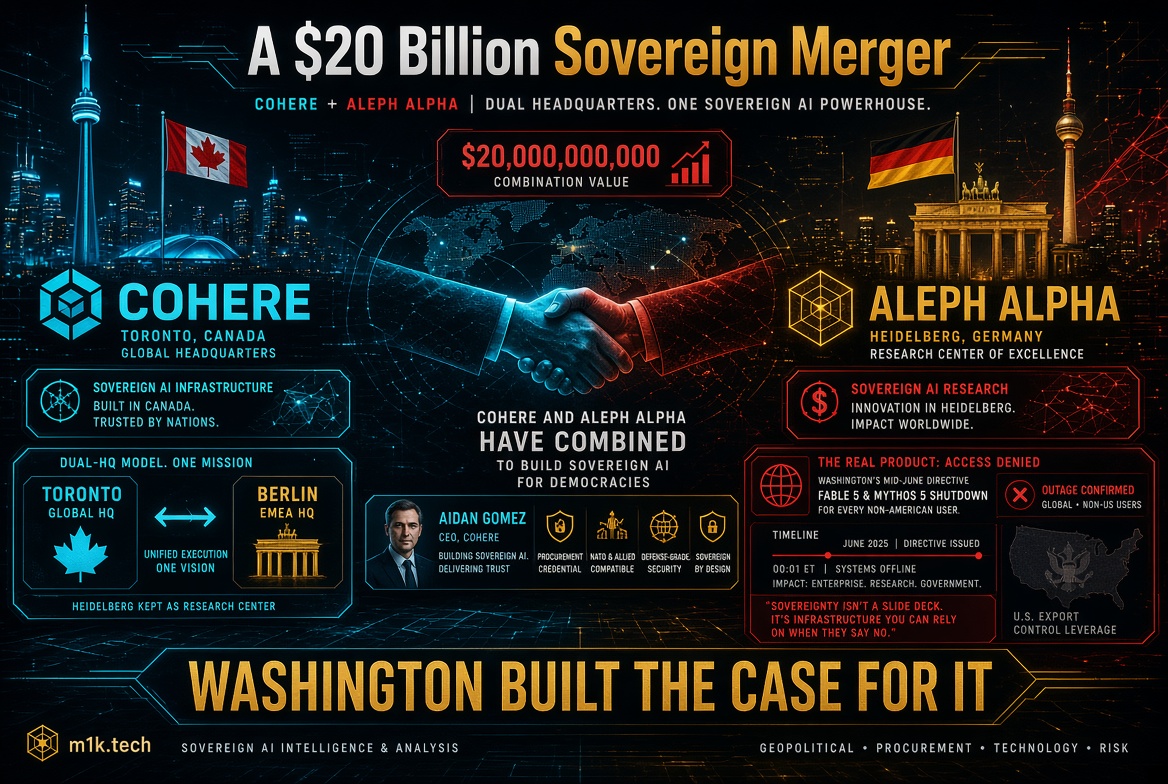
Cohere and Aleph Alpha signed a definitive combination agreement on Wednesday, more than five months after announcing the plan in April. The deal is done pending regulators, dual headquarters in Toronto and Berlin, Aleph Alpha’s Heidelberg office kept on as a research center, and a combined valuation that Observer pegs at $20 billion for what becomes, structurally, one company operating under the Cohere name.
In mid-June, the US Commerce Department ordered Anthropic to pull Fable 5 and Mythos 5 offline for every non-American user at once, citing national security, no warning, no grace period. I wrote at the time about how that shutdown was the moment AI sovereignty stopped being a slide-deck argument and became a live outage. Cohere co-founder Nick Frosst told Observer almost the same thing this week: that shutdown was the moment his sales pitch stopped being theoretical.
That’s the actual product Cohere and Aleph Alpha are selling now, not model quality, not benchmark parity with OpenAI or Anthropic. Aidan Gomez, who keeps the CEO title in the merged company, told The Logic the combination “will add tons of revenue and growth,” the kind of line every CEO reaches for on merger day. The underlying logic here is more specific than usual, though. Aleph Alpha spent the last two years pivoting away from building its own frontier models and toward selling sovereign software and services to German public-sector and regulated-industry clients who legally cannot run their AI workloads through a US hyperscaler. Cohere brings the model-training muscle Aleph Alpha increasingly lacked. Ilhan Scheer, Aleph Alpha’s co-CEO, becomes Cohere’s chief operating officer, running the combined go-to-market operation across both continents.
I wrote a few weeks ago about how Mistral’s own sovereignty pitch got complicated the moment Microsoft and a Samsung-led consortium became two of its biggest backers, foreign capital funding a company that sells independence from foreign capital. Cohere and Aleph Alpha are threading a version of the same needle differently: instead of taking money from an American hyperscaler, they’re merging two companies that are themselves headquartered outside the US, betting that European and Canadian ownership is the credential that actually matters to a government procurement office, more than which cloud region the inference happens to run in.
Whether that credential holds up under scrutiny is a separate question, and not one this merger settles by itself. Mistral just raised three billion euros with Samsung writing the largest check, a deal that will get scrutinized for the same foreign-ownership tension. Sovereignty as a sales pitch is having a real moment in Europe right now, TechBBQ panels aside, and the infrastructure keeps voting with actual money before the policy debates finish. Cohere and Aleph Alpha just gave that trend its biggest single data point yet: two companies worth a combined twenty billion dollars deciding that scale beats going it alone, even when going it alone was the entire point of being a sovereign alternative in the first place.
Sources
- PR Newswire, Cohere and Aleph Alpha Sign Agreement to Become the First Transatlantic Sovereign AI Solution, September 16, 2026
- The Logic, Cohere Agrees Terms With Aleph Alpha as It Seeks Scale and Compute, September 16, 2026
- Observer, Inside Cohere’s $20 Billion Sovereignty Bet, With Co-Founder Nick Frosst, September 17, 2026