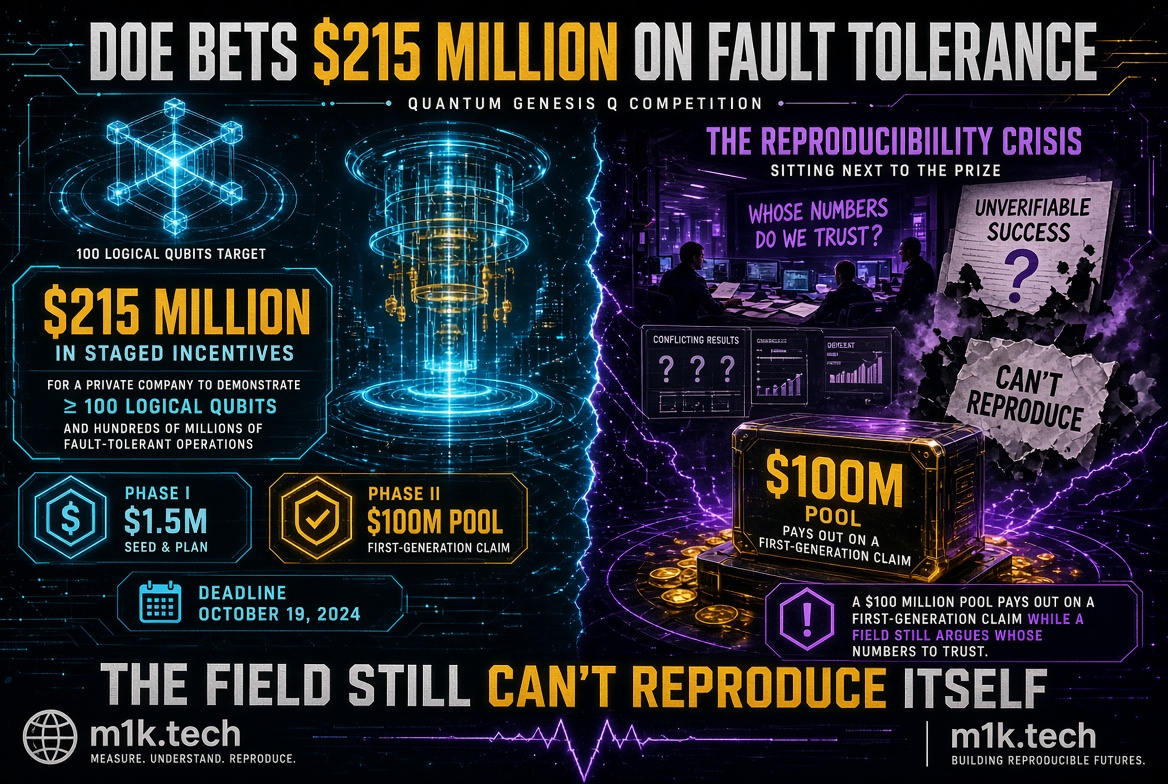
The Department of Energy wants a quantum computer with at least 100 logical qubits, capable of running hundreds of millions of fault-tolerant operations, and it’s willing to put up to $215 million behind whichever private company gets there first. Nobody has built one of those yet. That’s not a knock on the program; it’s the entire premise: DOE announced the Quantum Genesis Q Competition on September 17, open to any private-sector applicant with a real shot at what the agency calls a fault-tolerant, scientifically relevant quantum computer.
The structure tells you how uncertain the agency actually is about the timeline. Phase I hands out fixed awards of up to $1.5 million per team for hitting early milestones. Phase II is where the real money sits: a $100 million general incentive pool split among whoever can demonstrate a first-generation machine with at least 100 logical qubits, plus two separate $50 million bonus pools reserved for teams that clear 150 and 200 logical qubits. Only $2.5 million of the $215 million total is actually committed this fiscal year. The rest depends on Congress appropriating money it hasn’t appropriated yet, a fairly large asterisk on a program DOE is framing as a direct response to June’s executive order on quantum innovation. Applications close October 19, and Under Secretary for Science Darío Gil called it a way of “unleashing new computational frontiers” through public-private partnerships, the kind of line that shows up whenever an agency wants credit for a result it can’t yet guarantee.
Three weeks ago I wrote about quantum computing’s reproducibility crisis, the growing pile of published results other labs can’t cleanly replicate once you control for how each team defines success. DOE is now dangling nine figures for a fault-tolerance bar that assumes the field can already tell a real 100-logical-qubit machine from an overstated one. Those two things sit uncomfortably next to each other. A hundred million dollars split among however many teams clear the line is an enormous incentive to report success on favorable terms, right as the community doing the verifying is still arguing about whose numbers to trust.
This isn’t happening in a vacuum, either. IBM’s Anderon subsidiary just finalized its own billion-dollar CHIPS Act award for a quantum foundry in Albany, a completely different federal funding line aimed at manufacturing rather than this open demonstration bounty. Chicago’s own bet, the 440-acre Quantum Park breaking ground on the old US Steel site, is a third approach again, betting on physical infrastructure and jobs rather than a single milestone prize. Europe isn’t sitting still either. Germany’s Jülich lab just turned on its own quantum machine while Copenhagen broke ground on a foundry of its own. Washington is running at least three different federal funding models at once, which either means the strategy is genuinely diversified or that nobody’s decided which approach actually works yet. I lean toward the second one.
What DOE is actually betting on isn’t that some company hits 100 logical qubits by whatever deadline gets set later; that part is mostly an engineering timeline problem money can accelerate. The harder bet is that the verification and validation science catches up fast enough that when someone claims the bonus pool, the rest of us, and the rest of the field, can actually trust the number. Nobody’s written that check yet.
Sources
- US Department of Energy, DOE Launches Competition to Accelerate Development of World’s First Fault-Tolerant Quantum Computer, September 17, 2026
- GovTech, U.S. Energy Department Launches New Quantum Push, September 17, 2026
- POWER Magazine, What the DOE’s Quantum Computing Competition Could Mean for Fusion and Battery Materials, September 17, 2026