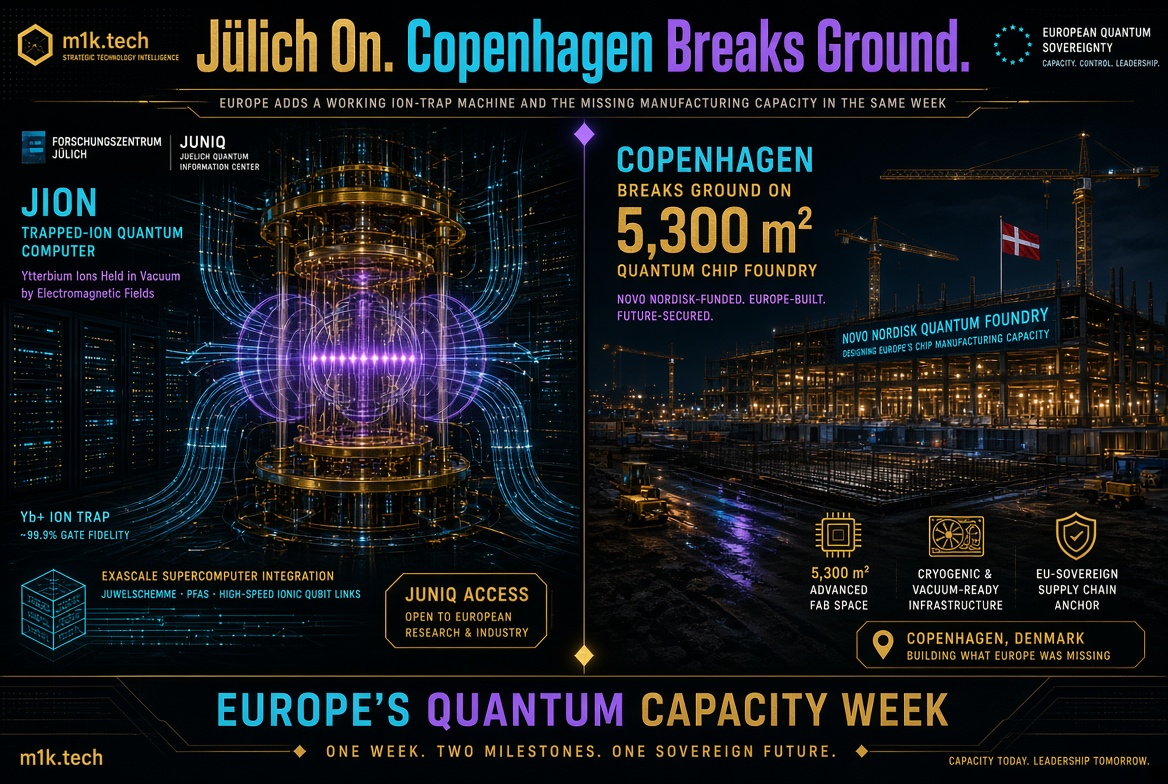
Ytterbium ions trapped in a vacuum by electromagnetic fields started doing physics for hire in Jülich, Germany, this week, and a day later, Copenhagen announced a quantum foundry that will eventually make chips for machines just like it. Two different countries, two completely different kinds of announcement, and I think they only make sense read together.
The German piece is JION, short for Jülich trapped-ion quantum computer, officially commissioned on Thursday at the Jülich Research Center. NRW Minister-President Hendrik Wüst called it a milestone of technology, which is the kind of line a politician says at every ribbon-cutting, except this one came with money attached. JION is a gate-based ion trap machine: individual ytterbium atoms, ionized and held in place by magnetic fields, used as qubits instead of the superconducting loops IBM and Google favor. The advantage nobody talks about enough is that ion traps do not need to run near absolute zero, which is a genuinely different engineering problem than the dilution refrigerators everyone is used to seeing in photos.
Right now, JION has only a handful of working qubits. The roadmap says ten by mid-2027, built by Siegen spinoff Eleqtron using a control technique called MAGIC, magnetic gradient induced coupling, that uses microwaves and precisely shaped magnetic field differences to address qubits individually. That is a small number next to Japan’s own full-stack quantum computer, which came online barely two weeks earlier. More important than the qubit count is that JION is wired directly into JUNIQ, Jülich’s quantum access infrastructure, which in turn plugs into the JSC’s exascale supercomputer. Selected calculations can get offloaded from classical hardware to the quantum system and back, which is closer to how these machines will actually get used commercially than another isolated lab demo.
Wüst did not just show up for a photo. He handed Eleqtron a funding notice worth up to 25 million euros, EU money routed through the EFRE and Just Transition Fund program, to push ion trap tech toward a chip-based, scalable platform called JION+, targeting 40 qubits by 2028. A separate 35 million euro project, Q-STAR.NRW, is earmarked to integrate an entirely different architecture, a 200-qubit semiconductor quantum system, into the same JUNIQ infrastructure. That is 60 million euros committed in one afternoon to two competing hardware bets running side by side, which tells you Germany has stopped trying to pick a winning qubit technology and started just buying capacity in all of them.
Then Copenhagen showed up the next day with the part Europe has actually been missing. Quantum Foundry Copenhagen is not another lab or another qubit architecture. It is a 5,300-square-meter fabrication facility for wafer processing, characterization, testing, chip assembly, packaging, and ultra-high-vacuum manufacturing, opening in 2027 to sell foundry services to quantum companies worldwide. CEO Peter Krogstrup framed the goal plainly: become a world-leading quantum chip manufacturer supplying Europe with next-generation processors. The money, about $62 million, is not government funding or a venture round. It comes from the Novo Nordisk Foundation, the charitable owner of the company behind Ozempic, which has now put roughly 390 million euros into quantum technology between this foundry and a Niels Bohr Institute research program chasing Denmark’s first fault-tolerant quantum computer by 2034.
I keep circling back to that funding source because it is such a strange loop. A diabetes and obesity drug’s commercial windfall is now underwriting Europe’s cleanroom capacity for quantum chips, in a category of industrial infrastructure that governments and venture capital have mostly ignored in favor of funding more research papers. European Commission executive vice president Henna Virkkunen showed up to the launch and said the quiet part out loud: strengthening chip manufacturing capacity is essential for competitiveness and technological sovereignty. That is the same language France has been using while racing to keep its own quantum startups from getting bought out by foreign money, and it rhymes with the instinct behind Illinois building out its own quantum park on 440 acres outside Chicago. Everyone involved has landed on the same conclusion at roughly the same time: research funding was never the bottleneck; manufacturing capacity was.
None of this fixes quantum computing’s real credibility problem: the field still cannot reliably reproduce many of its own headline results, and a ten-qubit machine with a 2027 roadmap won’t outargue a skeptic. I am not getting into whether any of this changes the calculus for IonQ or PsiQuantum’s own roadmaps; that is a different post for a different day. What I will say is that a 25 million euro ion trap grant, a 35 million euro semiconductor grant, and a 62 million euro foundry all landing within about 24 hours of each other is not a coincidence of press cycles. It is what it looks like when the policy language European officials have been repeating for two years finally shows up as poured concrete instead of another strategy document nobody outside Brussels reads.
Sources
- heise online, “Milestone of technology”: New ion trap quantum computer in Jülich, September 3, 2026
- The Next Web, Novo Nordisk Foundation to build $62M quantum chip plant in Copenhagen, September 4, 2026
- Bloomberg, Novo owner to build $62 million quantum chip plant in Denmark, September 4, 2026