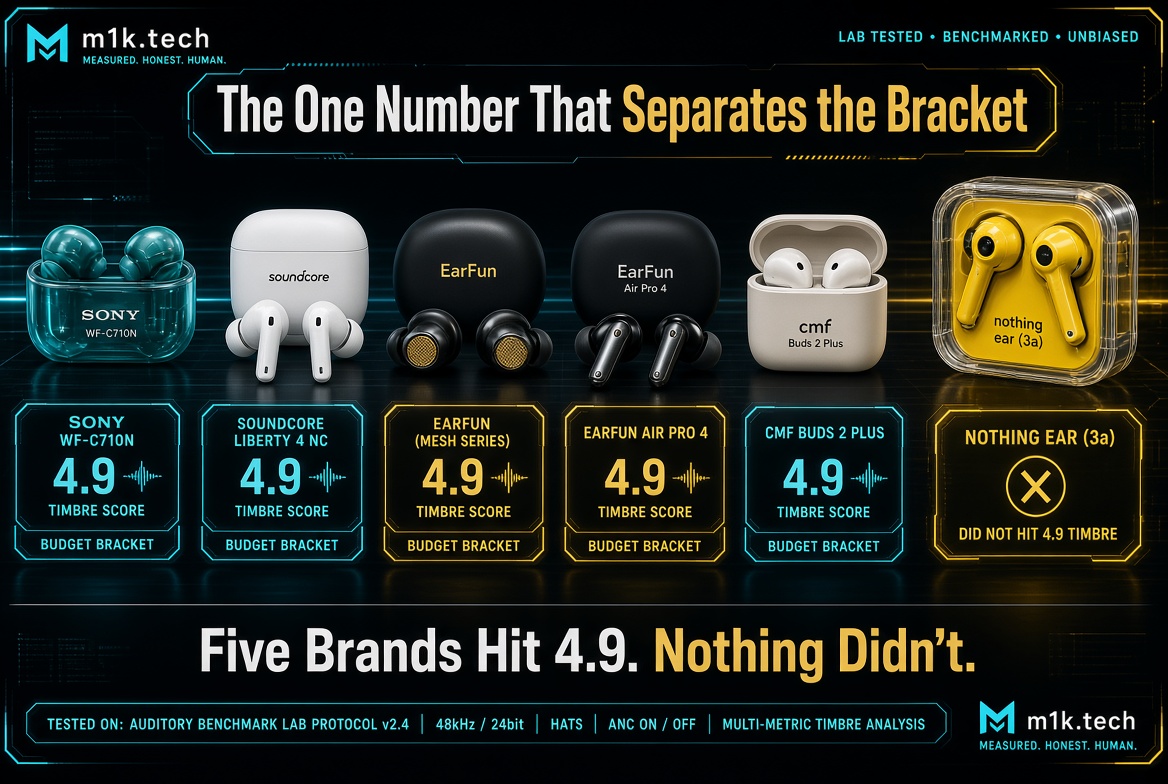
Four point nine. That is the Timbre score for the Sony WF-C710N, the Anker Soundcore Liberty 4 NC, the SoundPEATS Capsule3 Pro+, the EarFun Air Pro 4, and the CMF Buds 2 Plus. Same lab, same head-acoustics model, same scale of one to five. Five different manufacturers at five different price points, and they all land on the same number.
The Nothing Ear (3a) does not. That is the whole story of this comparison, and I want to work through why before anyone reads it as a hit piece, because the Ear (3a) still wins some things no spreadsheet will show you.
I said in the Ear (3a) review that the wider field deserved its own post. This is it. Every serious contender in earbuds under $100 is here, and I have deliberately restricted myself to models measured on the same rig wherever possible, because the alternative is comparing a company’s own marketing dB figure against another company’s own marketing dB figure, which is worth roughly nothing.
What the same lab found across the bracket
| Model | MSRP | Street | ANC (loudness cut) | MDAQS | Timbre | Battery, ANC on | Codecs |
|---|---|---|---|---|---|---|---|
| Nothing Ear (3a) | $99 | $99 | 80.9% | 4.8 | weak point | ~6h (10h ANC off) | SBC/AAC/LDAC |
| Sony WF-C710N | $119 | ~$100 | 85% | 4.8 | 4.9 | 9h25m | SBC/AAC only |
| CMF Buds 2 Plus | $69 | ~$50 | 83% | 4.8 | 4.9 | 13.5h rated | SBC/AAC/LDAC |
| EarFun Air Pro 4+ | $99.99 | ~$80 | 80% (63% passive) | n/a | n/a | 6h17m | LDAC, aptX Lossless |
| EarFun Air Pro 4 | $89.99 | ~$63 | 75% | 4.8 | 4.9 | 8h44m | LDAC, aptX |
| Soundcore Liberty 4 NC | $99.99 | ~$70 | n/a | 4.9 | 4.9 | ~10h | SBC/AAC/LDAC |
| Soundcore Liberty 5 | $129.99 | ~$100 | 76% | 4.7 | 4.8 | 7h08m | SBC/AAC/LDAC |
| SoundPEATS Capsule3 Pro+ | $99.99 | ~$90 | n/a | 4.9 | 4.9 | 3h53m | SBC/AAC/LDAC |
| Google Pixel Buds 2a | $129 | $129 | pending | pending | pending | 10h rated | SBC/AAC |
The 80.9% the Ear (3a) posted is a real result and a large generational jump over the Ear (a)’s 57%. It is also fourth in this table. Sony takes the ANC crown at 85%, and the second-place 83% belongs to a Nothing product that costs thirty dollars less.
Sony’s trade, stated plainly
The WF-C710N cancels more noise than anything else here, and it does it with unusually strong passive isolation before the electronics even engage: the tips alone block around 10dB of low-frequency and up to 40dB of high-frequency noise, and the ANC circuit adds up to 30dB in the lows on top. In testing, it lasted nine hours and twenty-five minutes on a charge, beating Sony’s own 8.5-hour claim.
The bill comes due in connectivity. No LDAC. No aptX. SBC and AAC, and that is the entire list, on a 2025 product from the company that invented LDAC. SoundGuys scored its connectivity a 5.0 out of 10, and that seems generous to me. If you are on Android and you care about codecs at all, Sony has built you a wall. On an iPhone, it doesn’t matter in the slightest, because iOS speaks AAC and nothing else anyway, which makes the C710N one of the strongest iPhone recommendations in the bracket and one of the weakest Android ones. Three ear tip sizes, no fins or wings, and a fit that slips during exercise round out the compromises.
EarFun is the one that should be winning
On paper, the Air Pro 4+ is the most complete product in this table, and it is not close. Bluetooth 6.0, LDAC and aptX Lossless and Auracast, a dual-driver arrangement pairing a 10mm dynamic with a balanced armature, IP55, five tip sizes, wireless charging, a 10-band EQ with a hearing-test-driven sound profile, and three hours of playback from ten minutes on the pad. The street price has been around $80.
Its ANC measured 80% with the circuit on and 63% from the tips alone, which puts it within measurement noise of the Ear (3a) and behind Sony and CMF. Battery came in at six hours seventeen minutes with ANC running, against a 12-hour rating, so treat EarFun’s headline numbers the way you would treat anyone’s.
What EarFun lacks is a brand anyone outside this hobby recognizes, and that is the entire reason it keeps losing sales to worse products. I find that irritating in a way that is probably disproportionate. The regular Air Pro 4 at roughly $63 street is arguably the better buy of the two, since it gives up Auracast and the balanced armature and gets you eight hours forty-four minutes of measured battery, nearly two and a half hours more than its own successor.
The CMF problem, which is Nothing’s problem
Here is the part I have been circling.
The CMF Buds 2 Plus cost $69 at list and drift toward $50 on sale. They cancel 83% of external loudness, compared with the Ear (3a)’s 80.9%. They carry IP55 where the Ear (3a) carries IP54. They are rated for 13.5 hours in the buds and 55 hours with the case, against 6 and 25 with ANC engaged on the Ear (3a). They support LDAC over Bluetooth 5.4. They score 4.8 overall and 4.9 on Timbre. And they include Audiodo-powered personalized sound from an actual hearing test, which is the exact feature Nothing withheld from the Ear (3a) to protect the Ear (3).
CMF is Nothing’s own sub-brand. This is not a competitor eating Nothing’s lunch. This is Nothing eating Nothing’s lunch, using a cheaper kitchen. And the sub-brand has form: CMF moved 100,000 phones in three hours the first time it was allowed to compete properly.
I wrote in the Ear (3a) review that the gap between the value tier and the flagship tier keeps closing, and that the flagship’s job description was getting unclear. Now that I’ve put the whole bracket side by side, I think I understated it. The pressure is not coming from above. The (3a) is not really threatened by the Ear (3) at $179; it is threatened from below by a product wearing the same parent company’s badge that beats it on four measured axes and undercuts it by thirty dollars.
The Buds 2 Plus are not flawless. Isolation scored 6.0; they dropped the tactile Smart Dial from the case that made the previous generation charming; there is no wireless charging; and the Immersiveness score of 3.8 is the lowest in this table. If you want the transparent aesthetic, the Nothing X app, the recording features, or anything approaching design coherence, CMF does not sell you that. But if what you want is quiet ears and long battery for under $70, Nothing already makes that product, and it is not the one with Nothing’s name on it.
Where the measurements and the listening disagree
Scarbir, who has reviewed north of 530 wireless earbuds solo since 2019 and therefore has the most consistent single-listener reference in the category, ranks a completely different set at the top. Strongest ANC under $100 goes to the EarFun Air Pro 4i at around $60, which he puts a fraction below the $250 AirPods Pro 3. Best all-rounder goes to the OnePlus Buds 4, currently $99.99 down from $129.99, with seven hours of ANC-on playback and a case that fully recharges the buds in ten minutes. Strongest wind-resistant ANC goes to the Redmi Buds 8 Pro, which ties the EarFun on cancellation and handles wind better than the AirPods do, at the cost of a four-and-a-half-hour battery that is the worst in its class.
None of those three appear in the measured table above, because they have not been through the same rig. That is a real gap and I am not going to paper over it by pretending a subjective ranking and a percentage-of-perceived-loudness figure are the same kind of claim. They are not. What I take from the overlap is that the EarFun and Soundcore Liberty 4 NC families show up near the top of both methodologies, which is about as strong a signal as this category produces.
The Capsule3 Pro+ is the outlier worth one paragraph: SoundPEATS put xMEMS, solid-state drivers in a $99 earbud; it scored 4.9 overall, and then the battery died at three hours fifty-three minutes with ANC on. That is less than half what the Ear (3a) manages. Wonderful drivers, unusable runtime.
I am leaving the call-quality dimension almost entirely alone here. Microphone performance varies more with wind and room reverb than with price, the sample sets are not comparable across outlets, and it would double the length of this post for a dimension most people rank fourth.
So what does the Ear (3a) actually win
Not ANC, where Sony and its own sibling beat it. Not battery with the circuit on, where the Liberty 4 NC and the CMF buds roughly lap it. Not out-of-the-box tuning, where it is the only product in the table that measurably needs fixing before you enjoy it. Not codecs, where EarFun offers aptX Lossless and Auracast on top of LDAC.
It wins the app, and it wins it by a distance nobody else is close to. The 8-band parametric EQ exposes gain, center frequency, and Q per band, and the Explore tab turns other people’s corrections into a QR code you scan once. Soundcore counters with 22 presets and HearID; EarFun counters with a 10-band EQ and My Sound Profile. Neither has built the shared marketplace, and that marketplace is precisely what converts the Ear (3a)’s worst measured flaw into a four-minute inconvenience.
It also wins the thing that is not on any chart. The 32MB of onboard flash and the recording features it enables have no equivalent anywhere in this bracket or above it, caveats and all. And it wins on wanting to be looked at, which sounds trivial until you notice that every other product in this table is a black plastic bean.
If you are buying purely on measured performance per dollar, buy the CMF Buds 2 Plus and enjoy the fact that Nothing is undercutting itself so efficiently. If you are on iOS and want maximum quiet, the Sony is the answer, and the missing codecs cost you nothing. The Ear (3a) is for people who want a product with a point of view, are willing to spend four minutes in EQ to get there, and want to record a phone call with their ears. That is a narrower buyer than Nothing’s marketing implies, and it is still a real one.
What I keep wondering is how long Nothing can keep running a value tier and a sub-brand that both undercut its flagship, without eventually admitting that the flagship is the SKU that no longer has a reason to exist.
Sources
- SoundGuys, best wireless earbuds under $100, and individual lab reviews of the Nothing Ear (3a), Sony WF-C710N, CMF Buds 2 Plus, EarFun Air Pro 4, EarFun Air Pro 4+, Soundcore Liberty 4 NC, Soundcore Liberty 5, SoundPEATS Capsule3 Pro+, and Google Pixel Buds 2a
- Scarbir, strongest cheap ANC earbuds under $100 and best budget TWS under $100
- PCMag, best cheap wireless earbuds
- OnePlus Buds 4 product page for current pricing