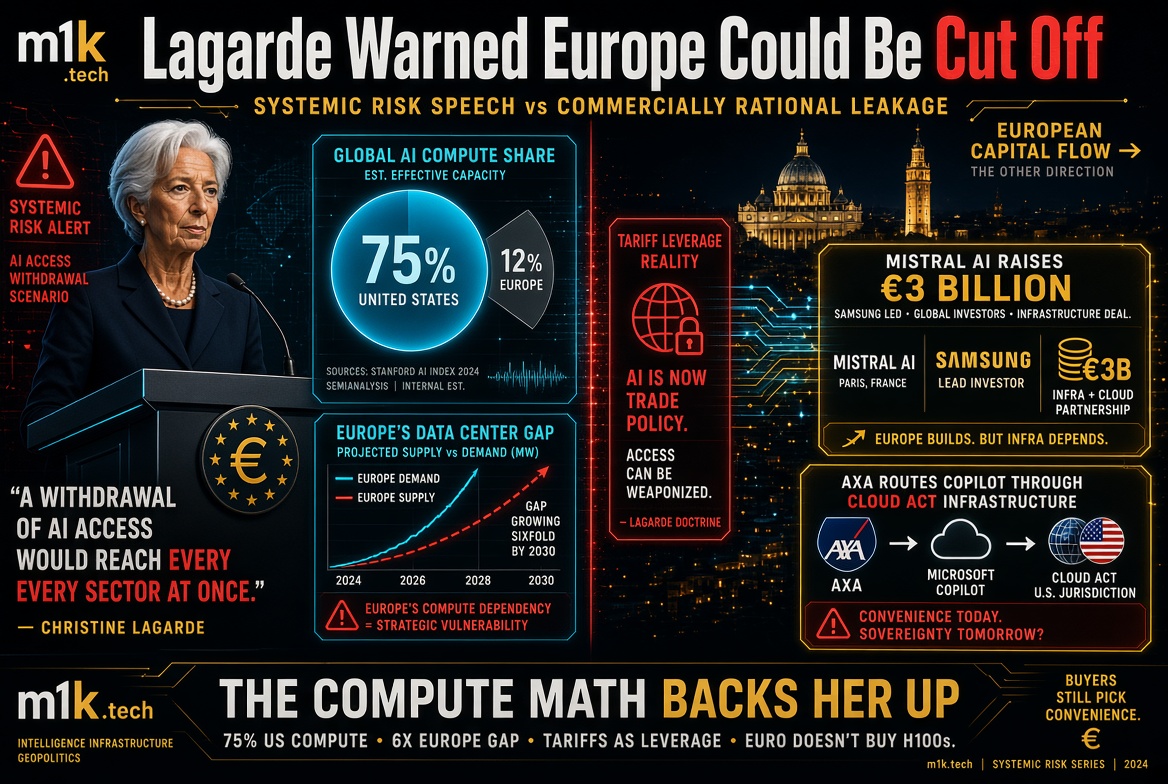
Christine Lagarde doesn’t usually talk about GPUs. On Monday in Vienna, the ECB president spent part of a speech ostensibly about monetary sovereignty doing exactly that, warning that Europe’s near-total reliance on imported AI, mostly American, hands its trading partners a kind of leverage nobody in Frankfurt is used to pricing. “A withdrawal of access,” she said, “would reach every sector at once.” That’s not a central banker being dramatic for effect. That’s someone whose entire job is spotting systemic risk before it detonates, looking at the AI stack and describing the same single point of failure I keep circling back to from the infrastructure side, just with a number attached that made me stop and reread the sentence twice.
The number is this: the US holds roughly 75 percent of global AI compute. Europe’s own data center gap, on its current trajectory, could grow sixfold within a decade if nothing changes. Lagarde’s argument isn’t really about chips. It’s about what that dependency buys the country holding them, and she’s explicit that it could get wielded as a card in tariff negotiations or a digital tax standoff, the same way gas pipelines became a lever over half of Europe a few winters back. I don’t read that as hyperbole coming from her specific chair. The ECB’s job is to game out exactly this kind of concentrated exposure, and it just said the quiet part out loud instead of leaving it to a conference panel.
Which is funny, because the conference panel already said it, at length. Emad Mostaque told a room in Copenhagen a few weeks back that sovereignty is “the ability to resist power being exerted over you,” and that the person who controls the AI controls the country. Lagarde is essentially co-signing that line, except now it comes with a central bank’s institutional weight and a specific number instead of a founder’s conference-circuit soundbite. That matters more than it should, honestly. A warning from someone who can move interest rates lands differently than the same warning from a guy running a startup called Intelligent Internet.
Here’s the part that undercuts her own point, though, and it’s the part I can’t stop thinking about. While the ECB was warning that Europe risks losing access to AI wholesale, the actual capital allocation decisions this year kept pointing the other way. Mistral’s record €3 billion round, the largest any European tech company has ever raised, was led by Samsung, not a European sovereign fund, and its two biggest rounds to date have both been led by foreign hardware giants rather than anything with an EU flag on it. The same company now hosts a Chinese model, Z.ai’s GLM-5.2, unmodified on its own platform, because its CTO said there was no good reason not to. And AXA, which spent two years building an actual sovereign gateway with prompt anonymization and full audit logging, rolled out Microsoft 365 Copilot on top of it anyway, routing insurance data through a semantic index sitting on infrastructure the CLOUD Act can reach. None of these companies are stupid. They’re making the commercially rational call every time, which is precisely the problem Lagarde is describing without quite saying so: sovereignty keeps losing to convenience at the exact moment the institutions warning about it need it to win.
What gives the speech more teeth than the usual Brussels hand-wringing is the timing. The EU’s AI Board convenes in Brussels this Thursday to get a Commission briefing on recent AI incidents, directly in the shadow of the Trump administration calling AI safety warnings a hoax and rejecting a moratorium outright. Lagarde isn’t operating in a vacuum here. She’s speaking into a week where the American position on AI governance is hardening into open dismissal of the European approach, which makes her framing of AI access as tariff leverage look less like a hypothetical and more like a read on where this actually heads if the trade relationship sours further.
I keep coming back to what the ECB can actually do about any of this, which is not much. Lagarde can urge domestic compute buildout from a podium in Vienna, but she doesn’t control fiscal spending across 27 member states, doesn’t own a single gigafactory contract, and doesn’t get a vote on whether the next AXA-sized company picks Copilot over a sovereign alternative. The euro doesn’t buy H100S. Until someone in Brussels controls a checkbook big enough to change the underlying math, Mistral, AXA, and every other rational European buyer keep running; the ECB’s compute anxiety is just the loudest, best-credentialed version of a complaint every founder in that Copenhagen hallway was already making to anyone who’d listen.
Sources
- Reuters, Europe facing ‘unprecedented’ risk of being cut off from AI, Lagarde warns, September 14, 2026
- Politico EU (via dig.watch), EU capitals to discuss AI incidents and global cooperation, September 15, 2026
- CNBC, Trump’s opposition to AI rules undercuts industry’s calls for a slowdown, September 15, 2026
- TechCrunch, At TechBBQ, Europe’s AI conversations kept coming back to: Who’s actually in control?, August 29, 2026