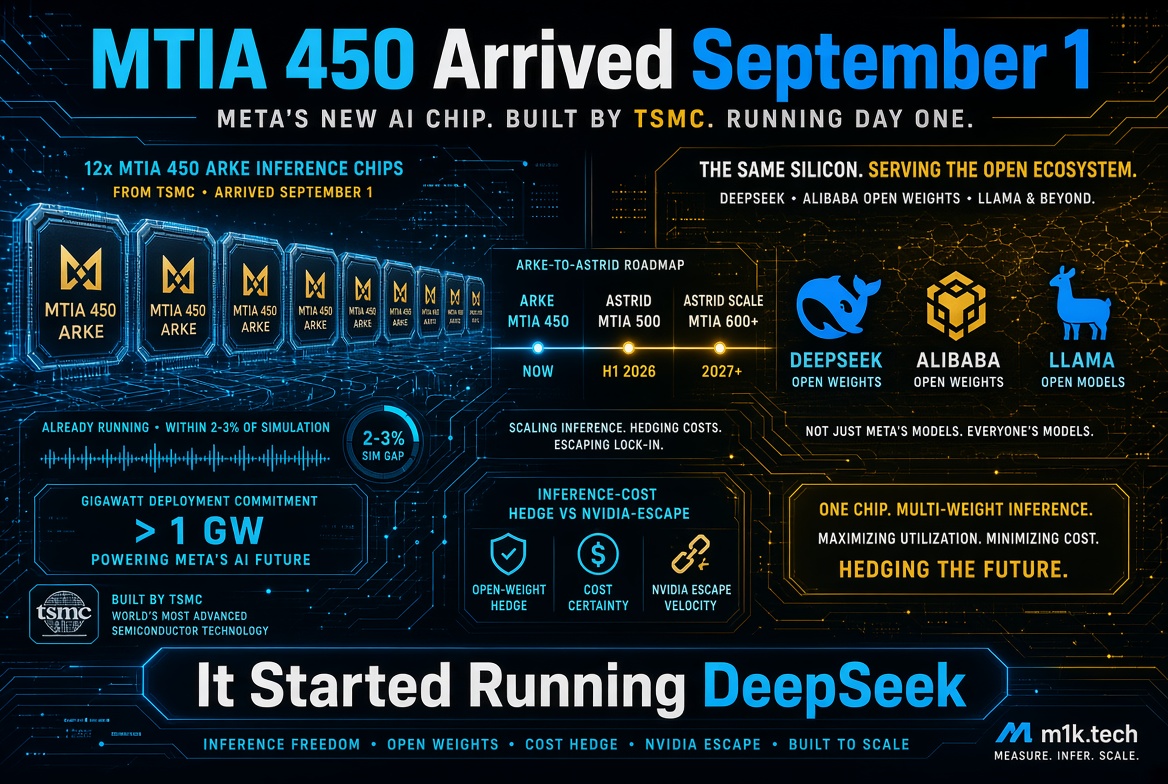
Twelve chips arrived from TSMC on September 1st, and Meta spent Monday telling Bloomberg they’re already running within two to three percent of simulation. That’s an unusually tight number for anyone to publish about silicon fresh off the line, and it’s the detail that tells you this isn’t a research demo anymore. The chip is MTIA 450, internally code-named Arke, Meta’s third-generation custom AI accelerator, and Meta VP Yee Jiun Song used the same briefing to preview a fourth generation, MTIA 500 or “Astrid,” finishing design in roughly a month and targeting deployment by the end of 2027. Meta has committed to more than a gigawatt of these chips deployed over the next twelve months. That’s not a pilot program. That’s a company trying to get off someone else’s bill at scale.
The someone else is Nvidia, obviously, and Meta joining that migration puts it in the same camp as everyone with enough volume to justify the engineering cost. Google has run Broadcom-co-designed TPUs for close to a decade, Amazon builds Trainium and Inferentia, Microsoft has Maia, and OpenAI just spent nine months getting its own Broadcom-built Jalapeño chip to first silicon. Meta’s MTIA line isn’t new either; this is generation three, but the specificity of what got disclosed this week (real hardware, a named codename, a hard deployment number) reads like a company that’s decided the ASIC bet has cleared whatever internal threshold used to keep it a side project.
The part that actually made me sit up isn’t the gigawatt figure; it’s what Meta says it ran on the new silicon during testing: DeepSeek and Alibaba’s models, alongside its own Llama family. Sit with that for a second. A chip Meta built explicitly to cut its dependence on an American vendor spent part of its bring-up cycle proving it can serve Chinese labs’ open weights just as well as its own. I don’t think that’s an accident or a throwaway benchmark choice. If your accelerator only runs your own model family well, you’ve built a very expensive single-purpose part. If it runs whatever the industry’s best open weights happen to be that quarter, you’ve built a hedge against your own research team falling behind, which is a much more honest thing for an infrastructure chip to be optimized for than anyone at Meta is going to say on the record.
Here’s where I’ll push back on the framing a little, because “Meta escapes Nvidia” is the headline everyone’s going to run with, and it’s not quite what’s happening. Nvidia’s moat was never really the silicon, it was CUDA, and MTIA doesn’t touch that at all because Meta’s inference stack was never CUDA-locked the way a startup buying merchant GPUs off the shelf would be. Meta controls its own serving framework end to end, which is exactly the precondition that made a custom ASIC rational in the first place. This is closer to what Apple did with the custom ASICs it commissioned from Broadcom for connectivity silicon, buying supply certainty and cost control on a workload Meta already fully understands, than it is to some grand escape from Nvidia’s ecosystem. Apple’s $30 billion Broadcom commitment runs the same logic: once you know exactly what you’re running and at what volume, the flexibility premium on a general-purpose chip stops being worth paying.
What I actually buy is the cost argument, because Bloomberg’s framing leaned hard on savings rather than independence, and that’s the more honest sell. Training frontier models still needs Nvidia’s top-end parts and will for a while; nobody’s claiming MTIA touches that workload. Inference is different. Inference is the part that runs every single time someone opens Instagram and gets a recommendation, every time Meta AI answers a prompt, millions of times a second at a cost that scales linearly with however much margin Nvidia is charging that quarter. Shaving even a modest percentage off that bill at Meta’s volume is real money, and unlike a training cluster, an inference chip doesn’t need to chase the absolute frontier of performance to be worth deploying. It needs to be good enough and cheap enough, repeatedly, forever. That’s a much easier bar to clear on a second custom silicon generation than beating Blackwell on a training benchmark, and it’s why even AMD’s own VP was arguing this summer that the CUDA lock-in people still worry about barely comes up in customer conversations anymore, because everyone serious about inference is already one or two abstraction layers above where that lock-in used to bite.
I’m not going to pretend I know whether Astrid ships on schedule. Meta’s own timeline admits the design isn’t finished, and a “roughly a month” estimate to finish a chip that deploys at the end of 2027 leaves enormous runway for the kind of slip that turned Intel’s Ohio fab into a punchline. What I do trust is the 2 to 3 percent simulation-to-silicon gap on Arke, because that’s the one number in this whole announcement that’s hard to fake and easy to check once the chips actually ship in volume. If Meta is telling the truth about that, its chip design pipeline has gotten good enough that the interesting question isn’t whether Meta can build its own silicon anymore. It’s how much of Nvidia’s inference revenue every hyperscaler with Meta’s resources is going to quietly take for itself before anyone outside these companies notices the shift already happened.
Sources
- Bloomberg, Meta touts the cost-saving benefits of latest in-house AI chips, September 15, 2026
- Los Angeles Times, Inside Meta’s custom AI chips slashing energy bills in data centers, September 15, 2026
- Yahoo Finance, Meta To Reportedly Launch New AI Chip In 2027, September 15, 2026