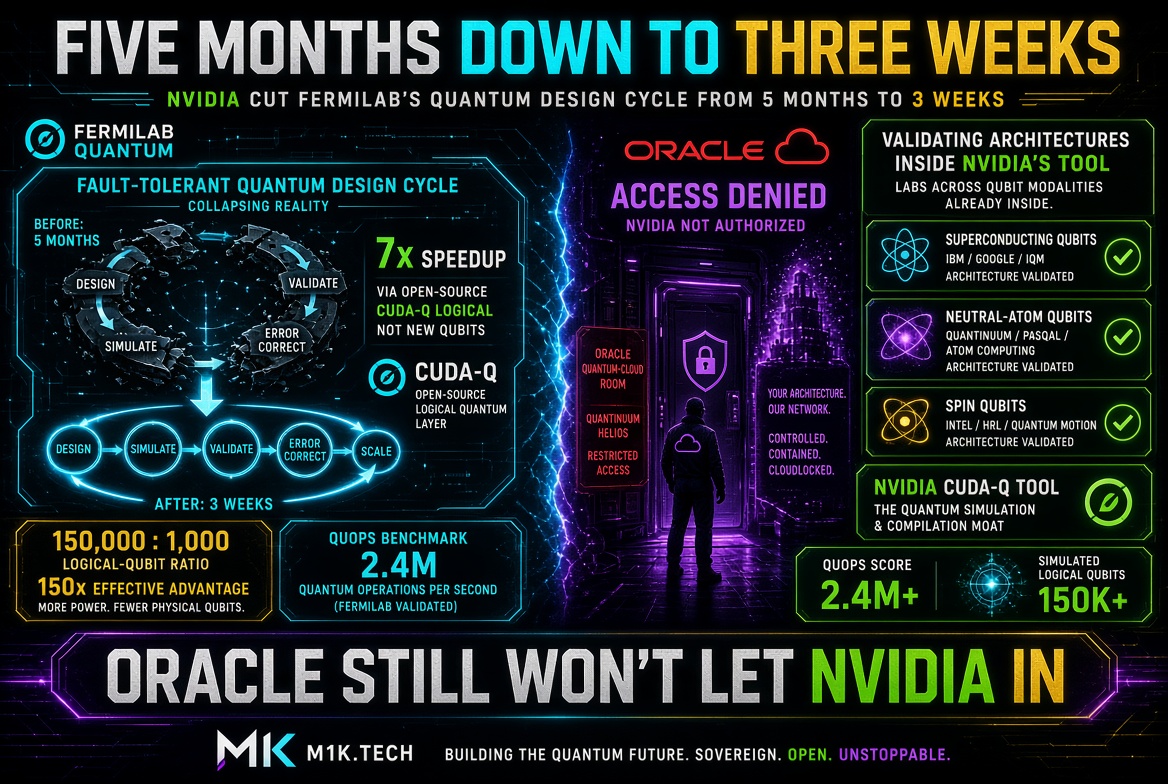
NVIDIA didn’t bring a new qubit count to IEEE Quantum Week in Toronto this week. It brought a piece of open-source software, and the number attached to it is more interesting than anything a qubit-count press release has produced all year: Fermilab took its fault-tolerant quantum design cycle from roughly five months down to three weeks, a 7x speedup, using a tool called CUDA-Q Logical instead of new hardware.
The problem CUDA-Q Logical is solving sounds dry until you sit with it. Building a fault-tolerant quantum computer means codesigning the algorithm, the error-correction code, and the hardware architecture together, because changing any one of those three changes how many physical qubits everything else needs. Historically that meant building bespoke infrastructure for every combination worth testing, which is exactly the kind of grinding, non-repeatable process that turns a research group’s roadmap into guesswork. Anna Grassellino, Fermilab’s chief technology officer, put it plainly: her team explored combinations of resources in three weeks that would typically have taken about five months of building specialized infrastructure from scratch.
The list of who’s already using it is the part I keep coming back to. Sandia National Laboratories, Infleqtion, IQM, Quantum Motion, and Fermilab itself span superconducting, neutral atom, and other qubit modalities entirely, which is the opposite of NVIDIA picking a hardware winner. Iceberg Quantum ran Diraq’s spin-qubit architecture through CUDA-Q Logical and found it could hit 1,000 logical qubits with roughly 150,000 physical qubits, about ten times fewer than Diraq’s own earlier estimate. That physical-to-logical ratio is close to the single number that determines whether fault-tolerant quantum computing is a 2030 story or a 2040 one, and shaving an order of magnitude off it through better codesign tooling, not better qubits, is the kind of result that should worry anyone still betting purely on hardware roadmaps.
Sandia also used the moment to release QUOPS, an independent cross-platform benchmark meant to measure progress toward genuinely useful fault-tolerant systems rather than the qubit-count theater the field has run on for a decade. Early QUOPS results already cover Google, IBM, and Quantinuum hardware. I’ve written before about how only nine percent or so of quantum computing papers actually reproduce under outside scrutiny, and a benchmark plus a design tool built explicitly around repeatable, verifiable workflows is a direct answer to that problem, whether or not that was NVIDIA’s intent going in.
What I can’t stop thinking about is how this runs counter to the sovereignty argument running through the rest of this year’s quantum coverage. Germany turned on its own quantum computer and Denmark broke ground on its own quantum chip foundry, both explicitly framed around reducing dependence on outside vendors. None of that touches the design layer NVIDIA just planted itself in the middle of. You can build sovereign qubits on sovereign silicon and still end up running your codesign workflow through a tool that only exists because NVIDIA open-sourced it, which is roughly the pattern that gave NVIDIA’s original CUDA its grip on classical AI computing in the first place. Oracle went out of its way to build a quantum cloud on Quantinuum’s Helios hardware without NVIDIA anywhere in the announcement, and I doubt that omission was an accident. It gets a lot harder to route around NVIDIA when half the fault-tolerant quantum ecosystem, across incompatible hardware types, is already validating its architecture choices inside NVIDIA’s own tooling before a single logical qubit ships.
I’m not going to pretend I know whether CUDA-Q Logical becomes as load-bearing for quantum computing as CUDA became for GPUs. Software moats take years to prove out, and this is week one. But the shape of the bet is familiar, and Fermilab’s three-week number is exactly the kind of concrete result that gets a tool adopted quietly, lab by lab, long before anyone writes the NVIDIA-quantum-monopoly headline.
Sources
- NVIDIA Newsroom, NVIDIA Expands Open Source CUDA-Q Platform for Fault-Tolerant Quantum Computing, September 14, 2026
- Infleqtion, Infleqtion Advances Fault-Tolerant Quantum Computing With NVIDIA CUDA-Q Logical, September 14, 2026
- The Next Web, Nvidia’s new quantum layer cut Fermilab’s design work from five months to three weeks, September 14, 2026