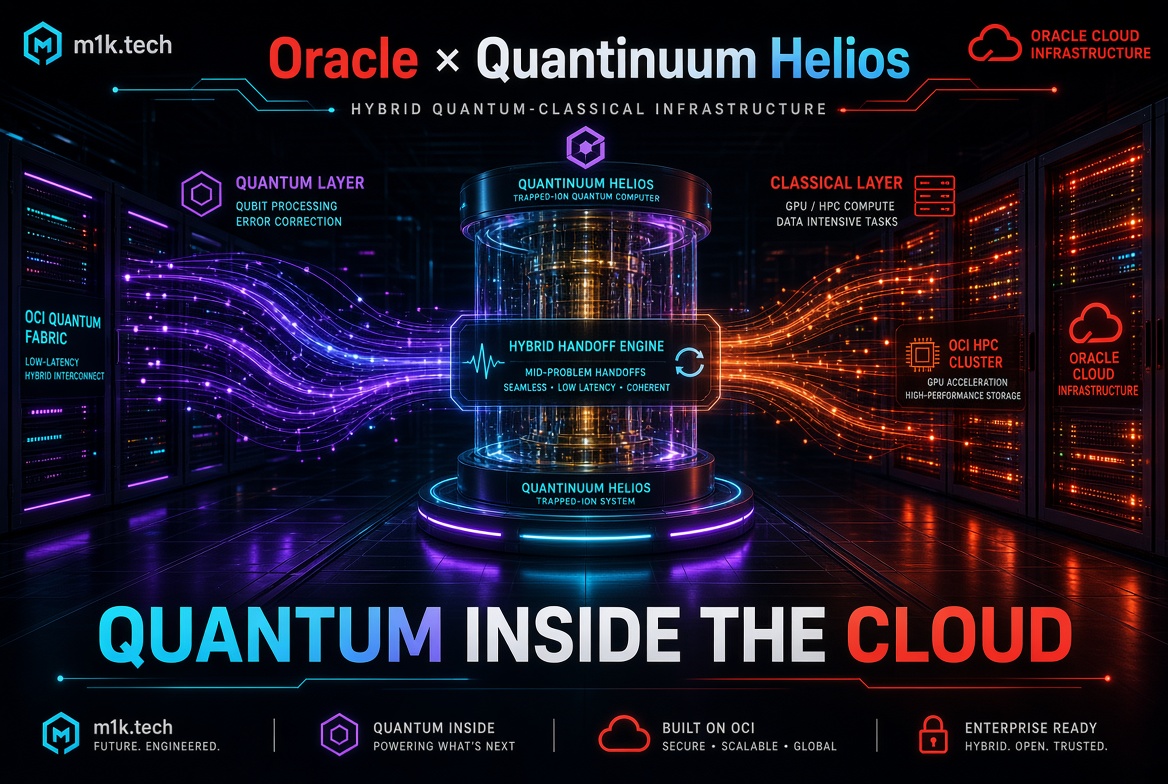
Oracle’s new deal with Quantinuum puts a real quantum computer physically inside an Oracle Cloud Infrastructure data center, and I’ve read a lot of quantum cloud announcements that hide behind vague timelines, but the structural choice underneath this one is still worth taking seriously. Quantinuum’s Helios trapped-ion machine is going into a US OCI facility, sold as a managed OCI service rather than brokered access to hardware sitting somewhere else. There’s no pricing and no launch customer, and the closest thing to a date is “the coming months.”
What separates it from what AWS Braket, Azure Quantum, and IBM already sell is that those are marketplaces. A job goes out from a console, lands on hardware sitting in the vendor’s own facility, and results come back later. Putting Helios inside an actual OCI data center means the quantum processor sits on the same fabric as Oracle’s GPUs and HPC clusters, under the same governance and security controls already running everything else in that building. That’s the precondition for hybrid workloads, the kind that hand a calculation back and forth between classical and quantum hardware mid-problem, to be worth attempting at all rather than just technically possible on paper.
Helios itself isn’t new hardware. Quantinuum launched it commercially back in November: 98 physical qubits, 48 demonstrated logical qubits, an average two-qubit gate fidelity of 99.921%, and a power draw around 60 kilowatts against the tens of megawatts a real supercomputer burns. That efficiency number sounds great until you remember how narrow the set of problems Helios can currently touch actually is, and comparing power draw across two machines that don’t do the same job is the kind of stat that flatters whoever’s citing it. Quantinuum CEO Rajeeb Hazra called the arrangement a chance to “accelerate commercial adoption.” Oracle’s Mahesh Thiagarajan was more careful, framing it as a way for developers to “explore” whether quantum can complement AI and HPC workloads. Explore is the accurate word here, not accelerate.
What actually stopped me on this one is who isn’t in the announcement. Quantinuum has had an NVQLink integration with Nvidia since last November, and Oracle’s whole pitch rests on physical proximity to GPUs being what makes hybrid quantum-classical work worth attempting. Nvidia is nowhere in this release: no quote, not even a passing mention. Maybe that’s a licensing detail that didn’t make the press cycle, or a sign that the GPU-proximity pitch is more marketing framing than working architecture on day one. Either way, a hybrid pitch that can’t name its GPU partner is one I want to see running an actual workload before I believe it.
IBM has been selling quantum cloud access since 2016 and is still arguing with two of its own rivals over what “quantum advantage” even means, so Oracle showing up nearly a decade later isn’t as damning as it sounds on its own. What Oracle is actually borrowing, physical co-location instead of remote brokerage, looks a lot more like what Finland’s IQM has been doing by planting superconducting machines directly inside research data centers rather than routing everything through a hyperscaler’s marketplace. It’s the same argument Chicago has been making at a civic scale with its own quantum buildout: useful quantum computing tends to show up first where it’s sitting next to the classical infrastructure it needs to talk to, not where it’s easiest to sell as a subscription line item. The Illinois Quantum and Microelectronics Park is betting the same twenty billion dollars on that logic.
None of this moved the market much. Oracle closed down almost 4% the day of the announcement, and Quantinuum slipped about a point before recovering slightly after hours. I don’t think that’s investors missing the point so much as investors correctly pricing an agreement with no dollar figure, no customer, and no date attached to it. Quantinuum’s own numbers make the skepticism reasonable on their own: $30.9 million in revenue against a $192.6 million loss for 2025, just months after a Nasdaq IPO that still priced more than 20 times oversubscribed at a roughly $14 billion valuation. That gap between investor enthusiasm and actual commercial output is close to where quantum computing sits industry-wide right now, not just at Quantinuum.
I don’t think Oracle’s approach is wrong. Co-locating hardware instead of brokering it is a real bet on where the useful work shows up first, and it lines up with what the more grounded parts of the quantum industry are already doing. I just don’t think anyone gets to call it “accelerating commercial adoption” until there’s a named customer running a named workload that classical hardware alone couldn’t touch. Right now it’s a very expensive appliance sitting in the right building, waiting for a reason to matter.
Sources
- The Next Web, Oracle is putting a Quantinuum quantum computer inside its own data centre, August 12, 2026
- The Next Web, Quantinuum’s Nasdaq IPO prices upsized at a $14 billion valuation, June 2026
- The Next Web, Inside IQM’s approach to quantum computing data centres, 2026
- Quantinuum, Quantinuum and Nvidia partnership announcement, November 2025