Snapdragon Summit 2026 was barely an hour old when an AI agent on the main screen in Maui told a Qualcomm product manager which laptop to buy. It picked an ASUS Zenbook A16 with a Snapdragon inside, steered her toward the $1,899 online checkout because the rewards points would cover a photography excursion she’d been eyeing, and then added, unprompted, that “the devices with other processors just wouldn’t keep up.” The room laughed. I laughed too, and then I wrote the line down, because those ten seconds were the most honest part of Day 1. Qualcomm spent the morning explaining that agents will soon shop, book and pay on our behalf, that the whole idea lives or dies on trust, and its own demo agent behaved exactly like a sponsored search result.
Keep that scene in the back of your head for the rest of this, because almost everything Qualcomm put on stage on September 22 asks for trust in some form. The new two-tier flagship asks you to believe the split is about giving phone makers flexibility rather than about what memory costs this year, and the new Sensing Hub asks you to treat a phone that indexes your conversations as a convenience. A few of those requests earn it today. Most are still IOUs.
I’ve been around this chip family since early 2006, back when I was handling EVT and PVT hardware, and Snapdragon was still an internal name nobody outside San Diego was supposed to say in public. Cristiano Amon brought that era up himself this morning: the first Snapdragon 8, the 1GHz clock, the open question of whether a phone could be a real computer and still last a day. Rick Osterloh went back even further when he joined him on stage, to the MSM7200 the two companies worked on in Android’s earliest days. So nostalgia was on the agenda. What wasn’t on the agenda, at least not by name, is the thing that I think explains most of what happened today: the memory market.
“One size no longer defines flagship.” That was Chris Patrick, who runs handsets at Qualcomm, and it set up the real news. There isn’t one Snapdragon flagship this year. There are two: the Snapdragon 8 Elite Gen 6 (SM8950) and the Snapdragon 8 Elite Extreme Gen 6 (SM8975), both on TSMC’s N2P 2nm process, and it’s the first time Qualcomm has cut its top tier in half on launch day instead of shipping one chip and letting a “for Galaxy” bin or an “s” variant trickle down months later. The official reasoning came from Lekha Motiwala, the senior director of product management who owns the program, who told reporters that some OEMs are trying to reach the pinnacle of technology while others are trying to reach broader audiences. Patrick framed it the same way on stage, running through the base models, ultras, camera phones, gaming phones, flips, folds and trifolds that now all claim to be flagships.
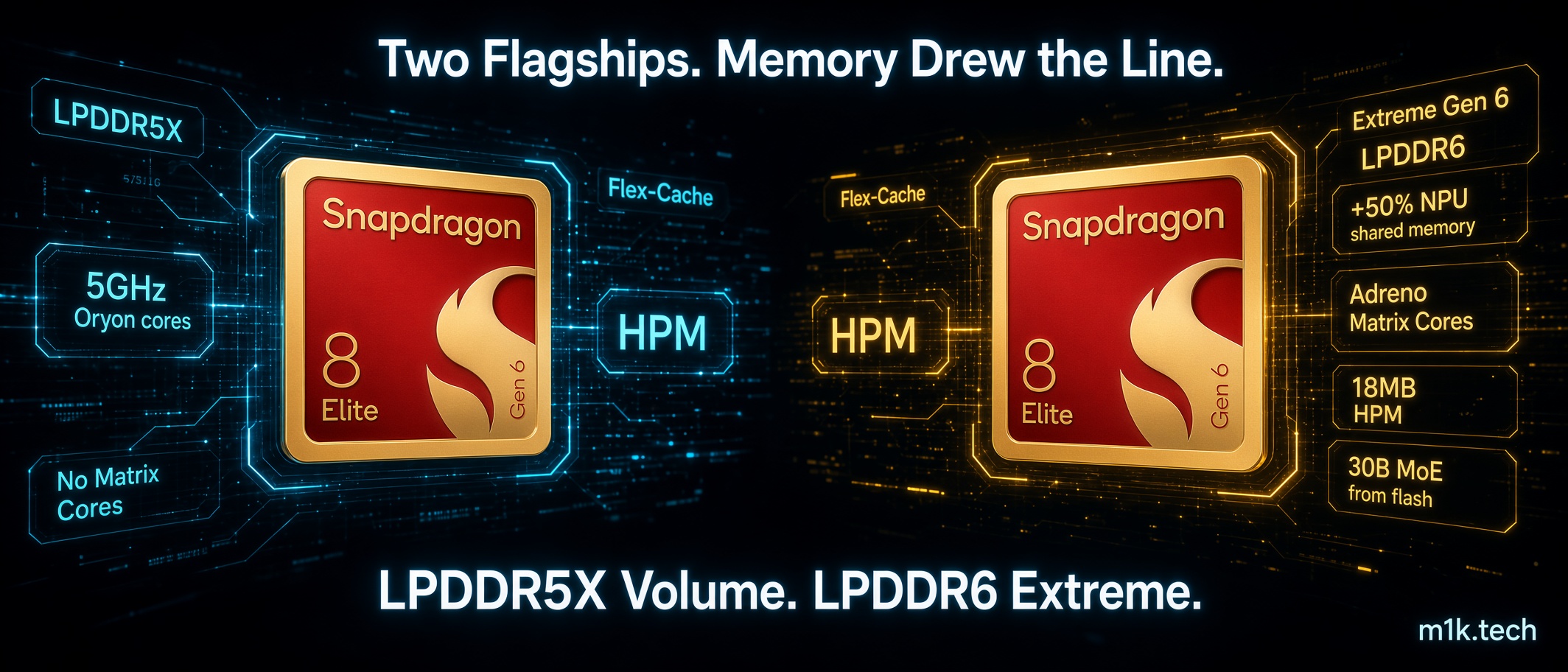
That explanation is true as far as it goes. It just leaves out the column on the spec sheet that I think actually drew the line. The Extreme supports LPDDR6. The plain Gen 6, according to the spec breakdowns circulating today, stays on LPDDR5X. You don’t need a market research subscription to see why that matters in September 2026. LPDDR contract prices have been climbing for two quarters, flagships have been quietly sliding from 16GB to 12GB, and the Poco F9 Ultra skipped an entire Snapdragon generation with Poco’s own product manager blaming memory costs out loud. Today’s business coverage framed it against a smartphone market contracting because of memory prices, and that’s the right frame. A single flagship built around LPDDR6 would have forced every OEM on the list to eat the most expensive memory bill in the industry or skip the generation, Poco-style. Two flagships let Qualcomm sell the halo and the volume part separately, and let the “Extreme” name carry the marketing while the unbranded Gen 6 carries the unit count.
Xiaomi’s Adam Zhang gave away the whole product definition in one sentence without meaning to. The Xiaomi 18 Pro Max and its Extreme chip, he said, have the same Qualcomm CPU and GPU architecture and the same 5GHz clock as the Gen 6 in the 18 Pro, “but with stronger AI and a more powerful cooling system.” Same cores, same frequency. What you pay extra for is AI capacity, which in 2026 is mostly a polite way of saying on-chip memory, the bandwidth to feed it, and the thermal headroom to keep it at peak. Here’s how the two chips line up on paper, using Qualcomm’s own generation-over-generation claims against last year’s 8 Elite Gen 5:
| Snapdragon 8 Elite Gen 6 | Snapdragon 8 Elite Extreme Gen 6 | |
|---|---|---|
| Part number | SM8950 | SM8975 |
| Process | TSMC N2P (2nm) | TSMC N2P (2nm) |
| CPU | 2x Prime @ 5.0GHz + 6x Performance @ 4.0GHz, 16MB Oryon Flex-Cache | Same |
| CPU vs Gen 5 | +10% performance, +37% efficiency | +13% performance |
| Hexagon NPU vs Gen 5 | +14% performance, +20% perf/W | +35% performance, +33% perf/W, +50% Large Shared Memory |
| On-device models | 32K-token context, Element Accelerator | Adds 30B-parameter MoE models streamed from flash |
| Adreno GPU vs Gen 5 | +35% performance, +40% efficiency | +44% performance, +40% efficiency |
| Adreno Matrix Cores / Neural Fusion | No | Yes, 18MB second-gen High Performance Memory |
| Memory support | LPDDR5X | LPDDR6 |
| Video capture | 8K30, 4K120 slow motion | 8K60, 4K240 slow motion, APV codec |
| Connectivity | X105 modem (Release 19, NR NTN satellite), FastConnect 8800 Wi-Fi 8 | Same |
| First phones | Xiaomi 18 Pro | Xiaomi 18 Pro Max, Motorola Signature 27 |
Read down the Extreme column and the pattern is hard to miss. Nearly everything that reduces pressure on external DRAM, the extra Large Shared Memory in the NPU, the Matrix Cores that keep neural rendering inside the GPU’s own memory, the ability to page a 30-billion-parameter model out of flash, sits in the Extreme column. The keynote presented the 50 percent shared-memory bump as a platform feature, and I only caught that it belongs to the Extreme when I lined the spec sheets up side by side. I argued last week that every one of the three engines Qualcomm previewed before Maui was an argument about memory. Today confirmed it and added a twist I didn’t expect: Qualcomm decided to charge extra for the memory-saving features.
The CPU is the one engine where the two chips really are identical. Qualcomm’s third-generation mobile Oryon has two Prime cores that hit 5.0GHz, the first mobile cores to cross that line, and six Performance cores at 4.0GHz, with no efficiency cores anywhere. The more interesting change is Oryon Flex-Cache, a single 16MB L2 pool shared across all eight cores and allocated dynamically rather than split into fixed per-cluster slices. Patrick pitched it as an agent feature, and there’s something to that: an agent loop is a mess of short, bursty work that hops between threads as it reasons, calls a tool, pulls context and hands off to the NPU, and a shared pool means a thread that migrates across the complex doesn’t land cold. But the bigger reason is the same reason as everything else today. Every hit in a 16MB pool is a trip to DRAM that never happens, and in a year when DRAM is the expensive part of the phone, cache is the cheapest memory you can buy. Qualcomm claims 10 percent more CPU performance and 37 percent better efficiency on the Gen 6 versus Gen 5, and 13 percent more performance on the Extreme. That 37 percent is the number I’d frame, not the clock.
The Hexagon NPU gets a new block Qualcomm calls the Element Accelerator, support for context windows up to 32K tokens, and up to 80 percent faster prefill on select models. Prefill is the part of inference where the model reads your prompt and your context before it writes a single token, and for an agent that has to swallow a calendar, an email thread and a screen’s worth of UI before it acts, prefill is most of the wait. So that 80 percent figure matters more to the agent pitch than the headline TOPS ever did, and “select models” is doing a lot of work in that sentence. The Extreme’s NPU adds 35 percent more performance and 33 percent better performance per watt over Gen 5, against 14 and 20 percent on the regular Gen 6.
Then there’s the claim that made me sit up: the Extreme can run 30-billion-parameter mixture-of-experts models directly from flash storage, using UFS 5.0 and what Qualcomm calls an intelligent flash-to-memory management system. A mixture-of-experts model only activates a small slice of its parameters for any given token, which is why Apple could ship a 20-billion-parameter MoE model at WWDC in June without needing 20 billion parameters’ worth of RAM. Streaming the experts in from storage instead of holding them all in DRAM pushes that idea one step further. The flash is standing in for memory you can no longer afford to put in the phone. It’s clever, and it’s the clearest single piece of evidence today that Qualcomm designed this generation around a RAM shortage. What Qualcomm didn’t give is a tokens-per-second figure for a 30B model while experts are paging in from storage, and that’s the only number I care about here. A model that takes twenty seconds to answer correctly is still a demo, and nothing said today tells me which side of that line this lands on.
I’d been waiting for the GPU story since September 2. When Qualcomm previewed Adreno Neural Fusion, I wrote that the 18MB of memory sitting next to the new Matrix Cores was last year’s number, and that the question I actually wanted answered in Maui was what happens on Adreno hardware without Matrix Cores, because the install base decides whether studios bother. Today’s answer is worse than I expected. Matrix Cores and Neural Fusion are Extreme-only. That means this year’s own non-Extreme flagship joins the fallback pile, alongside every Gen 5 and older Adreno in circulation. A studio deciding whether to integrate Neural Fusion now has to justify it on the slice of the Android high end that buys Pro Max and Ultra tiers, in the first year, before most of the world even sees these chips. That’s a tough sell no matter how good the upscaler is.
And to be fair, the upscaler might be good. The Extreme’s Adreno claims 44 percent more performance and 40 percent better power efficiency than Gen 5, which Lekha called the largest generational leap Adreno has made, and 35 percent more performance for the Gen 6. Neural Fusion combines AI super resolution with frame generation, claims up to 40 percent power savings in supported titles, and launches with more than 20 games and real engine support: Unreal Engine 5 with Lumen global illumination, MegaLights, Nanite and ray tracing, plus Unity and NetEase’s Messiah engine. Honkai: Star Rail, Diablo Immortal, War Thunder Mobile, Monster Hunter Outlanders, and Neverness to Everness are on the list. The High Performance Memory is now “second generation,” though still 18MB as far as anything Qualcomm published shows, and the 40 percent power figure still comes without a baseline anyone has defined. Against native rendering? Against the previous shader-based super resolution? I asked this three weeks ago, and nothing on stage answered it.
Imaging got its own quiet overhaul, and one sentence in it bothered me more than anything else in the keynote. The Spectra ISP’s new Intelligent Pixel Control carries 16 bits of data per pixel, which Qualcomm says is 256 times the detail of the previous generation, and it works with the NPU to tag what every pixel belongs to: face, hair, food, sky. Then Lekha added that it can go as far as “adding demographic information” while identifying and tracking individuals as they move through the frame. I understand the photographic logic of knowing where skin and hair are for tone mapping. A camera pipeline that assigns demographics at the pixel level is a different kind of feature, and nobody on stage said where that data goes, whether apps can read it, or whether it’s on by default. That’s a question I’ll be asking loudly once the phones ship.
The Extreme finally brings 8K at 60fps to a phone, plus 4K at 240fps slow motion and support for the APV professional video codec; the Gen 6 does 8K30 and 4K120. Both chips decode VVC (H.265’s successor) in hardware, and Qualcomm claims up to 55 percent more battery life during VVC playback. A new offset package-on-package design is supposed to sustain peak performance more than twice as long under heavy load, which is Qualcomm’s way of admitting that a 5GHz core means nothing if it throttles in forty seconds. There’s also the X105 modem, the first ready for 3GPP Release 19, with quad-band GNSS and satellite voice, video and data over NR NTN, and the FastConnect 8800 with a 4×4 Wi-Fi 8 design. I’m leaving the modem for its own post. Satellite voice and video on a mainstream flagship deserves more than a paragraph squeezed into a recap.
The benchmarks came out the same afternoon, from reference devices in a controlled session, and they need a pinch of salt. On the Extreme reference phone, Geekbench 6 landed around 4,377 single-core and 13,363 multi-core, and AnTuTu hit 5,656,347 against 3,463,142 for a Galaxy S26 Ultra on the Gen 5, roughly a 63 percent jump. Android Headlines reported an 82 percent single-core gain over Gen 5 alongside only 6 percent in multi-core and about 22 percent on the GPU, and I don’t believe that 82. Qualcomm claims 13 percent for the Extreme’s CPU. When a third party’s single-core gain is six times the vendor’s number while multi-core barely moves, the likelier explanation is a baseline or version mismatch, not a miracle. Tom’s Guide measured something closer to 16 percent on the CPU, found the Snapdragon edging Apple’s A20 Pro in multi-core, and watched the A20 Pro keep its single-core crown. And the GPU gap between a claimed 44 percent and a measured 22 percent is exactly the kind of thing that sustained-load testing on retail phones will settle. QRD reference devices are always maxed out on memory and thermals. Wait for the Xiaomi units.
The part of Day 1 that I think will matter most in three years got about four minutes and zero numbers. Amon called it High Bandwidth Compute: a technology Qualcomm built for its data center push, “a new engine that connects memory and the accelerator,” now scaled down into a co-processor that sits alongside Snapdragon in a phone. He said it’s headed to laptops, glasses, cars, and edge devices after that, and told the audience to watch Mobile World Congress for the real reveal. No bandwidth, no capacity, no process node, no first device, no date. I don’t love announcing a part with no spec, and I’d normally file this under keynote theater. What stops me is the context. Qualcomm just signed a $60 billion AI chip deal with Amazon that it paid for with a $4 billion stock warrant, which means its data center memory-and-accelerator work is real enough for a hyperscaler to bet on. If HBC is what its name suggests, some form of wide, close-coupled memory attached to an AI accelerator inside a phone, it’s the logical end point of every trend in this post. It’s also a new component that adds bill-of-materials cost in a year when OEMs can least absorb it. March will tell us which of those matters more.
Amon’s pitch, the one all of this silicon exists to serve, is simple to say and hard to deliver: we’re moving from apps to agents. The phone doesn’t disappear; it becomes the hub, the device that knows you best and carries the context every agent needs, while watches, glasses, PCs and cars become endpoints. The agent perceives, reasons, plans, remembers, and acts on your behalf, with your permission. Amon’s best line was also his most accurate one: “The best AI is not AI that is going to ask more of you. It does more for you.” And the criterion he gave for when people will actually hand a task to an agent is the most useful thing anyone said all day. Using the agent has to be easier than doing it yourself. He compared it to how e-commerce moved from laptops to phones because the phone had less friction, and I think that’s exactly right. It’s also the standard most agent demos still fail, including today’s, where half the tasks took longer to narrate than they would have taken to tap.
Qualcomm backed the vision with two numbers. Don McGuire, the CMO, opened the day by saying 70 percent of consumers are interested in a personalized agent and 66 percent want multiple devices built around one, with no source given for either. And Amon said future agentic devices may process up to a million tokens a day on-device while still lasting all day. The million-token figure I’ll take seriously once someone measures it on a retail phone doing real work, because the whole point of Flex-Cache, the Element Accelerator and flash-streamed MoE is to make that number survivable on a battery.
The feature that makes the agent personal is the one I’m least comfortable with. The next-generation Qualcomm Sensing Hub uses a dual micro-NPU design that Qualcomm says delivers 85 percent more performance at 20 percent less power, runs small models up to around 200 million parameters, and stays awake listening for voice activity and personal context without waking the main processor. On top of it sits Personal Scribe, which can, at your direction, index your conversations, identify the individual speakers, and organize what they said into a private knowledge graph on the device. “At your direction” covers the owner. It doesn’t cover the colleague across the table, the friend at dinner, or the doctor in the exam room, none of whom agreed to be indexed, and I’ve watched this exact argument turn into litigation on glasses already, where the Meta AI glasses lawsuit just added bystanders who never owned a pair. On-device processing beats shipping audio to a cloud, but it does nothing for consent, and a phone that’s always half-listening is a much bigger surface than a pair of glasses.
Google’s presence on stage explained who really owns that context. Osterloh brought the growth numbers: token usage up seven times year over year, Gemini at a billion monthly users (the fastest product to that mark in Google’s history, he said), a billion people a month using AI Mode in Search, and Google Cloud growing 80 percent last quarter. Gemini is being rebranded as “Gemini Intelligence,” which Google describes as moving from an operating system to an intelligence system, rolling across phones, the new Googlebooks, glasses and cars. And when Amon asked how Gemini makes experiences personal, Osterloh said Google is “blessed to be able to have so much information about our users.” He meant it warmly. I heard the business model. Qualcomm can build the most efficient agent silicon on earth, but on Android the agent’s memory of you lives in Google’s layer, and every personal feature in this keynote runs on top of that relationship.
Mastercard was the ecosystem partner I didn’t expect, and it made the most coherent case of the morning. Its CEO appeared by video to say the company is building “the trust layer for agentic commerce,” and Raja Rajamannar followed on stage with the clearest description of the problem I’ve heard from anyone. Discovery is discretionary, he said: if an AI gives you a bad answer, you curse it and ask another one. A purchase is final. When you let an agent buy, you’re delegating authority, and that requires a different order of trust, especially with deepfakes and new kinds of fraud rising at the same time. Mastercard’s answer is its brand and its authentication rails; Qualcomm’s is device-level security that keeps credentials and identity safe even if the phone is stolen. Both are real contributions. Neither addresses the problem that opened this post. Mastercard can make sure the payment is really you. Nobody on stage said who makes sure the recommendation is really for you, and an agent that tells you rival processors “just wouldn’t keep up” is the answer to that question nobody should want.
Xiaomi got the loudest OEM slot of the day, and earned it as the first company in the world to launch both chips, the Xiaomi 18 Pro on the Gen 6 tuned for efficiency and the 18 Pro Max on the Extreme tuned for peak performance, with both launching in Beijing at 7 PM local time on Wednesday. Zhang claimed that joint tuning between HyperOS 4 and the Gen 6 on scheduling, memory management, and the app runtime cut single-frame power by 38.1 percent in one heavy mobile game, which is the kind of oddly precise number I’d like to see reproduced. The rest of the phone is a Leica dual 200-megapixel camera system, a new smart back display and a Hyper RGB privacy display, with a global rollout promised later this year. What I find more interesting than any of it is the context: Xiaomi is also the company shipping its own Xring O3, a ten-core chip with no efficiency cores, and it still lined up to be Qualcomm’s global debut partner for both flagships. Zhang reminded the room that the relationship goes back to 2011 and the Mi 1 on a Snapdragon S3, and that a Snapdragon 8 Gen 3 now runs the cabin in the new SU7. Xiaomi’s own chips hedge the relationship; they clearly haven’t replaced it.
Motorola brought the first announced phone on the Extreme, the Motorola Signature 27, and it’s a serious spec sheet. Sony’s Lytia 910 sensor at 50 megapixels with a claimed 17 stops of dynamic range, a 200-megapixel periscope telephoto, Bang & Olufsen audio, six antennas that Motorola says deliver 25 percent faster downloads, seven years of OS updates, and Gemini Omni and Lyria built in for video creation and soundtracks. The cooling system, which Motorola calls ArcticMesh, stacks diamond-infused thermal gel, a 3D vapor chamber 40 percent larger than before, liquid metal, and copper mesh, which shows how seriously OEMs are taking a 5GHz part in a pocket. It’s coming to the US, with no price or date. I’ll note, as I did when GrapheneOS picked a Motorola flagship for 2027, that Motorola’s actual American volume lives in the Moto G line and not here. The Signature 27 is a statement phone, and a statement about who Qualcomm’s friends are this year.
Sergio Buniac got the least applause of any announcement and deserved more. Motorola’s former CEO walked on stage as Qualcomm’s new Group General Manager of Mobile Computing and XR. Amon made a point of noting they’re both from Brazil. Buniac said he expects Snapdragon to go from hundreds of millions of devices to billions in a short time, which is the kind of line new executives are contractually obliged to say. Last year the mobile keynote at this event came from Alex Katouzian, who carried a similar-sounding group title; this year Chris Patrick gave it and Buniac arrived with the new one. Nobody explained the reshuffle on stage, and I’m not going to guess. I’ll just point out that the loudest Extreme launch partner on Day 1 is the company Qualcomm’s new mobile chief used to run, and in an industry this small, that’s less a scandal than a Tuesday.
Honor showed up on video with its “AI robot phone,” which smiles at you and dances when you play music, and which Honor called a “new species.” I’ll believe it’s a category when someone uses it for a week. The part of Honor’s segment worth watching is the claim that its YOYO agent on the upcoming Magic 9 series handles tasks of more than 100 steps, and the ARRI LogC3, ARRI Looks and Cinema Mode integration, which is the first time ARRI’s color science has landed on a phone. Honor also said to stay tuned for “September 20,” which was two days ago, so I’m assuming a slip.
The official list of OEMs committed to the two chips is Honor, iQOO, Motorola, Nubia, OnePlus, OPPO, REDMI, RedMagic, vivo, Xiaomi, and ZTE. Samsung is not on it. Everyone assumes the Galaxy S27 Ultra will carry an Extreme in early 2027, and it probably will in some markets, but it’s worth remembering that Samsung has been telling anyone who’ll listen that its 2nm Exynos 2700 beats this chip in multi-core, and that Qualcomm still hasn’t agreed to Samsung Foundry’s 2nm price even with yields past 70 percent. Both chips announced today are TSMC parts. Samsung is both a Qualcomm customer and a foundry Qualcomm just turned down on price, and its absence from a Qualcomm launch list is a little more pointed than usual.
Googlebook landed the day before the Summit, and it’s the one launch this week that made me frown at the chip name. Google’s new Android 17 laptop category, built around Gemini Intelligence with native Android apps and features called Cast my Apps, Magic Pointer, and Rambler, debuts on Snapdragon, with Dell and HP opening preorders immediately. The Dell XPS Googlebook has a 13.4-inch 2880×1800 OLED, 16 or 32GB of LPDDR5X, and a lid Glow Bar; HP’s Googlebook 14 runs the 12-core chip with 32GB. Both use the Snapdragon X Elite, the X1E-80-100. That’s the 2024 part. Not the X2 Elite that ASUS just shipped in a retail mini PC, not anything announced this week. Acer, ASUS, and Lenovo went with Intel Panther Lake for their Googlebooks, and Lenovo added a MediaTek Kompanio detachable, so Qualcomm is one of three silicon suppliers on a platform it spent Day 1 describing as a shared vision. Code in the Chromium tree also points to Snapdragon X Plus Googlebooks aimed at roughly $599 to $799. I read all of that as Googlebook being engineered around cost and software maturity, with a two-year-old Arm chip as the safe bet for Android 17 on a desktop. It’s a defensible decision, just less flashy than the keynote implied, and I expect Kedar Kondap’s PC keynote tomorrow to explain where the X2 fits.
Twenty-three million Snapdragon Insiders was the first big number of the day, and the branding segment it opened turned out more revealing than it was meant to be. Qualcomm says its creators reached a combined 405 million people in the past year, and McGuire argued that people are 12 times more likely to watch a creator test a device than read its specs, and that 92 percent of tech buyers trust peer recommendations over traditional marketing. The Manchester United and Mercedes Formula 1 sponsorships got pitched as the way into culture, backed by Qualcomm’s own survey numbers: 89 percent of Man United fans with a Snapdragon phone would recommend it, and 70 percent of F1 fans say they’d recommend Snapdragon to a friend. McGuire also said he wished United would win more, which got the biggest laugh of the segment and is the one claim from this morning I can independently verify. The “Extreme” name belongs in this story too. For twenty years Qualcomm has tried to make a component brand matter to people who buy a Xiaomi or a Motorola, and “Extreme” is a consumer word, not an engineering one. Now put that next to the agent demo. If agents start choosing products on our behalf, the audience that matters for a component brand stops being the fan in the stadium and starts being whoever trains the agent.
Qualcomm’s answer to that, at least on the developer side, is Modular. Amon closed his keynote by confirming Qualcomm is open-sourcing Mojo and MAX, the programming language and inference stack it got in the Modular acquisition, and pitching them as a way to build and optimize AI across any hardware, not just Snapdragon. He was explicit that the goal is a platform for “all of the other semiconductor companies” too. That fits the argument I made when I wrote about Qualcomm’s AI pivot beyond Snapdragon: you can’t out-lock-in Nvidia from behind, so you try to own the neutral layer instead. Chris Lattner, who built LLVM and Swift before Mojo, gets his own session tomorrow, and that’s where we’ll find out whether “open” means a real community or a well-documented on-ramp to Snapdragon.
MediaTek got to 2nm first, and that’s where any fair read of Qualcomm’s market position has to start: the Dimensity 9600 Pro shipped on TSMC’s 2nm process on September 15, a week before Maui, and MediaTek already owns most of the Chinese flagship volume Qualcomm doesn’t. Apple’s A20 Pro still wins single-core and, by the early numbers, the GPU. Samsung wants to put its own 2nm silicon in the Galaxies that used to be Qualcomm’s most reliable Western volume. Against all of that, Qualcomm walked out of Day 1 with the broadest OEM list in Android, the first 5GHz mobile CPU, a credible gaming stack if studios bite, the Google partnership in its strongest form in years, and a product structure designed for a memory crisis rather than pretending there isn’t one. I’d rather be holding that hand than MediaTek’s, even though MediaTek got to the node first.
Xiaomi’s Beijing event is tomorrow evening China time, and a pile of Chinese launches from OnePlus, iQOO, vivo, RedMagic and the rest will follow over the next several weeks. The Motorola Signature 27 has “coming to the US” and nothing else yet. Then there’s a long quiet stretch where reviewers finally run sustained-load tests on retail units, and we find out whether that 44 percent GPU claim survives a twenty-minute Genshin session. Samsung’s decision lands sometime around the turn of the year. HBC gets its real introduction at MWC in March. My bet, and I’ll own it if I’m wrong, is that the plain Gen 6 ends up shipping in more phones than the Extreme outside China’s Pro Max and Ultra tiers, that the Extreme becomes the halo chip the “for Galaxy” bins used to be, and that at least one major OEM ships a Gen 6 phone at a lower price than its Gen 5 predecessor, just to prove the split was worth it.
I left Day 1 impressed and a little irritated. The engineering is real, and the split is a smart answer to a bad memory market. What irritates me is where the line fell. The features I found most interesting- the Matrix Cores, Neural Fusion, the extra on-chip memory, the 30B model streaming from flash- are exactly the ones Qualcomm fenced behind the more expensive tier, which means the best ideas in this generation will reach the fewest people in its first year. And the agent vision is running ahead of the trust it keeps saying it needs, with an ISP that tags demographics, a Sensing Hub that indexes other people’s voices, and a demo agent that sells its sponsor’s chips. Qualcomm never said what an Extreme costs compared with a Gen 6. That number decides whether today was a product strategy or a price increase wearing a new name, and the first real clue arrives with Xiaomi’s price tags tomorrow night.
Sources
- Investing.com, Qualcomm at Snapdragon Summit 2026: pushing into the agentic age (full Day 1 transcript), 22 September 2026
- The Verge, Qualcomm Snapdragon 8 Elite Extreme Gen 6, 22 September 2026
- TechRadar, Qualcomm just announced the Snapdragon 8 Elite Gen 6 and 8 Elite Extreme Gen 6, 22 September 2026
- CNBC, Qualcomm releases Android chip built for AI amid memory shortage, 22 September 2026
- TechCrunch, Qualcomm launches two new smartphone chips with emphasis on AI, 22 September 2026
- Android Headlines, We benchmarked the Snapdragon 8 Elite Gen 6, 22 September 2026
- Tom’s Guide, I tested Snapdragon 8 Elite Extreme Gen 6, 22 September 2026
- Motorola, Motorola Signature 27, 22 September 2026
- Pulse 2.0, Qualcomm unveils two Snapdragon 8 Elite Gen 6 chips and Snapdragon X Elite-powered Googlebook laptops, 22 September 2026
- Chrome Unboxed, Dell’s more-affordable Snapdragon X Plus Googlebook lineup comes into focus, September 2026
- Converge Digest, Qualcomm Snapdragon Summit 2026: agentic AI and HBC, 22 September 2026