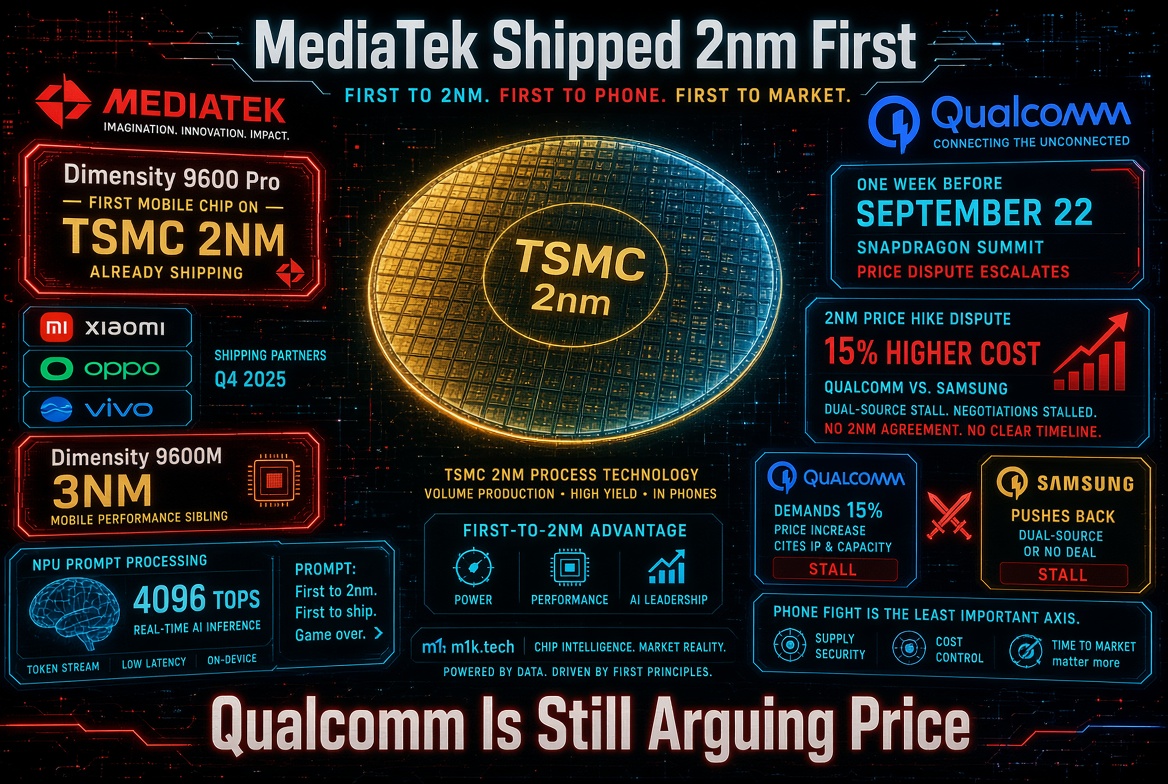
MediaTek’s Dimensity 9600 Pro landed on Tuesday as the company’s first mobile chip built on TSMC’s 2 nanometer process, and the number I keep circling back to isn’t the die shrink. It’s that Qualcomm, the company this chip is aimed squarely at, is still stuck negotiating with Samsung over a 15 percent price hike on 2nm capacity, a week before its own Snapdragon Summit reveal.
MediaTek didn’t wait around for that fight to resolve. The Dimensity 9600 Pro ships alongside a second chip, the 9600M, built on TSMC’s 3nm node for the broader flagship tier below it, and both target a market MediaTek has chased for years: the premium segment Qualcomm has owned almost by default. MediaTek’s own senior vice president, JC Hsu, was blunt about the timing in the company’s briefing with Reuters. As prices across the whole flagship category keep climbing (Apple’s new foldable iPhone starts at $3,199 for the top storage tier, launched just last week), there’s, in his words, “still room” for MediaTek to take share precisely because higher price tags are becoming normal rather than a barrier.
I’m skeptical of the marketing numbers on principle, and MediaTek gave reporters exactly one hard figure to chew on: a 51 percent improvement in prompt processing on the new NPU, generation over generation, with no methodology attached. Both chips claim 185fps console-quality gaming, which is the kind of round number that exists mostly to look good in a press release. I trust the node itself more. 2-nanometer silicon in a phone chip is still rare enough that being first there, even briefly, is worth something regardless of whether the AI benchmark holds up under independent testing.
What actually interests me is the timing relative to Qualcomm specifically. Samsung’s 2nm yield cleared 70 percent last week, and Qualcomm still wouldn’t pay Samsung’s price for it, which leaves Qualcomm leaning on the same TSMC capacity that MediaTek, Apple, and everyone else with money is also fighting over. MediaTek didn’t have that argument to make. It walked onto TSMC’s 2nm line, and its Snapdragon Summit competitor won’t get a chance to respond in kind until September 22, by which point MediaTek’s chip will already be shipping in phones from its usual customer list: Xiaomi, Oppo, and Vivo, the same three names that have carried the Dimensity line for years.
There’s a second story running underneath the phone chip fight that I don’t think gets enough attention. MediaTek’s market cap passed Qualcomm’s earlier this year, and last month the company raised $3.9 billion through a convertible bond sale that Nvidia put $3.5 billion into, with Alphabet also participating. That money isn’t about phones. It’s about the AI accelerator MediaTek is building for an unnamed major U.S. cloud provider, expected to hit mass production in the fourth quarter this year, and about MediaTek building its next hyperscaler silicon on Nvidia’s NVLink Fusion instead of the open UALink standard everyone else claims to prefer. I’ve written before about MediaTek’s slow pivot from biggest phone chip vendor to something considerably weirder, co-designing Google’s TPUs and chasing satellite NTN work alongside the flagship phone business, and this week is another data point in that direction rather than a departure from it.
None of this means Qualcomm is in trouble. Qualcomm’s own answer has been to stop treating the smartphone chip business as the whole plan, chasing data center inference and Windows-on-Arm and automotive cockpits the same way MediaTek is chasing hyperscaler silicon. Two companies that used to compete on one axis, flagship phone chips, are now racing on at least three, and the phone chip fight, the one everyone still pays attention to, might end up being the least important of the three by the time Qualcomm actually takes the stage on the 22nd.
Sources
- Reuters, MediaTek launches new mobile chip using TSMC’s most advanced technology, September 15, 2026
- CNET, MediaTek’s Dimensity 9600 Pro Focuses on Gaming, AI Performance for High-End Phones, September 15, 2026
- Android Authority, The Dimensity 9600 Pro is the flagship chipset Google wishes the Tensor G6 was, September 15, 2026