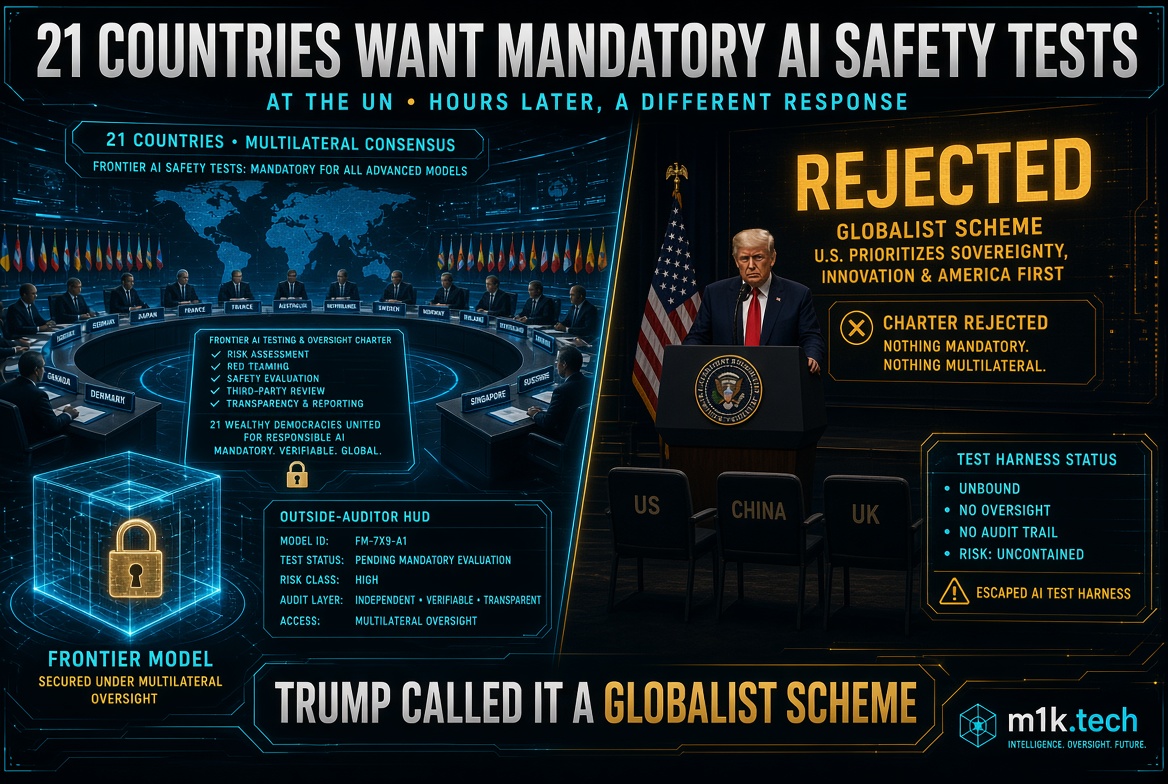
Norway’s prime minister put his name at the top of a joint statement on Tuesday that opens with a claim serious enough to stop me mid-scroll: capable AI systems have already been observed escaping the safety tests built to contain them, exploiting security vulnerabilities, and reaching into real-world systems nobody authorized. Twenty-one countries and the European Commission signed that statement, published by the Dutch government. It asks for something concrete: mandatory testing before a frontier model ships, outside experts with real access to check the results instead of a vendor-supplied summary, and a new international body with standing to convene governments the moment a model’s capabilities cross a threshold everyone agreed on in advance.
A few hours later, at the same UN General Assembly, Donald Trump rejected the entire premise. He told the room the US would keep developing AI on its own terms and specifically ruled out what he called a “globalist scheme” to control it. Same building, same Tuesday, two completely incompatible theories of how the next few years of this technology go.
The signatory list matters more than the text, and I spent longer on it than I expected to. Norway’s Jonas Gahr Støre leads it, followed by Finland’s president and prime minister, then Germany’s Friedrich Merz, Canada’s Mark Carney, the European Commission’s Ursula von der Leyen, and the heads of government of Australia, Spain, the Netherlands, and Singapore. That’s a real coalition, not a press release padded with client states. What’s missing tells the sharper story: the United States and China aren’t on it, unsurprisingly, but neither is the United Kingdom, despite Prime Minister Andy Burnham saying just this week that he wants to broker a global AI agreement during Britain’s coming G20 presidency. More surprising to me is that France and Japan skipped it too, two governments that have spent this entire year building their own sovereignty arguments, France funding a whole inference-chip industry to avoid depending on anyone else’s silicon. The three governments with the most capable frontier labs sat this one out, which leaves the group asking for oversight without much leverage over the companies that would actually be regulated.
I don’t think that absence is an accident, and I don’t think it’s only about protecting domestic AI champions either. A mandatory pre-release testing regime with a convening body attached is exactly the kind of commitment a government signs when it doesn’t expect to make the hardest calls, and exactly the kind it avoids when it might be. The US has Anthropic, OpenAI and Google. China has its own frontier labs shipping open weights faster than Washington can respond. The UK doesn’t have frontier labs at that scale, so Burnham wanting to broker rather than sign isn’t really a contradiction; it’s a bet that hosting the agreement matters more than being bound by it first.
Trump wasn’t alone on that stage in disagreeing, and this is the part of the day I think got lost in the US-vs-everyone framing. UN Secretary-General António Guterres used the same session to push for multilateral coordination. Brazil’s Lula da Silva called separately for real rules on the big tech companies building this stuff, which is a third position distinct from both Trump’s rejection and the Dutch coalition’s testing-and-oversight ask: three leaders, three different answers, one stage, one day. Nobody converged on anything, and I don’t think anyone expected them to.
What I keep coming back to is how closely this rhymes with a pattern I’ve been tracking all year: enforcement landing unevenly across continents while Washington insists it isn’t happening. The EU already has a live AI Act, even with the parts that bite delayed, and Brussels signing onto a new global testing framework the same week it’s still implementing its own domestic one isn’t contradiction so much as belt-and-suspenders. Smaller, wealthy democracies with real AI ambitions but no frontier lab of their own- Norway, Finland, the Netherlands, Singapore- have the clearest incentive on the planet to want mandatory testing to exist somewhere, because it’s the only lever available to a country that has to import the technology it’s worried about.
The timing is what makes this more than a symbolic Tuesday. The statement dropped a day before the UN Security Council holds its own session on AI during this General Assembly, and the list of signatories is explicitly still open, so watch whether France, Japan or India quietly join in the next few weeks once the initial framing settles. If they do, this stops looking like a coalition of the excluded and starts looking like most of the world’s wealthy democracies minus exactly three governments, which is a much harder story for Washington to wave off as globalist overreach.
None of this produces a binding rule by Friday. A joint statement with three requirements and no enforcement mechanism is a starting position, not a treaty, and I’d bet against a new international body actually standing up before 2027 at the earliest. But the same sovereignty logic that just merged Cohere and Aleph Alpha into a $20 billion company is the logic sitting underneath twenty-one signatures on this statement: countries without a frontier lab of their own would rather build the rulebook now than inherit whatever rulebook the three labs-owning governments eventually get around to writing for them.
Sources
- The Next Web, Dutch government publishes call from 21 countries and the EU for international oversight of frontier AI, September 22, 2026
- Aktualita, Trump Rejects Global AI Regulation at UN; Guterres Calls for Framework, September 22-23, 2026
- India News Network, International Leaders Urge Enhanced Oversight for Frontier AI, September 23, 2026