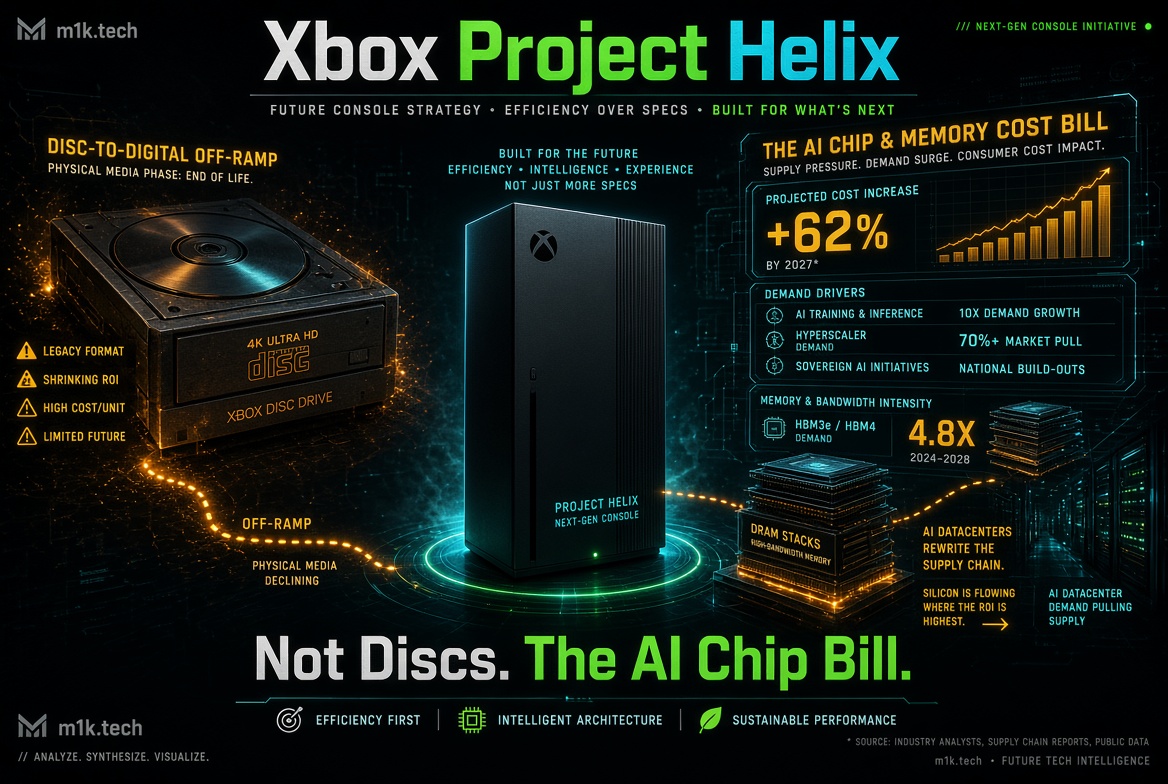
Asha Sharma sat down with the BBC this week to talk about a disc-conversion feature, and ended up saying something more interesting. Xbox’s next console has to be built around an affordability problem the industry hasn’t fully admitted to yet. “This next generation, we have to be thinking about efficiency and affordability alongside performance,” the Xbox CEO said, tying rising hardware costs directly to AI spending eating into the same chip and memory supply that consoles depend on.
That quote is doing more work than the news Xbox actually came to announce. Starting August 31, Xbox Insiders can begin testing a feature that lets players claim a digital entitlement for supported Xbox One and Series X|S disc games just by inserting the disc and launching it once. The disc keeps working exactly as it always has, but the entitlement unlocks Xbox Play Anywhere and Xbox Cloud Gaming where supported. Xbox says it is starting with thousands of titles and will add more over time, though it hasn’t published a list of what qualifies at launch.
Sharma wouldn’t say whether the next-gen console, still going by its Project Helix codename, ships with a disc drive at all. That ambiguity matters more than it looks, because the timing lines up with Sony’s own January 2028 cutoff for pressing new PlayStation discs, plus Grand Theft Auto VI’s confirmed digital-only launch. I already wrote about what it means that the company that mocked Xbox’s always-online DRM in 2013 is now the one closing the loop on physical ownership. Xbox’s disc-to-digital feature reads less like a rescue for physical media and more like a polite off-ramp: bring your old discs in one last time, and you won’t need one again.
The affordability line is the part worth sitting with longer, because it isn’t really about Xbox specifically. I’ve written before about how the DRAM price spike behind this year’s memory shortage is the same story driving layoffs at studios like Halo Studios, both downstream of AI datacenter demand pulling memory and advanced packaging capacity away from consumer electronics. Sharma putting a name to that, on the record, from the person now running the division, is Microsoft admitting in public what its balance sheet already knew after the restructuring that cut roughly a fifth of Xbox’s headcount and divested four studios.
None of this happens in a vacuum. Sony has already won this console generation by a wide margin, and Microsoft made its peace with that outcome back in 2024 when it confirmed former console exclusives would ship on rival platforms. That pivot always looked like Microsoft conceding the box to focus on Game Pass and services instead. What Sharma’s BBC interview adds is the reason the next box, whenever it ships, might not look like a traditional console rivalry play at all. If input costs for RAM and chips stay elevated because AI is still eating that supply, the console that wins isn’t the one with the best specs, it’s the one that survives the bill of materials.
The unresolved question is whether “efficiency and affordability” ends up meaning a genuinely cheaper machine, or just a leaner one that shifts more cost onto a subscription instead of the sticker price. Backward compatibility and digital entitlements are good consumer stories either way, but they are also the kind of feature you lean on hardest when you can’t compete on raw hardware value. Xbox has more digital infrastructure to lean on than anyone else in the console business. Whether that’s a strength or an admission depends on what Project Helix actually costs when Microsoft finally shows it.
Sources
- BBC, Xbox boss ‘thinking about affordability’ of next-gen console, August 26, 2026
- Xbox Wire, Your Discs. Now Also Digital., August 26, 2026
- GamesIndustry.biz, Xbox to let Insiders convert physical game discs into digital entitlements later this month, August 26, 2026