Halo Studios’ layoffs this week, a scrum master here, a Campaign Evolved engineer there, landed exactly seven days after the remake actually shipped and did well. That timing alone tells you these cuts were never about performance. They’re the tail end of the 3,200 jobs Microsoft already said it was cutting across its own studios back in July, split roughly evenly between immediate cuts and a phased wind-down running through mid-2027, and Halo Studios just happened to be next in line regardless of what shipped that week.
It wasn’t the only cut this week. That’s No Moon, the studio building the single-player Crossfire game, trimmed its technical and environmental art teams days after Double Fine cut a quarter of its own staff, another casualty of Microsoft’s post-restructuring shakeout now that Double Fine is independent again. And Devolver Digital’s board is trying to take the company private again, five years after its IPO, citing a blunt mismatch between what public markets expect from quarterly growth and what an indie publisher’s business actually looks like right now. The filing itself names widespread layoffs, platform rationalization, and substantial impairments as the backdrop for the whole industry since 2021, not just Devolver’s own numbers.
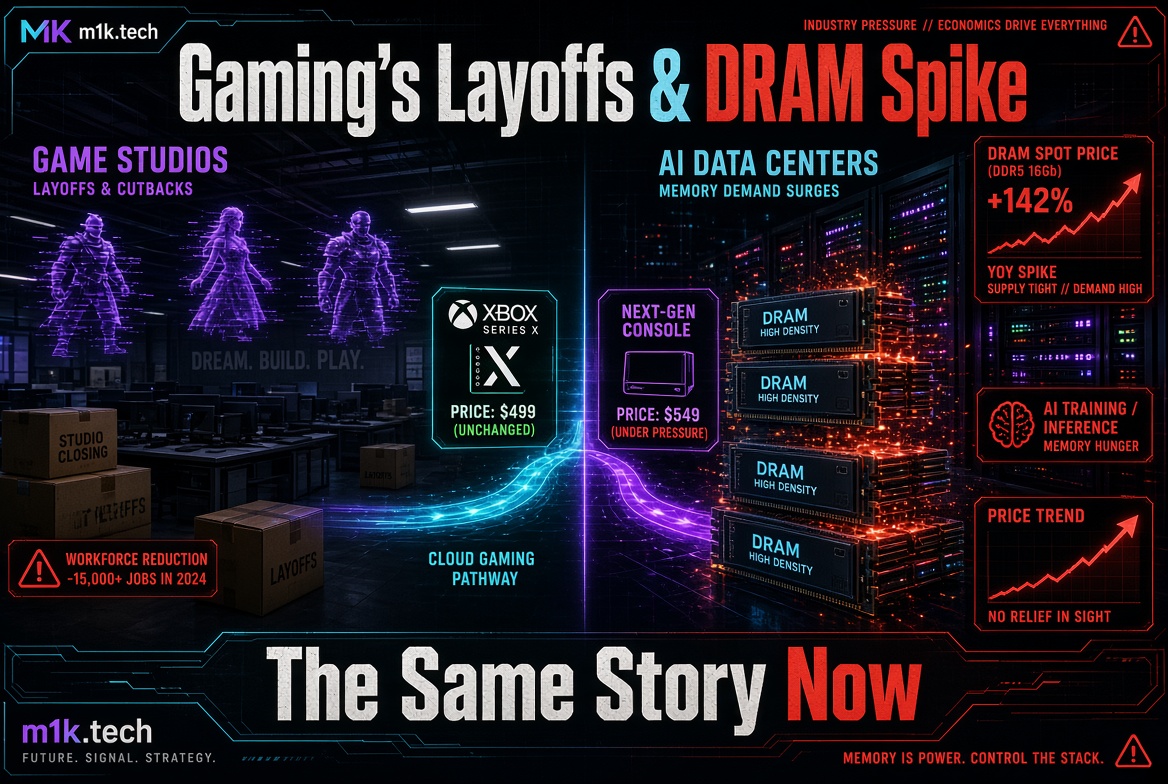
None of that is new, exactly. Gaming has been bleeding jobs in waves since the post-pandemic hiring correction started. What is new, and what I don’t think enough people are connecting yet, is what’s happening to the hardware underneath all of it. An Amazon exec working on cloud gaming, Jeff Gattis, made the case this week that surging DRAM and NAND prices, driven almost entirely by AI datacenter demand eating the same memory supply everyone else needs, are pushing console and PC economics somewhere uncomfortable. The numbers he cited are concrete: Xbox Series X now runs $599.99, up from its $499.99 launch price. Series S at 512GB is $379.99, up from $299.99. Several first-party Xbox titles are reportedly moving to $79.99 this holiday.
I’ve written before about what the LPDDR6 ramp and the general memory oligopoly are doing to phone pricing, and about how a company like CXMT clawing its way into DRAM production is the more consequential story than anyone’s Beijing expansion headline. Gaming is now visibly downstream of the same fight, and it has zero leverage in it. A console maker can absorb a few dollars of BOM inflation for a while. It cannot outbid Nvidia, Microsoft’s own Azure buildout, or Meta for wafer allocation, and at some point that inflation has to land somewhere: the console price, the game price, or the studio’s headcount.
That’s the part that actually connects these stories, even though nobody in either the layoffs coverage or the pricing coverage is framing it that way. Microsoft is simultaneously the company cutting Xbox studio jobs and one of the hyperscalers whose AI infrastructure spend is helping drive the memory prices squeezing the rest of the console business it also owns. I don’t think that’s a contradiction anyone at Microsoft is losing sleep over, the Azure side and the Xbox side don’t share a budget line, but it’s a genuinely strange position for one company to be in from the outside.
Sony seems to be handling this differently, at least for now, mostly by having already won the generation on volume and not needing to defend a struggling third console the way Microsoft is stuck doing. Whether that holds once Sony’s own hardware refresh cycle runs into the same memory market is a different question, and one I don’t have an answer to yet.
What I keep coming back to is that cloud gaming has been the future for about a decade without actually arriving, mostly because the economics never quite worked and the latency never quite disappeared. A memory shortage that makes local hardware genuinely more expensive every single year might be the first real structural argument in its favor that isn’t coming from a company trying to sell you a cloud gaming subscription.
Sources
- Eurogamer / Polygon, “Halo Studios hit by layoffs one week after Campaign Evolved launch,” August 6, 2026
- IGN, “Layoffs hit Crossfire developer That’s No Moon,” August 6, 2026
- PC Gamer, “Devolver Digital wants to get off the stock market,” August 6, 2026
- CGMagazine, “Rising component costs pushing the industry toward cloud gaming,” August 6, 2026