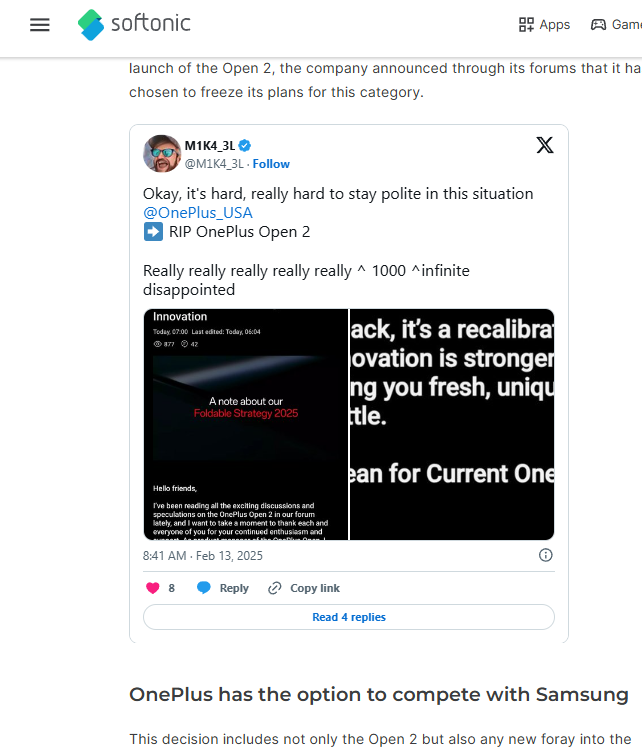
Softonic, the Spanish tech publication with a global English edition, just quoted my tweet in an article about the OnePlus Open 2 cancellation. The piece is titled “The biggest winner of this decision by OnePlus is… Samsung,” and my reaction, the one where I said it is really hard to stay polite about this, is embedded right in the middle as proof of fan disappointment.
I appreciate the quote. I do not appreciate the analysis.
https://en.softonic.com/articles/the-biggest-winner-of-this-decision-by-oneplus-is-samsung
What the article gets right
The Softonic piece correctly identifies that OnePlus has frozen its foldable plans. It correctly notes that the OnePlus Open had an elegant design, a strong camera package, and good battery life. It correctly observes that OPPO’s Find N5, while promising, has limited global availability. These are all true statements, and any tech outlet covering this story would land on the same set of facts.
What it gets wrong
The headline says it all: “The biggest winner of this decision by OnePlus is… Samsung.” That is the lazy take, and I think it is wrong.
The article treats the OnePlus exit as a simple competitive vacuum, with Samsung’s Galaxy Z Fold absorbing the orphaned demand by default. There is no discussion of why OnePlus is actually pulling out (the BBK dissolution, the OPPO group consolidation, the resource-allocation squeeze of running three brands on a single engineering base). There is no examination of what the cancellation signals about the broader OPPO-OnePlus-Realme merger and the structural retreat from Western markets. And there is zero mention of the company best positioned to fill the gap left by OnePlus.
I wrote my own deep dive on the same day I posted that tweet, and my conclusion is that the real winner in the OnePlus exit is not Samsung. It is Motorola.
The Motorola argument Softonic missed entirely
Samsung does not “win” when a competitor leaves the foldable market. Samsung was already the default. The Z Fold has been the only serious book-style foldable in North America for years, and its market position has not been threatened by the OnePlus Open because the Open was never on enough carrier shelves to reach mainstream buyers. Samsung wins by inertia, not by merit.
Motorola, on the other hand, has something OnePlus never built: deep carrier distribution across every major US operator. The Razr Plus 2024 is selling well, the reviews are strong, and the price undercuts Samsung’s flip offerings by a real margin. Motorola already knows how to build foldable hinges and flexible displays. Lenovo’s manufacturing scale gives it the capital and factory capacity to develop a book-style foldable without the internal resource competition that killed the Open 2 inside the OPPO group. A Razr Fold, priced at $1,200 to $1,400 and sold through Verizon, AT&T, and T-Mobile, would pressure Samsung in a way the OnePlus Open never could.
That is the story. Not “Samsung wins by default” but “the gap OnePlus leaves is exactly the right shape for Motorola to fill.” The Softonic article does not mention Motorola once.
The BBK story they did not tell
The deeper miss is structural. The OnePlus Open 2 cancellation is not an isolated product decision. It is a symptom of the collapse of the BBK Electronics empire and the rationalization of the OPPO group into a single operational entity running three brands (OPPO, OnePlus, Realme) on one engine. BBK dissolved in 2023 under regulatory pressure. Realme just returned to sub-brand status under OPPO during CES. OnePlus is losing product lines, losing operational independence, and increasingly becoming a software skin on OPPO hardware.
When you understand that context, the Open 2 cancellation stops being a story about “OnePlus decides not to compete with Samsung” and starts being a story about “a Chinese conglomerate is consolidating under financial and regulatory pressure, and the most expensive product adaptations for Western markets are the first to go.” That is a much more interesting and much more accurate reading of the situation.
On being quoted without context
I want to be fair to Softonic. They saw a tweet with genuine emotion, embedded it, and used it to illustrate how fans are reacting. That is legitimate journalism, and I have no complaint about the embed itself. My name, my handle, my reaction: all correctly attributed.
But a tweet is a reaction, not an analysis. My actual analysis, the one I spent hours researching and writing, reaches a fundamentally different conclusion than the article that quotes me. The irony is that the very tweet Softonic used to support a “Samsung wins” narrative was written by someone who believes the opposite.
This is the thing about being a creator in the tech space: your most emotional, least nuanced take is the one that gets picked up, because it is short, quotable, and fits the narrative someone else is already writing. The longer, harder, more researched take stays on your own blog, where fewer people will see it, but where the argument is actually complete.
I stand by the tweet. I am genuinely disappointed about the Open 2, and I do not plan to be polite about it. But if you are reading this because you saw my quote on Softonic and wanted to know what I actually think, here it is: Samsung is not the winner. Samsung is the incumbent about to face pressure from Motorola, a company with better carrier distribution, stronger pricing instincts, and a foldable track record that is improving quickly. The real story of the OnePlus exit is not who inherits the crown. It is those who have the nerve to compete for it.
Read the full analysis: RIP OnePlus Open 2: The BBK Collapse and Why Motorola Should Fill the Gap.