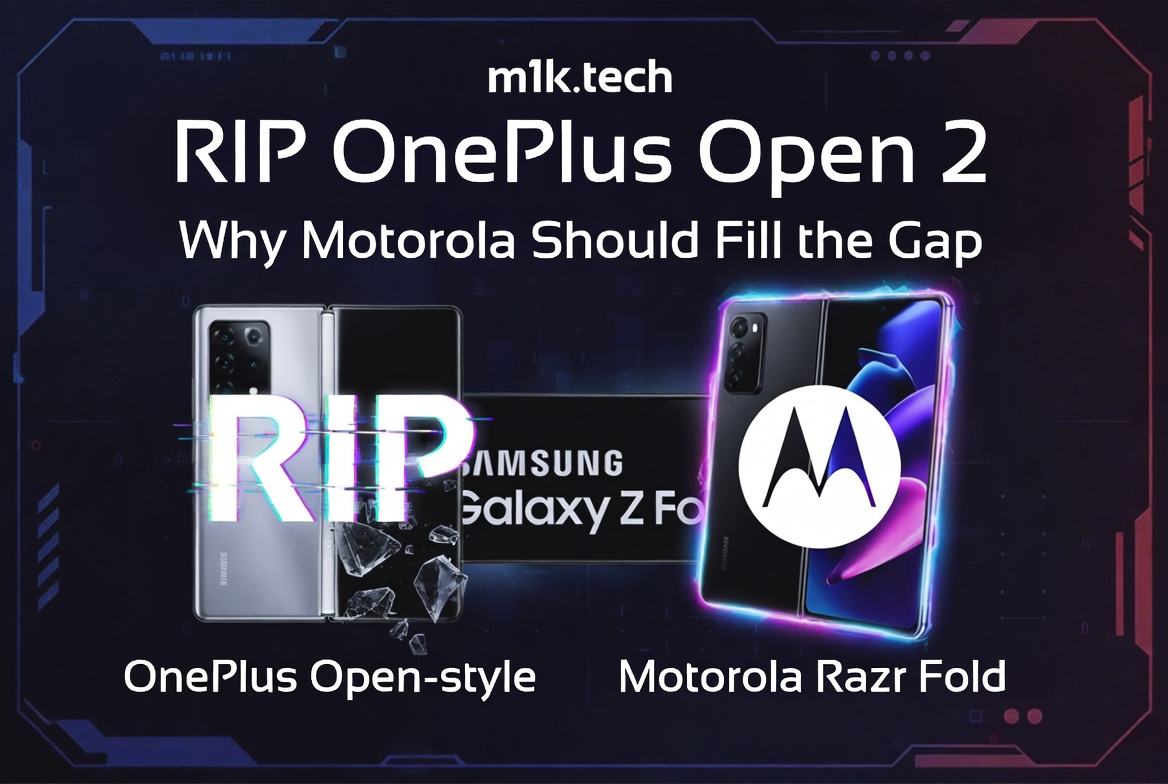
I am going to be honest: I am furious. OnePlus just confirmed on its forums that there will be no OnePlus Open 2 this year, and possibly not ever in the form we expected. The company that built one of the most impressive first-generation foldables I have ever held is walking away from the category. I said it publicly yesterday, and I will say it again here: it is hard, really hard, to stay polite about this.
Okay, it’s hard, really hard to stay polite in this situation @OnePlus_USA
— M1Κ4_3L (@M1K4_3L) February 13, 2025
➡️ RIP OnePlus Open 2
Really really really really really ^ 1000 ^infinite disappointed pic.twitter.com/ctmxiukB8b
But disappointment is cheap. What I actually want to do is understand why this is happening, what it tells us about the real state of OnePlus and the OPPO group, and, critically, who fills the vacuum in a North American foldable market that just lost its most interesting alternative to Samsung.
The OnePlus Open was excellent
Let me be clear about what we are losing. The OnePlus Open was not a tentative first attempt. It launched in late 2023 with a design that was thinner and lighter than the Galaxy Z Fold 5 it competed against, a camera system that actually worked (a rarity for foldables), battery life that held up, and software that felt considered rather than bolted on. It was running on the Snapdragon 8 Gen 2, one generation before the 8 Gen 3 I covered at Snapdragon Summit, and made the case that you could have a book-style foldable that did not feel like a compromise. It was, by most accounts, the best Android foldable that was not made by Samsung.
And now it is dead. Not because it failed on its merits, but because the company behind it lacks the resources to sustain it alongside everything else it is trying to do.
What is actually happening inside BBK and the OPPO group
To understand the Open 2 cancellation, you have to zoom out to the holding company level, and the picture there is much messier than anything OnePlus will say publicly.
BBK Electronics, the Chinese conglomerate that quietly owned OPPO, vivo, OnePlus, Realme, and iQOO, dissolved its corporate umbrella in 2023. The dissolution was driven by regulatory pressure, particularly in India, where the brands were under investigation for tax evasion, and maintaining the fiction that they were “independent” companies was becoming legally untenable. After the split, OPPO, vivo, and iMoo (the children’s smartwatch brand) became the successor entities. OnePlus and Realme remained linked to OPPO, but the organizational chart got deliberately murky.
Fast forward to last month. Just a few weeks ago, during CES 2025, Realme quietly confirmed that it is returning to sub-brand status under OPPO. Sky Li remains CEO, but the brand now sits within OPPO’s management structure, sharing after-sales infrastructure, retail channels, and, inevitably, product development resources. OnePlus already went through a version of this “merger” with OPPO in 2021, when Pete Lau took on the dual role of OnePlus CEO and OPPO chief product officer, and the two companies began openly sharing R&D and supply chains.
What all of this means in practice is that OPPO is now running three brands, OPPO, OnePlus, and Realme, out of the same engineering and manufacturing base, with one leadership team making prioritization decisions across all three. When you run three brands on one engine, something has to give. The Open 2 is what gave.
The resource allocation problem
A book-style foldable is the most expensive, most complex product a smartphone company can build. The hinge engineering alone requires dedicated teams and custom tooling. The displays are bespoke. The software optimization that makes Android actually work across two different screen sizes and orientations is a sustained multi-year investment. Samsung can afford this because the Galaxy Z Fold is a flagship line with massive marketing spend and carrier subsidies across every major market. OPPO can afford it for the Find N series because that product is aimed primarily at China, where OPPO has dominant distribution and brand recognition.
OnePlus cannot afford it because OnePlus is not really OnePlus anymore. It is a brand sitting inside OPPO that has to justify every product line against internal competition. The OnePlus Open was essentially a re-engineered OPPO Find N3, adapted for global markets with a different software skin, tuning, and name. That adaptation layer costs real money: separate software builds, separate carrier certification in North America and Europe, separate marketing campaigns, separate after-sales infrastructure. When the parent company is consolidating three brands into one operational structure to cut costs, the most expensive adaptation, a niche foldable for markets where OnePlus has a single-digit market share, is the first thing to go.
And OPPO has its own foldable to launch. The Find N5 is coming, and early reports suggest it is excellent. But here is the catch: the Find N5 is aimed at China and select Asian markets first. Its global availability is uncertain. The Find N3 barely made it out of China. The pattern is clear: OPPO builds world-class foldable hardware, but the distribution muscle to bring it to North America and Europe at scale simply is not there, and splitting that effort across an OPPO-branded version and a OnePlus-branded version is a luxury the group can no longer justify.
The ripple effect: Europe and North America
The Open 2 cancellation is a symptom of a broader strategic retreat playing out across OnePlus’s global footprint right now.
In North America, OnePlus has always been a niche player. The brand built a passionate community through the “Never Settle” mantra and the flagship-killer era, but it never cracked carrier distribution in the US the way Samsung and Motorola have. The OnePlus Open was sold unlocked and through T-Mobile, but it never had the shelf space or the subsidized pricing that Samsung’s Z Fold gets through Verizon and AT&T. Without a carrier push, a $1,700 foldable is an enthusiast proposition, not a mass-market one.
In Europe, OnePlus has a stronger presence, particularly in the UK, France, Germany, and the Nordics, but it competes against a much deeper bench of Chinese brands (Xiaomi, Honor, Nothing) and Samsung’s overwhelming operator relationships. The Open did reasonably well in Europe, but “reasonably well” for a first-generation foldable from a niche brand does not generate the volume needed to justify a second generation when the parent company is cutting costs.
The consolidation of Realme back into OPPO at CES was not a random move. Realme’s entire distribution in India was already being handled by OPPO Mobiles India. The pretense of independence was expensive. Running separate marketing teams, PR teams, and retail partnerships for three brands that share the same factories and R&D labs is a cost structure that makes sense when you are growing. When growth stalls, the overhead becomes a burden. And OnePlus’s growth has stalled. Its global market share is around 1-2 percent, squeezed between Samsung’s scale advantage at the top and Xiaomi’s price advantage at the bottom.
The OPPO group is, in effect, choosing where to fight. And foldables for Western markets is a fight it is choosing not to have.
So Samsung wins by default? Not so fast.
The lazy narrative writes itself: OnePlus leaves, Samsung’s Galaxy Z Fold is the only book-style foldable left in North America, Samsung wins. I think that narrative is wrong, and the company that should be paying the closest attention right now is not Samsung. It is Motorola.
The Motorola case for filling the fold gap
Here is why I think Motorola, not Samsung, is better positioned to capture the opportunity that OnePlus just abandoned.
First, carrier distribution. Motorola has something OnePlus never had, and Samsung takes for granted: deep, established relationships with every major US carrier. Verizon, AT&T, T-Mobile, and US Cellular: the Razr line is on all of them, subsidized, promoted, and sitting on the shelf next to Samsung’s Galaxy. That carrier infrastructure is the single hardest thing to build in the American market, and Motorola already has it. OnePlus never did, which is a big part of why the Open struggled to reach mainstream buyers despite being a better product than the Z Fold 5 in several respects.
Second, the Razr momentum is real. The Motorola Razr Plus 2024 is legitimately good. The cover screen is more usable than Samsung’s, the price undercuts the Galaxy Z Flip by a significant margin, and the reviews have been overwhelmingly positive. Motorola is proving it can execute on foldable hardware at a competitive price point. The flip phone is the entry drug. A book-style Razr Fold, priced below the Z Fold and sold through those same carrier channels, is the logical next step.
Third, Lenovo’s manufacturing scale. Motorola is owned by Lenovo, which gives it access to a manufacturing and supply chain operation that rivals Samsung’s. Lenovo builds everything from smartphones to data center hardware. It has the engineering depth and the factory capacity to develop a book-style foldable without betting the company on it. OnePlus did not have that independence: every foldable dollar it spent competed against OPPO’s own priorities. Motorola does not have that problem.
Fourth, Samsung is not executing well on foldables right now. The Galaxy Z Fold 6 was a minor update. The crease is still visible. The cameras are still a generation behind the Galaxy S Ultra line. The price is still north of $1,800 at launch. Samsung owns the category by default because nobody else is seriously competing in the US market, not because the Z Fold is the best it could be. A well-priced Motorola book-style foldable, running on the latest Snapdragon, with Motorola’s carrier distribution and a $1,200 to $1,400 price tag, would put genuine pressure on Samsung in a way the OnePlus Open never could because the Open was never on enough shelves.
I want to be careful here: Motorola has not announced a book-style foldable. This is me reading the strategic logic, not reporting a product leak. But the pieces are all there. The Razr flip line proves Motorola can build foldable hinge mechanisms and flexible displays. The carrier relationships are in place. Lenovo has the capital. And OnePlus just vacated the only alternative to Samsung in the North American book-fold market. If Motorola does not move into that space, it is leaving money on the table.
The bigger picture: what the OPPO consolidation means for Android diversity
Step back even further, and the OnePlus Open 2 cancellation is part of a pattern that should worry anyone who cares about competition in the Android ecosystem.
The old BBK model, in which OPPO, OnePlus, Realme, vivo, and iQOO operated as nominally independent brands, created an illusion of diversity. Five brands, five marketing teams, five product lines, but one set of factories and one pool of engineers underneath. That model worked when the smartphone market was growing, and carriers were happy to fill shelves with options. It does not work when the market matures, growth slows, and every brand has to justify its existence against the parent company’s bottom line.
What we are watching now is the rationalization of that empire. Realme folded back into OPPO. OnePlus is being hollowed out from the inside, losing product lines (the Open 2), losing operational independence, and increasingly becoming a software skin on OPPO hardware. Vivo separated cleanly and is doing its own thing, but it barely exists in North America. iQOO is a sub-brand for the Asian market. The net effect is that the number of truly independent Android hardware companies competing in Western markets is shrinking.
Samsung, Google (with the Pixel), and Motorola are the only Android brands with real scale and carrier presence in North America. OnePlus is fading. Nothing is interesting but tiny. Xiaomi does not sell phones in the US. The foldable market, in particular, is becoming a two-player game in the West, and one of those players, Samsung, is not feeling much competitive pressure to innovate.
What happens to the OnePlus faithful
The saddest part of this story is the community. OnePlus built one of the most passionate fan bases in tech through years of “Never Settle,” community-driven product development, and the flagship-killer identity. Those people are now watching the brand they championed get absorbed into OPPO’s cost-optimization machine. The Open 2 cancellation is not just a product decision. It is a signal that OnePlus no longer has the autonomy to make ambitious bets, and that the brand’s identity is being sacrificed on the altar of corporate efficiency.
Some of those fans will move to Samsung. Some will wait and see if OPPO itself brings the Find N5 to global markets. And some, I suspect, will look at what Motorola is doing with the Razr line and realize that the best foldable value in North America is no longer Chinese at all. It is a brand that has been based in Chicago since 1928.
I have owned and covered OnePlus devices for years, and I am watching this with real sadness. The Open was a statement that a smaller brand could out-engineer Samsung on hardware. The cancellation of its successor is a statement that engineering is not enough when the corporate structure behind you is collapsing into a cost-cutting exercise.
The consolidation of the OPPO group is rational. Running three brands on one engine and pretending they are independent was always going to reach its limit. But the cost of that rationalization is innovation at the edges, the weird bets, the ambitious first-generation products, the things that make the Android ecosystem interesting rather than just a Samsung monolith.
If there is a silver lining, it is that the gap OnePlus leaves behind is exactly the right shape for Motorola to fill. A book-style foldable, on Snapdragon, at a human price, sold through every carrier in North America. That is the product the market needs. The question is whether Motorola sees the same opening I see, and whether it moves fast enough to take it before Samsung’s inertia makes the category feel permanently like a one-horse race.
RIP OnePlus Open 2. You deserved to exist.
Related reading: how Xiaomi and the rest of the field reshuffled by 2026.