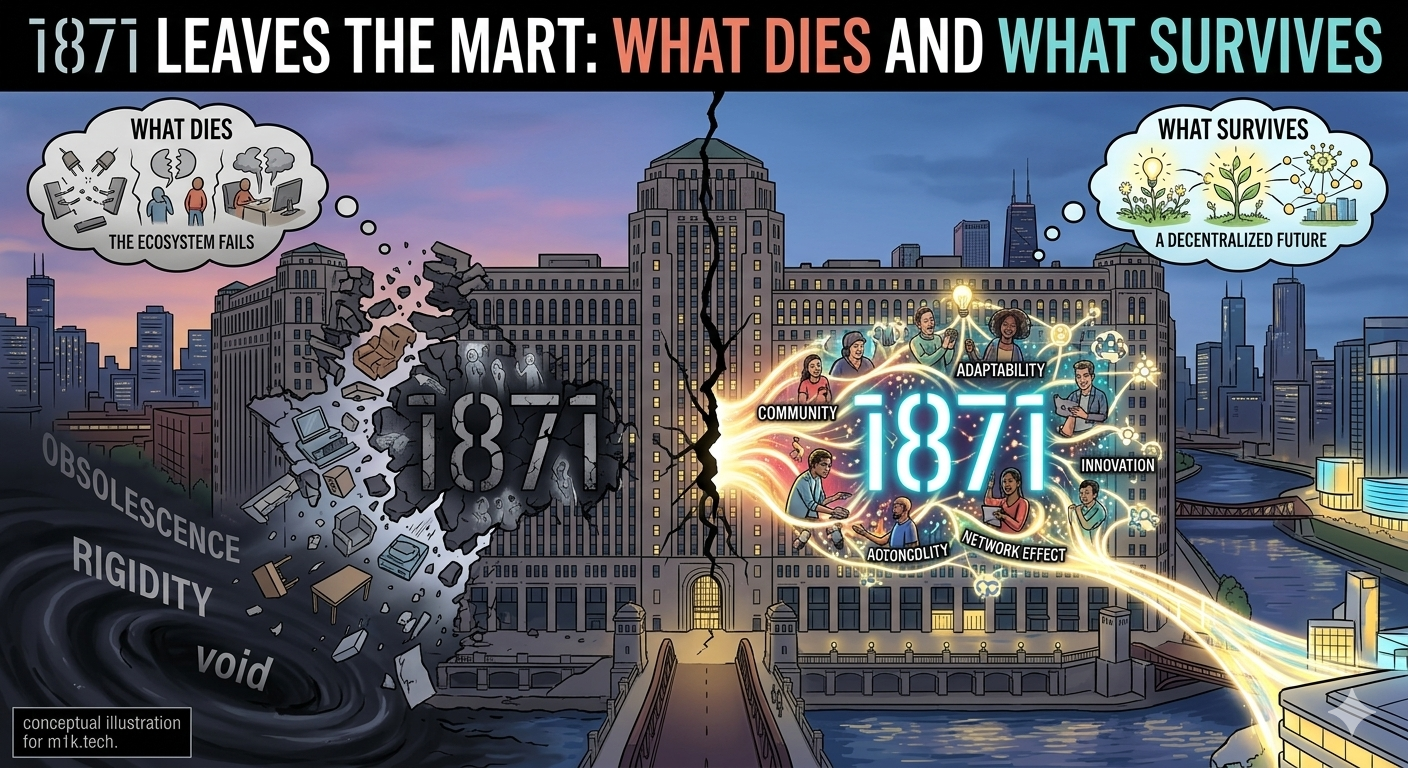
For thirteen years, 1871 was the physical center of gravity for Chicago’s startup ecosystem. The tech incubator at the Merchandise Mart was where founders met mentors, where VCs held office hours, and where visiting delegations (including more than a few I organized through Business France) came to see Chicago’s innovation story under one roof. That era is now behind us. 1871 announced this year that it could no longer sustain its real estate commitment to the Mart, ending an influential chapter in the city’s entrepreneurial history.
What actually happened
The pandemic gutted the coworking model. At one point in early 2021, when restrictions were still prevalent, only about 20 people were showing up on a given weekday. Membership revenues collapsed while the cost of holding premium square footage in the Mart did not. CEO Betsy Ziegler made the call to relinquish the space. 1871 found a lifeline in donated office space at Edelman’s headquarters at 111 N. Canal Street, a three-year lease that offered a chance to rebuild on a lighter footprint.
What dies and what survives
What dies is the model of the grand incubator as a destination: a physical place you visited, photographed, and pointed at as proof that Chicago had a vibrant tech scene. What survives is the network: 650 active alumni companies, approximately 15,000 jobs, and $4 billion in follow-on capital raised. The question is whether that network can maintain its strength without the physical anchor that once held it together. The concern is whether the ecosystem that produced Tempus, a dozen unicorns, and a generation of Chicago founders can sustain itself in a more distributed form.
The ecosystem is not solely defined by the building. The founders, the capital, and the talent pipeline are still here. 1871’s next chapter will be smaller, leaner, and less photogenic, which is probably a more honest version of what incubation actually looks like in 2026.