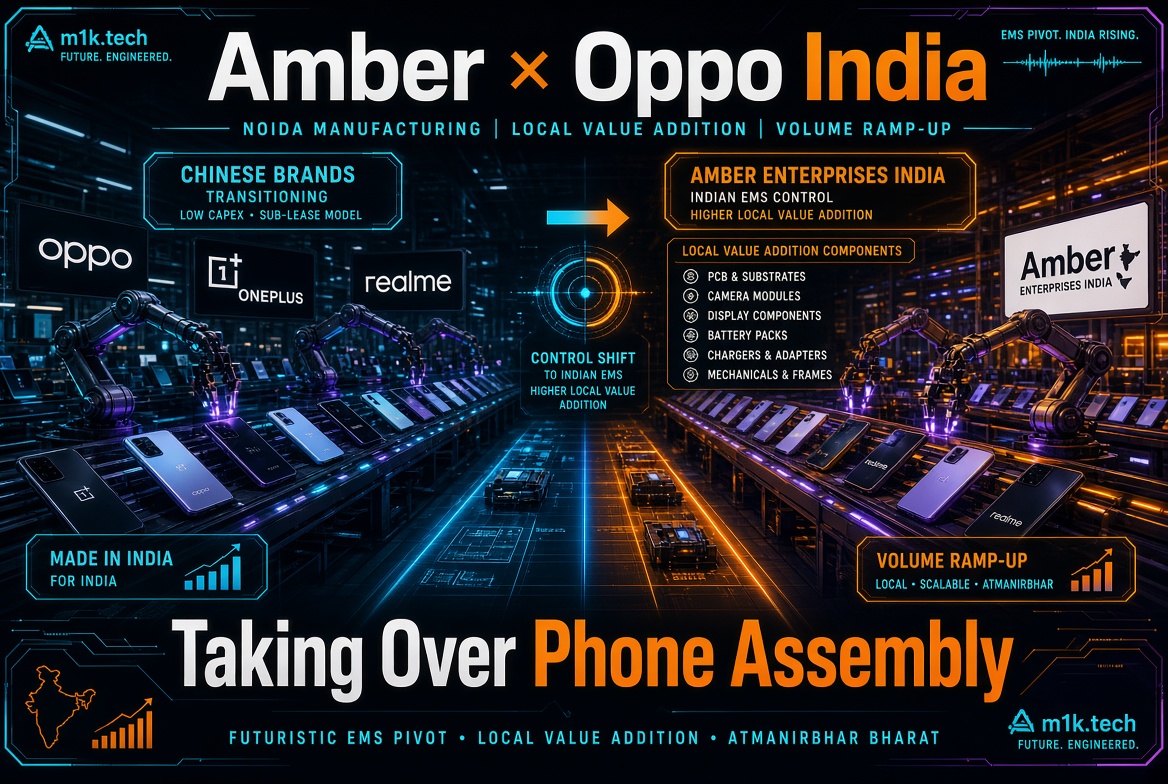
Under fifty crore rupees. That is the entire capital expenditure Amber Enterprises has budgeted to enter smartphone manufacturing, roughly five and a half million dollars, for a business that is supposed to produce eight million handsets in its first year and something close to sixteen million in its second. The reason the number is that small is that Amber is not building anything. It is sub-leasing a slice of Oppo’s own Noida plant, dropping in surface-mount lines, and assembling Oppo, OnePlus and Realme phones inside a factory Oppo already paid for. “To start with, we are not putting in any capex,” Jasbir Singh told investors after the June announcement. “It will be minimum, below Rs 50 crore.”
Trial production lands in the January-March 2027 quarter, commercial output the quarter after that, and Singh confirmed the timeline again on Amber’s Q1 FY27 earnings call last week. The company has already hired a COO purely to run the mobile vertical, which tells you this is not a side experiment.
What makes this worth more than a paragraph is what it sits next to. Dixon Technologies spent nineteen months waiting on a Press Note 3 clearance to form a 51/49 joint venture with Vivo India, finally got it on 8 July 2026, and is now standing up a venture that will absorb roughly two-thirds of Vivo’s Indian production, somewhere between twenty and twenty-two million units a year. Add Amber’s eight million, and it will ramp to sixteen. Counterpoint had Vivo at 17.8% of the Indian market in Q2 2026, Samsung at 17.6%, Oppo at 13.6%, and the full BBK stable, including iQOO, Realme, and OnePlus, at 45.6%. Nearly half of India’s smartphone volume is walking away from running its own factories, and almost nobody outside Indian equity research is talking about it.
The AC company nobody outside India has heard of
Amber started in 1990 as a sheet metal shop in Gurugram. It now manufactures more than a quarter of the air conditioners sold in India and supplies eight of the country’s ten largest AC brands, including Voltas, Blue Star, LG, and Daikin. If you have bought a split AC in India in the last decade, there is a decent chance Amber built it, and somebody else’s logo went on the front. FY26 revenue came in at ₹12,186 crore, up 22%, with operating EBITDA of ₹970 crore.
The interesting part is that Amber has spent most of eight years trying to stop being an AC company. In FY18, complete assembled AC units were 72% of its consumer durables revenue. By FY26, that had fallen to 47%, deliberately, because components carry better margins and stickier customer relationships than assembly contracts do. The three-division structure now reads consumer durables, electronics manufacturing services (ILJIN Electronics, Ever Electronics, Ascent Circuits, Shogini Technoarts), and railway subsystems and defense through Sidwal, which is quietly winning HVAC and pantry and gangway work on Vande Bharat trainsets.
Electronics is where the money is going. Ascent-K Circuit, a JV with Korea Circuit for HDI PCBs near the Jewar airport, is a ₹3,200 crore project. A multilayer PCB line is coming up in Hosur, a PCB assembly expansion in Pune, and more than ₹4,500 crore in approvals under the government’s Electronics Component Manufacturing Scheme. Amber funded all of this by raising ₹1,000 crore through a QIP at the parent and another ₹1,750 crore at ILJIN. In Q1 FY27, the electronics division grew revenue 29% and EBITDA 117%, which is the kind of number that makes the AC business look like the legacy asset it is becoming.
So why would a company running a hard pivot into high-margin PCB manufacturing sign up for phone assembly, which is the lowest-margin work in the entire electronics chain? Brokerage models put the mobile division’s EBITDA margin at 1.5% to 2% before incentives, maybe 3.5% with them, on a business that could add a fifth of Amber’s current top line.
Two answers, and the second one is the real one.
The first is seasonality, and it is not trivial. Room AC in India is a summer business that lives or dies on whether the pre-monsoon weeks are brutal enough, and FY26 was a soft year for exactly that reason. Phone assembly runs twelve months a year and consumes almost no capital, so it flatters return on capital employed even while it dilutes margin. Smoothing a violently seasonal revenue base with a boring year-round one is a perfectly good reason to take a 2% margin.
The second is the component ladder. Local value addition on these phones today sits around 12% to 13%. Amber’s stated target is 35% to 40% over five or six years, and Singh has been explicit about the sequence: assembly and SMT first, then PCB and component localization. “Once we touch 14 to 15 million, we’ll add the component side.” Read that against the ₹3,200 crore HDI PCB plant going up thirty-odd kilometers away and the shape becomes obvious. The phone contract is not the business. The phone contract is a captive, guaranteed, multi-million-unit demand signal that justifies the PCB fabs, and the PCB fabs are where 15% to 16% margins live. Amber is buying volume at a loss-leader margin to feed the factories it is already building. I think that’s smart sequencing, and I also think it is the single most fragile assumption in the whole plan, because the component ladder only pays off if Oppo actually lets an Indian supplier climb it rather than continuing to import boards from Huaqin.
Why Oppo wants out of its own factory
Here is where it stops being a manufacturing story.
In July 2022, the Directorate of Revenue Intelligence issued Oppo Mobiles India a show cause notice for ₹4,389 crore in customs duty. The government’s own release breaks it into two parts: ₹2,981 crore for wilful mis-declaration of imported components to claim duty exemptions Oppo was not entitled to, and ₹1,408 crore for royalty and license fees paid to Chinese and other multinational entities that were never added to the transaction value of the imported goods. Vivo got a ₹2,217 crore notice a few weeks later. The Enforcement Directorate seized $725 million from Xiaomi. The Chinese embassy publicly complained that the frequency of these investigations was chilling investment confidence, which it was, and which was arguably the point.
That is the backdrop for a policy push that began in 2023, when New Delhi started pressing Chinese handset brands to take Indian equity partners, appoint Indian executives to CEO, CFO and CTO roles, move distribution to Indian firms, and commit to export targets. Oppo has been shopping for an Indian manufacturing partner since 2024. When Moneycontrol reported in May that Oppo was talking to both Amber and Bhagwati Products, one source described the India timeline for the Realme integration as constrained by “ongoing legal issues involving Oppo.” Four years after the notice, the tax case is still shaping corporate structure decisions.
Then there is Press Note 3, the 2020 rule that required government approval for any investment from a land-bordering country and effectively froze Chinese FDI into India after Galwan. India partially unwound it in March 2026 through Press Note 2 of the 2026 series, operational from 1 May: up to 10% Chinese beneficial ownership through the automatic route, and a 60-day decision clock for capital goods, electronic components, polysilicon and ingot-wafer proposals, conditional on majority ownership and control remaining with Indian residents. Carnegie called it a gamble. An East Asia Forum piece in July called it selective derisking, which I think is the better description, because the security architecture stayed intact and only the commercially inconvenient parts got sanded down.
Notice what Amber’s structure does with all of that. Dixon and Vivo needed a PN3 clearance because Vivo is subscribing to equity in a joint venture. Amber and Oppo signed a manufacturing collaboration agreement and a sub-lease. No equity, no Chinese shareholder, no approval apparatus, no nineteen-month wait. Oppo keeps the brand, the design, the supply chain relationships, and the customer, and hands over the part of the business that generates factory-floor payroll, tax scrutiny, and capital lock-up. It is the cleanest possible answer to a government that wants Indian ownership of manufacturing: give them the manufacturing, keep everything that matters.
The third pressure is BBK’s own balance sheet. Realme was folded back into Oppo as a sub-brand in January; the OnePlus and Realme operations were formally merged in April under Realme founder Sky Li; OnePlus shut its offline retail in India and pulled back hard in Europe; and Realme’s R&D team got absorbed into Oppo’s hardware divisions. Memory prices have gone up roughly fourfold since September 2025. When your bill of materials is exploding, and you are consolidating three brands into one product organization to stop paying for duplicate engineering teams, the argument for owning an assembly plant in a foreign country with an open tax case gets thin fast.
I have written about how OnePlus went from flagship killer to Oppo sub-brand at some length, back when it was a forum-native enthusiast outfit that shipped one phone at a time, and there is something bleak about typing the sentence “your next OnePlus will be assembled by an air conditioner company.” That is not a criticism of Amber. It is just where the brand ended up.
The volume math, and why the timing looks insane
Amber is not taking all of Oppo’s Indian output. The eight million is explicitly structured not to disrupt Oppo’s existing outsourcing arrangements, which matters because Bhagwati Products, a Micromax and Huaqin joint venture, already leases a large chunk of Oppo’s Greater Noida factory and took over the old Vivo Greater Noida plant, and has been building Oppo phones from both. Bhagwati is prepping a ₹3,000 crore IPO at a targeted valuation north of ₹20,000 crore. So the picture is not two Indian contract manufacturers absorbing BBK, it is at least three, with Dixon the incumbent at over thirty-three million mobile units a year and roughly 18% of India’s contract manufacturing.
Amber signed up for eight million units in a market that is contracting harder than it has in over a decade. IDC put Q2 2026 shipments at 33.2 million units, down 11.1% year on year, with first-half volumes at 64.2 million, the lowest in five years. Counterpoint measured the same quarter at minus 10%, the worst June quarter in six years, and expects the full year down 13%. IDC now models 128 to 130 million units for 2026 versus 152 million in 2025, the lowest annual total since 2013.
Memory is the cause, and the damage is concentrated at the bottom. DRAM and NAND have pushed memory’s share of the bill of materials in the sub-₹15,000 tier from under 20% to over 45%. Shipments below ₹10,000 fell 74.3% year on year in Q2, and that segment’s share collapsed from 15.6% to 4.5%, which is the same cost curve that killed the CMF Phone 3 Pro before it ever shipped. Average selling price hit a record ₹30,000, up 14.4%, so market value actually grew 1.7% while volume fell by a ninth. Some individual models have seen cumulative price increases exceeding 100% of their launch price.
Contract assemblers get paid per unit. A brokerage note in June sized Amber’s addressable slice at 39 to 41 million units within a 162 million unit market, and that market number is already stale by twenty-five percent or so. If Oppo ships fewer phones, Amber assembles fewer phones, and the whole ₹42 crore to ₹83 crore incremental profit estimate that the sell side put on this deal starts looking optimistic. Against ₹12,186 crore of group revenue, that profit contribution is a rounding error either way. Amber wants volume, not earnings.
The incentive that already expired
The margin math gets worse when you look at what is funding it. The mobile PLI scheme ended on 31 March 2026. That is not a footnote; that is the difference between a 3.5% EBITDA margin and a 1.5% one. Amber signed this contract knowing the incentive that made phone assembly tolerable was gone, with a replacement scheme still being negotiated and reportedly likely to tie payouts to domestic value-addition targets rather than pure production volume.
The reason for that redesign is that the original PLI overshot on production and undershot on the thing it was actually meant to build. Cumulative production blew past targets, smartphones became India’s top export category in calendar 2025, and the scheme is expected to disburse around ₹20,000 crore of its ₹34,193 crore budget, most of it to Apple’s vendors, Samsung and Dixon. But value addition is only expected to reach 18% to 20% by FY26. India built enormous assembly capacity but still imports nearly everything that goes into the box, largely from China, and Press Note 3 was simultaneously blocking the Chinese component makers who could have localized that supply chain from setting up in India at all. China then filed a WTO dispute against India’s PLI local-content requirements, and a panel was established in February 2026. China is challenging the subsidy scheme, arguing that it drives Chinese component imports and discriminates against Chinese components. I have read that sentence several times, and it still does not stop being funny.
Anti-dumping duty on PCBs up to six layers is part of the same posture, and it directly helped Amber’s Ascent Circuits onboard new customers. The tariff wall on components, the ECMS approvals, the new value-addition-linked PLI, and the partial PN3 opening are all one policy: India will pay for local content, tax you for imported content, and let in exactly as much Chinese capital and expertise as it takes to get the content localized, provided an Indian holds the controlling stake.
I am not going to do the export math here, because whether any of this eventually ships out of India rather than just serving the domestic market is a separate post, and the honest answer right now is that Oppo’s Indian volumes are overwhelmingly domestic.
What India is actually buying
Strip the announcement down and here is the trade. Oppo keeps the brand, design, IP, distribution, and the margin. Huaqin keeps the ODM design work. The components keep arriving from China. India gets the assembly labor, the sub-lease rent, a line item in the manufacturing statistics, and a domestically owned entity whose name goes on the compliance filings instead of a Chinese subsidiary with an unresolved ₹4,389 crore customs notice.
That is not nothing. Screwdriver plants are how Shenzhen started, and Amber knows exactly which rung of the ladder it is standing on, which is why the PCB fabs are already under construction rather than waiting for the phone contract to prove itself. But the whole thesis rests on a step that has not happened yet and that nobody has committed to in writing. Local value addition has to go from 12% to 40%, which means Amber has to displace Chinese board and component suppliers inside a Chinese brand’s own supply chain, using a Chinese-designed product, on a five- or six-year timeline, while the market it is selling into shrinks by a fifth.
If that step happens, this deal will look like the moment India stopped renting its electronics industry. If it does not, Amber will have spent the back half of the decade running a two-percent-margin assembly line inside somebody else’s building, and the only thing that will have changed is whose name is on the lease.
Sources
- Amber to start manufacturing Oppo, OnePlus, Realme phones from Q4FY27 (PTI via Business Standard, 16 August 2026)
- Amber Enterprises Q1 FY27 results
- This company makes every fourth AC in a sweltering India (The Ken)
- Dixon Technologies and Vivo India JV clearance under Press Note 3
- DRI unearths Customs duty evasion of Rs 4,389 crore by Oppo India (Press Information Bureau)
- India’s China doctrine of selective derisking (East Asia Forum)
- India’s Press Note 3 Gamble (Carnegie Endowment)
- India’s smartphone shipments fall 10% YoY in Q2 2026 (Counterpoint Research)
- India’s smartphone shipments fall 11.1% to 33.2 million units in Q2 2026 (IDC)
- New smartphone PLI scheme may be linked to domestic value addition
- Oppo in talks with Amber Group, Bhagwati Products for India manufacturing JV