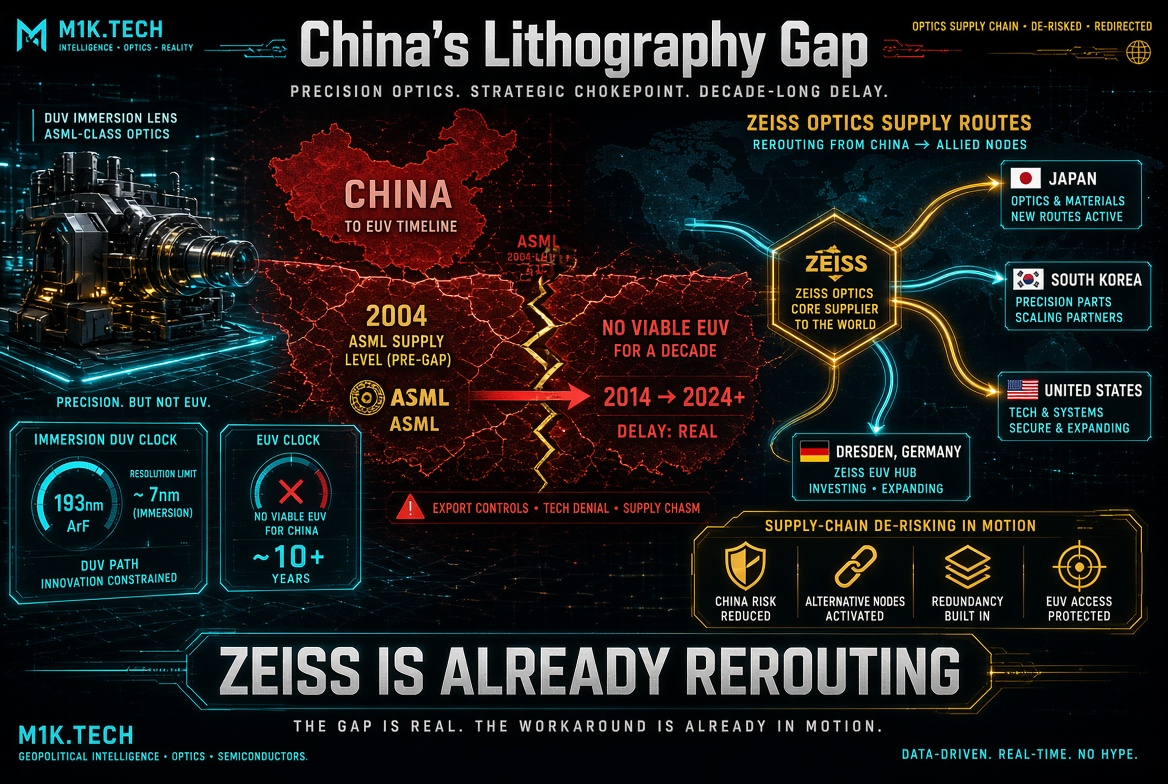
UBS just put a number on China’s lithography gap, and it’s sharper than the usual “years behind” hand-wave that gets attached to this beat. “They seem to be at a similar stage to ASML in 2004,” analysts led by Francois-Xavier Bouvignies wrote this week, and their conclusion is blunt: China isn’t producing a viable EUV alternative within the next decade.
That estimate comes with a second number that matters more in practice. UBS expects China to reach high-volume manufacturing of immersion DUV lithography, the older but still essential category, within two to five years. Immersion DUV isn’t a toy tier. ASML prices these machines at close to $90 million each, against more than $200 million for the EUV gear China still can’t touch, and DUV happens to be exactly the category Dutch export licensing already governs, the same fight the MATCH Act has been waging from the legislative side for the past few weeks. A decade of safety on the top tier and two to five years on the workhorse tier are two very different clocks, and only one of them should let anyone relax.
Which is what makes the same week’s other chip story land so differently. Frank Rohmund, the Carl Zeiss board member who runs the company’s semiconductor manufacturing technology business, told Kyodo News and other foreign press in July that Japan, South Korea, and the US now matter more to Zeiss’s supply chain than they used to, and that China is “an area where we believe the risk could be substantial.” Zeiss doesn’t build lithography machines. It builds the optics that go inside ASML’s, which puts it about as close as any single company gets to being the chokepoint the whole industry already runs through, one layer removed. When the company making the lenses starts talking about de-risking China exposure in the same week UBS publishes a decade-gap estimate, that’s not a coincidence. That’s two ends of the same board being moved at once.
The physical anchor for the Zeiss comments is Dresden, where TSMC’s first European fab is under construction and due to start operations by the end of 2027, its own version of the same geographic hedge it’s already running with its Kumamoto site in Japan. Saxony was a chip and auto hub before TSMC ever showed up, but Thomas Horn, who runs the region’s investment office, said the actual agenda out loud: the EU is having live discussions about “trusted chips,” about which servers handle which data, and he’d like Chinese-made semiconductors and materials excluded from critical infrastructure entirely, with Japanese companies filling the gap instead. Tokyo Electron already has people on the ground there. Nippon Express just opened a logistics facility nearby, betting on the freight that follows a fab.
None of this reads like one dramatic decoupling announcement, and I don’t think it’s meant to. It reads like a dozen smaller decisions, an optics maker here, a logistics company there, a regional trade office somewhere else, all quietly pointed in the same direction at once. UBS’s estimate gives China’s own engineers a number to chase, and I’d bet on them chasing it hard, especially on the DUV side where the two-to-five-year window is short enough to actually plan around, unlike the homegrown DUV tools Chinese manufacturers are already bringing online in small batches. What Zeiss and Saxony are doing in parallel is a different kind of hedge: making sure that even if China closes the technology gap on schedule, the supply chain it needs to actually build anything at scale with that technology has already rearranged itself somewhere Beijing doesn’t control.
I don’t think Beijing is unaware of any of this. I just don’t think there’s a lot it can do about a decision being made in a boardroom in Oberkochen and a trade office in Dresden instead of a lab in Shanghai. The gap UBS measured is real. It’s just not the only gap closing, or opening, this month.
Sources
- Bloomberg, China Unlikely to Match ASML’s Top Tool in Next Decade, UBS Says, September 1, 2026
- Yahoo Finance (Bloomberg wire), China unlikely to match ASML’s top tool in next decade, UBS says, September 1, 2026
- Kyodo News, German chip sector seeks Japan ties to reshape supply chain amid China risk, September 1, 2026