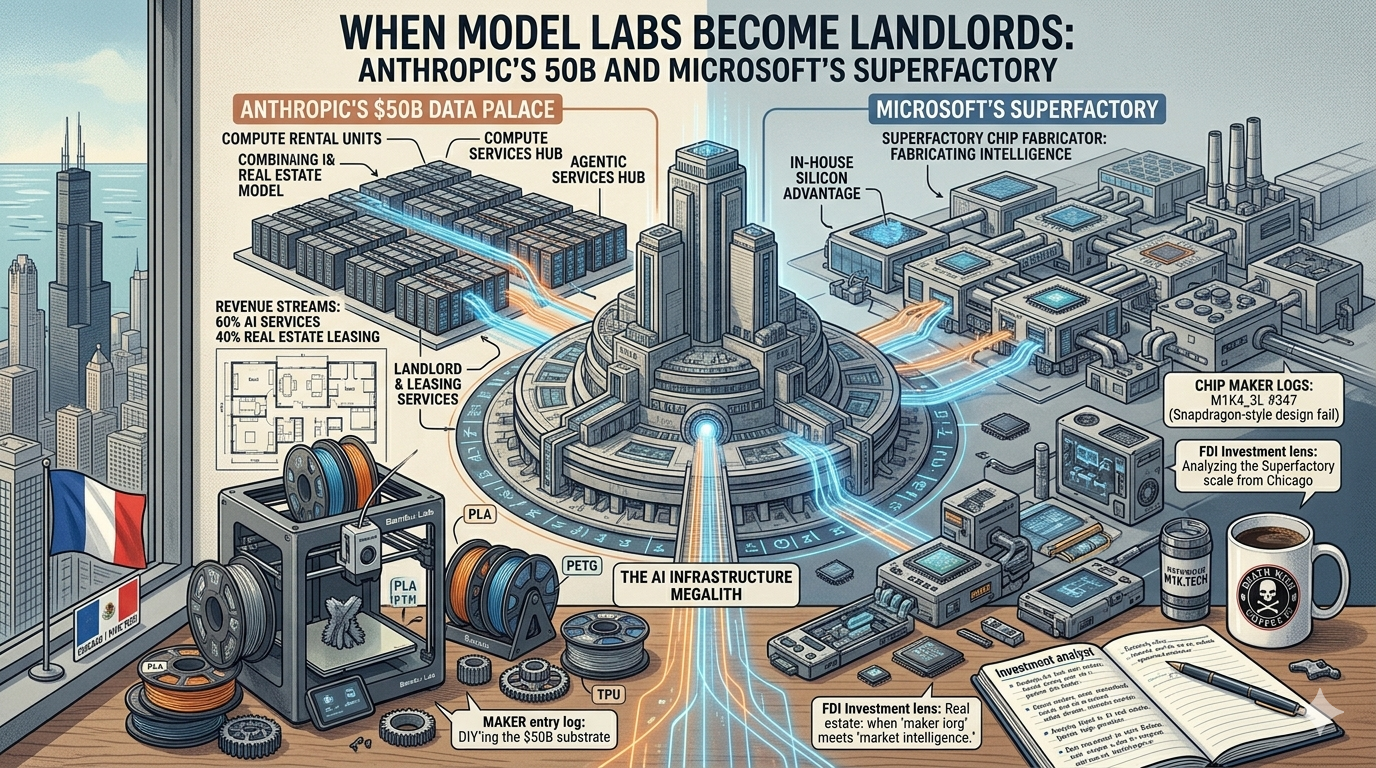
The Anthropic AI data centers announced today come with a telling twist: the model labs are becoming landlords. On November 12, Anthropic announced a $ 50 billion investment in American computing infrastructure, including custom data centers in Texas and New York built with its partner, FluidStack. The same day, Microsoft revealed a new Atlanta data center, which is wired to an existing Wisconsin site to form what it calls a massive supercomputer, hundreds of thousands of Nvidia chips stitched into a single machine. Two big announcements, one clear message: owning the compute is now the strategy, not just renting it.
Anthropic stops being only a tenant
Now, that’s an interesting part here, Anthropic has historically leaned on other people’s clouds; it has compute partnerships with Amazon and, as of October, with Google. Now it is investing 50 billion dollars to build its own custom facilities, designed specifically for its workloads, with Fluidstack as the build partner, with the first sites coming online through 2026. The company says the scale is necessary to meet growing demand for Claude from hundreds of thousands of businesses while keeping its research at the frontier. The projects are expected to create around 800 permanent jobs and 2,400 construction jobs.
Why does a model company suddenly want to own buildings? Because if your entire business depends on computing, renting it all from rivals is a strategic weakness. The performance, the cost, and the latency of frontier models all hinge on access to dense GPU clusters with brutally fast interconnects. Control that, and you control your own destiny on pricing and capability. Lease all of it, and you are at the mercy of whoever owns the racks. Anthropic doing this is the same instinct that drove OpenAI’s Stargate, and it confirms the pattern is now industry-wide.
Microsoft’s superfactory
Microsoft’s piece is architecturally fascinating. It branded the new two-story Atlanta facility Fairwater 2, after the original Fairwater complex south of Milwaukee, and the key idea is that these are not separate data centers. They are nodes in a single distributed supercomputer, connected across a dedicated high-speed optical backbone. Microsoft is treating the rack as the unit of acceleration and the continent as the chassis. That is a genuinely different way of thinking about a data center: not a building that computes, but one organ in a body-sized machine spread across states.
And the spending behind it is staggering. Microsoft put nearly 35 billion dollars into capital expenditures in a single quarter, July through September, with almost half of that going to chips. This is the same hyperscaler capex wave that keeps showing up everywhere. The Atlanta site will power Microsoft’s own AI, OpenAI’s, and other developers’, which is a reminder that even after Microsoft stopped being OpenAI’s exclusive cloud provider, the two remain deeply entangled in the same physical buildout.
The pattern, and the worry
Step back and the through-line is obvious. OpenAI kicked off the half-trillion-dollar Stargate plan in January, brought its Abilene flagship online, and added five more sites in September. Now Anthropic and Microsoft are piling in on the same day. Every serious AI player has concluded that whoever controls compute capacity controls the future, and they are all spending like it. OpenAI alone has reportedly racked up well over a trillion dollars in infrastructure obligations.
Personally, this is where I get a little uneasy, and the reporting around these announcements says it plainly. There are real and growing concerns about a bubble, the environmental cost, and the political fallout from fast-rising electricity bills in the communities where these things are built. When everyone races to own the same scarce thing at the same moment, prices and promises inflate, and not all of it survives contact with reality. C’est the tension of this whole era. The buildout is real, the demand is real, but the financing is leaning on belief about the future as much as on today’s revenue. I will keep tracking who actually brings capacity online versus who just announced it, because that is the line between an industrial supercycle and an expensive correction waiting to happen.
That worry stopped being abstract a month later, when the year’s data center dealmaking hit a record $61 billion and investors started openly asking whether this is a supercycle or a bubble.