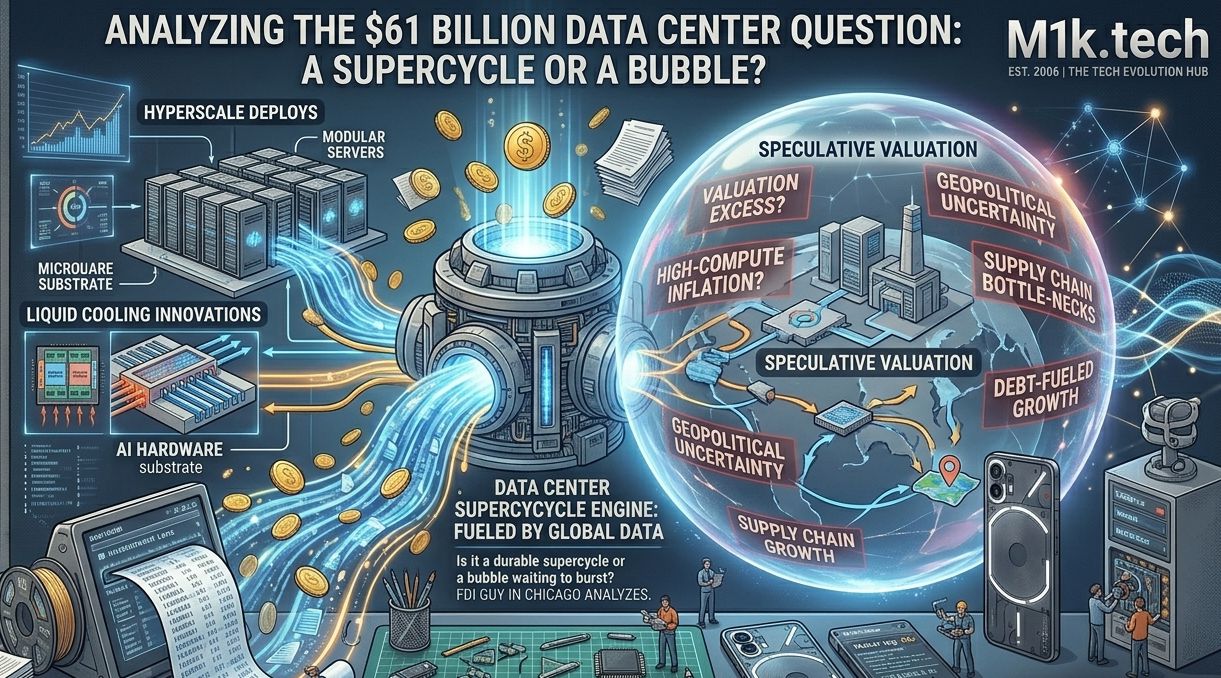
All year, I have been tracking the announcements: Stargate’s half-trillion-dollar plan, Abilene going live, Anthropic and Microsoft becoming landlords. Now that the receipts are in, the data center deals 2025 numbers are staggering. A new S&P Global report says dealmaking hit a record, with more than 61 billion dollars flowing into the market through November across over 100 transactions, already beating 2024’s full-year record. S&P called it a global construction frenzy. The question I keep coming back to is the one investors started asking out loud this autumn: is this a supercycle, or a bubble?
The numbers
More than 61 billion dollars in deals, M&A, asset sales, and equity investments combined, across more than 100 transactions in the first 11 months of the year. That edges past 2024’s roughly 60.8 billion, setting a new high. Most of the activity was in the US, followed by Asia-Pacific, with Europe lagging well behind. Since 2019, data center dealmaking has totaled around 160 billion in the US and Canada, nearly 40 billion in Asia-Pacific, and about 24 billion in Europe. The center of gravity is clearly North America, and the pace there is leaving everyone else in the dust.
Here is the detail that matters most, though, and it is the one I want you to sit with: how this is being financed. According to S&P, debt issuance nearly doubled this year to around $ 182 billion, as hyperscalers increasingly turn to outside capital rather than paying out of their own pockets. Meta alone has raised 62 billion in debt since 2022, nearly half of it this year. A large share of the surge in financing came from private equity. So the construction frenzy is running substantially on borrowed money, not just on the cash piles of trillion-dollar tech companies.
The bubble question, asked honestly
This is where I have to be straight with you. The debt-heavy financing is exactly what makes me nervous. When an industry builds at a record pace using record borrowing, the downside is no longer just “some money gets wasted.” It is leveraged, which means a slowdown hurts more and spreads further. Global stocks already sold off in November amid AI bubble fears. And right around the time this report landed, Oracle dropped 5 percent on news that Blue Owl Capital was pulling out of backing a 10-billion-dollar data center in Michigan. Oracle denied it, but Broadcom, Nvidia, and AMD all retreated on the news, and the Nasdaq had its worst day in nearly a month. That is what a jittery market looks like: one wobble in one data center deal, and the whole AI complex flinches.
The S&P analysts take the more optimistic view, and it is worth airing fairly. They expect the Oracle and AI concerns to be temporary, and they see demand for AI applications continuing to grow strongly into 2026. Their argument: the underlying demand is real, the assets are genuinely scarce and attractive, and one nervous month does not break a multi-year trend. They may well be right. Demand for compute has not actually fallen; if anything, it keeps rising.
Perso, here is where I land. Both things can be true at once. The demand can be real, and the financing can be fragile. A genuine industrial buildout can also be overbuilt and overleveraged at the top. The thing I will watch in 2026 is not whether AI demand grows, it will, but whether the borrowed money behind these buildings can be serviced if revenue grows slower than the debt assumed. C’est the difference between a supercycle and a hangover.
The part that gets forgotten: the communities
One more thing the deal headlines tend to skip. These buildings land in real places, and the people who live there are increasingly pushing back. Data centers were expected to increase their power-grid use by another 22 percent by the end of 2025, with projections that it would triple by 2030. A coalition of about 350 nonprofit environmental groups signed a letter urging all 50 states to halt data center expansion due to environmental concerns. And in plenty of towns, the buildout is showing up as rising electricity bills. The 61 billion dollar number is exciting on a finance dashboard. On the ground, it is power draw, water use, and local politics, and that friction is going to shape how much of this actually gets built, regardless of how the markets feel about it.
If you want to know how the bubble-or-supercycle question looks once the 2026 numbers arrive, the hyperscalers answered it loudly: combined capex is now on track for roughly $700 billion in AI spending, with a circular-financing twist worth watching.