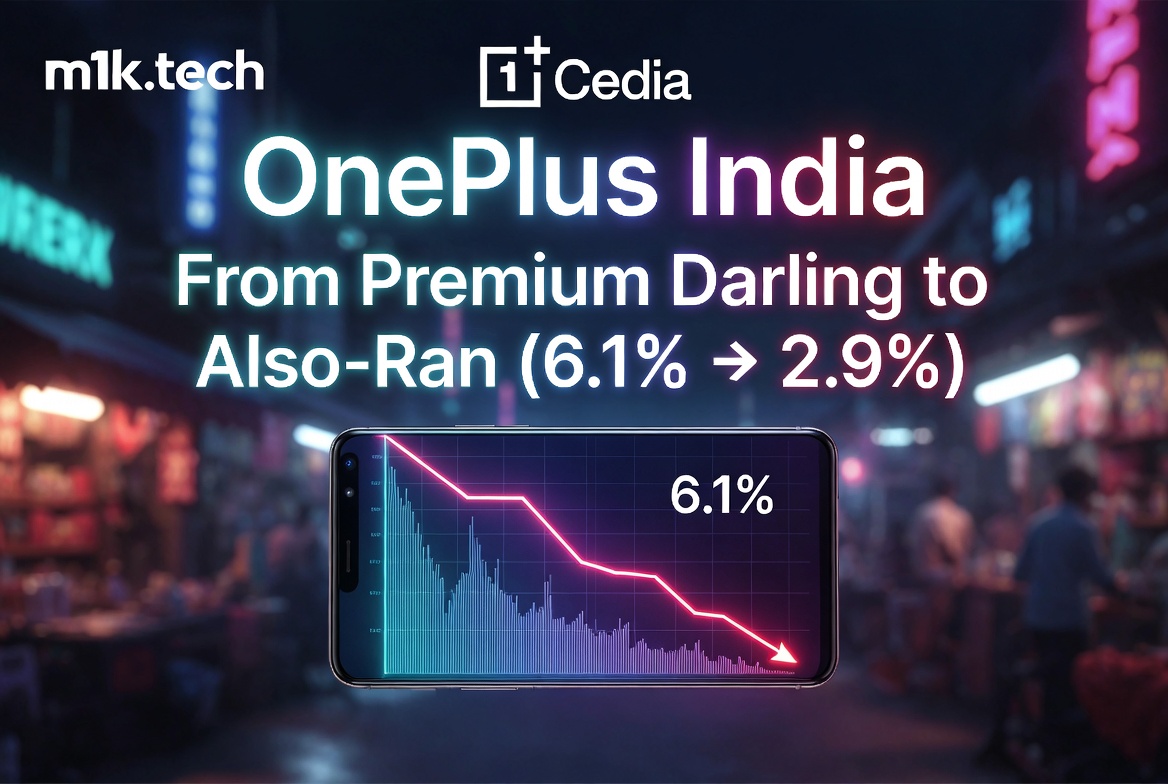
OnePlus has seen its share of India’s premium smartphone market fall from 6.1% in 2023 to 2.9% in 2025, a decline TechInsights identifies as the sharpest year-over-year brand drop in that segment. The green line display defect caused the most reputational damage, compounded by prior erosion of trust from OxygenOS changes and product lineup confusion.
Price escalation has further weakened OnePlus’s position, placing it in direct competition with Apple and Samsung at a tier where those brands hold structural advantages. Apple’s expanding manufacturing presence in India has made iPhones more price-competitive, reducing the incentive for existing OnePlus users to stay. Whether the brand stabilizes depends on strategic decisions not yet visible.
January 15, 2026. India market share data for 2025 is coming in and the numbers are difficult to look at if you have been following OnePlus since the One. India market share for OnePlus in the premium smartphone segment: 6.1% in 2023, 3.9% in 2024, 2.9% in 2025. TechInsights is calling it the sharpest year-over-year brand decline in the Indian premium smartphone market across those two years. The trajectory is not ambiguous.
The causes stack, and it is important to assign weight to each one accurately rather than collapsing them into a single explanation.
The green line crisis did the most damage
TechInsights analyst Abhilash Kumar has been clear in his commentary: “The key reason for their decline was the negative sentiment around the green line issue.” The Lifetime Display Warranty that OnePlus introduced in 2024 addressed the hardware problem but the brand damage preceded it. A community that was already processing the disappointment with OxygenOS 12 and SKU confusion encountered the green line defect with no trust reserves remaining. The warranty came after the reputation damage had compounded with the 2024 India data. When a quality problem hits a brand that is already overdrawn on trust, the consequences are disproportionate to what the same problem would have caused when the brand’s account was full.
The price escalation problem in the Indian context
The OnePlus 12 at ₹64,999 places it in a tier where Apple and Samsung have structural advantages: service networks, brand recognition, carrier relationships. OnePlus at ₹30,000 was an obvious choice in India. OnePlus, at ₹65,000, is competing against the iPhone 16 on Apple’s home turf, in a country where Apple’s manufacturing commitments have significantly reduced iPhone prices. Apple’s market share in India has been growing sharply in the very premium segment where OnePlus is attempting to compete. The Indian buyers who upgraded their OnePlus phones in 2024 and 2025 had a more compelling iPhone alternative than in 2021, and the OxygenOS experience gave them fewer reasons to remain loyal to Android.
Where this goes
OnePlus’s India operation is under real pressure. The numbers confirm it, and the organizational signals I am watching do as well. Whether the response is a genuine strategic reset (price recalibration, software quality commitment, community re-engagement) or a further corporate consolidation into the OPPO/Realme portfolio structure will determine whether 2.9% is a floor or a continuation of the decline trajectory. Right now, I do not have enough visibility into the organizational decisions being made to say confidently which way this goes.
Part of OnePlus: The Complete Story, my full history of OnePlus from founding to the Realme merger.