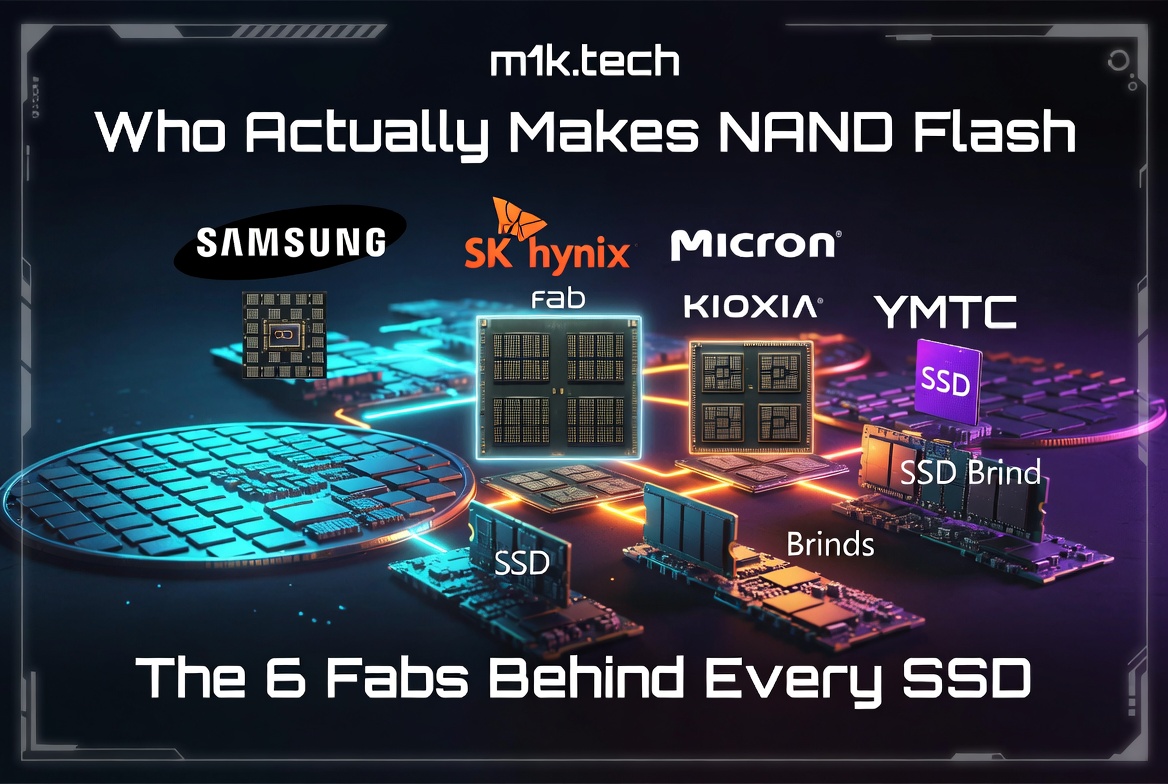
Only six companies in the world fabricate NAND flash — Samsung, SK Hynix, Kioxia, SanDisk, Micron, and YMTC — while most consumer storage brands are assemblers that buy flash from this short list and rebrand it. The silicon inside a drive can change between production runs without any update to the model number or packaging.
Rising AI demand has tightened NAND and DRAM supply, pushing prices higher and increasing the likelihood of silent component substitutions. Cell type, controller firmware, and sourcing decisions — not the brand name — determine a drive’s real-world performance and longevity, and buyers have limited visibility into any of these factors at the point of purchase.
The people who sell you storage are trying to get you to buy now. Team Group has told customers to expect higher prices. Phison’s CEO has said publicly that the DRAM and NAND shortage could push some consumer electronics companies out of business before the year is done. Three of the big module makers reportedly went and raised hundreds of millions between them just to lock in flash and DRAM supply ahead of the squeeze. The AI buildout is eating memory faster than the fabs can pour it, and the drive on the shelf is about to cost more and, in many cases, quietly contain something cheaper than the one reviewers tested.
Which is the part most buyers never think about? The logo on the box is almost never the company that made the silicon inside it, and right now that gap matters more than it has in years.
Six fabs, and two of them sell straight to you
Count the companies on Earth that actually fabricate NAND flash, and you get to six before you run out. Samsung, SK hynix, Kioxia, SanDisk, Micron, YMTC. That is the whole list, and one of those six only exists as a standalone company again because Western Digital spun its flash division back out as SanDisk Corporation in February 2025. Everyone else whose storage you have ever bought, Team Group, Lexar, ADATA, Corsair, Kingston, PNY, Sabrent, the house brand on the bargain drive at Walmart, buys wafers or finished packages off that short list and prints its own name on top.
Two of the six are really just fabs selling to you without a middleman. Crucial is that Micron hands you a drive directly rather than through a partner. Solidigm is SK hynix flying the flag it inherited when it bought Intel’s NAND business. Strip those out, and everybody else in the consumer aisle is an assembler: they take someone’s flash, pair it with a controller and a firmware stack, validate it, and ship. The skill is real, the engineering is real, but the flash is bought, not made.
Team Group is the textbook version. Open up two Team Group drives with the same model number bought a year apart, and the NAND inside might be Micron, might be Kioxia/SanDisk JV flash, might be SK hynix, and increasingly might be YMTC out of Wuhan. They multi-source on purpose, switching suppliers based on what is cheapest that quarter, what is in shortage, and which performance tier the drive is aimed at. Longsys runs a cleverer version of the same trick, owning two brands and splitting them by who they serve: Lexar for consumers chasing peak burst speed in cameras and gaming rigs, FORESEE for industrial gear that has to log data 24/7 across a -40°C to 85°C range and survive a yanked power cable without corrupting a single byte. Same parent, same underlying flash, completely different lives engineered into the firmware and the binning.
Twenty years of brands changing hands
The reason the badge tells you so little is that badges have been traded like baseball cards for two decades, while the fabs underneath have quietly consolidated into that handful.
Lexar is the cleanest example. Micron owned it, decided in 2017 that the retail memory-card business was not worth keeping, and instead of killing the name outright, sold the Lexar brand to Longsys in China. So a name that sat in every American camera bag in the 2000s is now owned by a Shenzhen company, running on flash that may or may not be Micron’s, depending on the product. The brand traveled. The fab stayed put and changed owners on its own schedule.
SanDisk has been passed around even more. Founded in 1988 by Eli Harari and Sanjay Mehrotra, who, in one of those details I love, went on to run Micron, a direct competitor, where he still is. Western Digital bought SanDisk in 2016 for around $19 billion, mostly to gain control of the Toshiba flash joint venture SanDisk was part of. WD held it for nine years, then, in early 2025, decided that the marriage of spinning hard drives and flash never really worked and spun SanDisk back out as its own public company. The hard drives stayed with WD. The flash and the seat in the Japanese fab JV went with SanDisk. A brand that was independent, then absorbed, then independent again, all without the fabs in Yokkaichi changing a single production line.
Intel’s exit is the one that reshaped the top tier. SK Hynix agreed in 2020 to buy Intel’s entire NAND and SSD business for about nine billion dollars, took the first half in 2021 and folded it into a new subsidiary called Solidigm, and closed the rest in 2025. That deal handed SK hynix a fab in Dalian, China, and made Solidigm the American-branded face of a Korean company. Toshiba, meanwhile, spun its memory unit out under financial pressure and sold control to a Bain Capital-led consortium in 2018 for roughly eighteen billion, renamed it Kioxia in 2019, and finally took it public on the Tokyo exchange at the end of 2024. SK hynix sat inside that Bain consortium too, which is why, when Kioxia and Western Digital tried twice to merge their flash businesses into one giant, SK hynix could and did block it. The consolidation that did not happen is as telling as the ones that did.
The graveyard is just as instructive. OCZ, a darling SSD brand of the early 2010s, went bankrupt, was absorbed by Toshiba, and then quietly retired. Plextor, beloved by enthusiasts, ended up under Lite-On, whose SSD business Kioxia bought in 2020, and the name faded out. Numonyx, the flash venture Intel and STMicro spun up, was acquired by Micron in 2010. Every few years another logo people trusted turns out to be a trademark with no fab behind it anymore, sold to whoever wanted the shelf space.
Most of this silicon is made in places the export-control lawyers worry about
Here is the part I find genuinely fascinating, and it is why a driver’s nationality is close to meaningless. Fabricating NAND is a Korean, Japanese, and US club with one Chinese member who got thrown into a corner. South Korea has Samsung and SK Hynix, with Solidigm as SK Hynix’s American storefront. Japan has Kioxia, the old Toshiba memory business, sharing its Yokkaichi and Kitakami fabs with SanDisk. The US has Micron outright, and SanDisk now stands alone. Taiwan, where a large share of these module brands and almost all the controller designers are based, does not fabricate the flash at all.
Then look at where the wafers physically come out of the ground, and the clean national story falls apart. A large share of Samsung’s NAND is made not in Korea but in Xi’an, China. SK Hynix makes flash in Dalian, the fab it got from Intel, also in China. And YMTC, China’s own champion, is based in Wuhan. So when you buy a “Korean” Samsung drive, a meaningful chunk of the time, the silicon was fabbed inside China by a Korean company, which is exactly the entanglement that makes the export-control fight so messy.
The US rules from October 2022 tried to choke off the advanced tools needed to build cutting-edge NAND, 128 layers and up, inside China. The catch was that those rules hit Samsung’s Xi’an fab and SK hynix’s Dalian fab just as much as they hit YMTC. Washington carved out the two Korean firms with Validated End User status so they could keep their China fabs running, and dropped the hammer on YMTC, putting it on the Entity List in December 2022. That is the asymmetry in a sentence: the Korean-owned fabs in China get a pass; the Chinese-owned fab in China gets blacklisted.
None of which stopped YMTC. It pushed its Xtacking architecture to 232 layers and reportedly beyond, and its flash is cheap, which is the only argument a module maker needs. That is why YMTC silicon keeps surfacing inside Western-branded budget drives, and why nobody advertises it. The flash in “your” American or Taiwanese-badged SSD is whichever fab won the purchase order for that production run, and that can change between two revisions of the same model number with not one word on the packaging. Buy a drive, and you are not really buying a nationality. You are buying whatever was the cheapest in Shenzhen the week it was assembled.
QLC, TLC, and why the cheap drive dies on a big copy
The single biggest variable across all these drives is how many bits each flash cell is asked to hold, and it drives cost, speed, and lifespan all at once.
A NAND cell stores data as a voltage level. The whole game of modern flash is cramming more bits into one cell by slicing that voltage range into more distinct steps. One bit needs two voltage states. Two bits need four. Three bits need eight. Four bits need sixteen. Every bit you add doubles the number of levels the cell has to tell apart inside the same physical window, so the margins between them get narrower, writes get slower, reads need heavier error correction, and the cell wears out faster because each program-erase cycle drags it through a finer set of distinctions.
| Type | Bits per cell | Voltage states | Rough endurance (P/E cycles) | Where you find it |
|---|---|---|---|---|
| SLC | 1 | 2 | ~50,000-100,000 | Industrial, enterprise write cache, FORESEE-grade logging |
| MLC | 2 | 4 | ~3,000-10,000 | Mostly retired from consumer, a few high-endurance niches |
| TLC | 3 | 8 | ~1,000-3,000 | The consumer mainstream, nearly every good SSD today |
| QLC | 4 | 16 | ~300-1,000 | High-capacity budget drives, big cheap NVMe |
| PLC | 5 | 32 | ~100, experimental | Barely shipping, still mostly in the lab |
SLC is the gold standard nobody can afford at scale: blazing-fast, almost unkillable, and so low-density that a consumer-sized drive built from it would cost a fortune. It lives in industrial gear and as a cache layer, not as your main storage. TLC is where the entire consumer market sits, because three bits per cell is the sweet spot where price per gigabyte drops hard without endurance falling off a cliff. QLC is the pure cost play, four bits per cell, making the densest, cheapest drives possible, which is how you get an affordable 4TB NVMe, paid for in slower sustained writes and a fraction of the endurance.
The part that trips people up is the SLC cache. A QLC drive will benchmark almost as fast as a TLC drive for the first chunk of a transfer, then crawl partway through copying a big folder. That is the cache running dry. TLC and QLC drives carve out a slice of their own flash and run it in fast pseudo-SLC mode as a write buffer. Small transfers never hit the wall and feel quick. Dump fifty gigabytes onto the drive, and you blow past the cache, at which point you are writing at the drive’s native QLC speed, which can be genuinely painful. If you ever wondered why your cheap high-capacity SSD felt fast in the review and miserable when you moved a Steam library to it, that is the mechanism at work.
The endurance panic around QLC is mostly overblown for normal use, and I will say it plainly because a lot of forum advice gets this wrong. A few hundred write cycles sound terrifying compared to SLC’s 50,000, but a modern 2TB QLC drive still has to endure hundreds of terabytes of writes before it wears out, and a typical desktop user will not come close to that within the warranty period. Stacking cells vertically in 3D NAND, now past 200 layers and climbing toward 300-plus, is what lets density keep growing without shrinking the cell into oblivion, and it actually improved endurance over the cramped sub-20nm planar QLC that gave the format its ugly early reputation. The real QLC weakness is not daily wear; it is data retention: an unpowered QLC drive leaks charge faster than a TLC drive, and the JEDEC client spec only promises about a year of retention at 30°C once a drive has reached its rated endurance. That makes QLC a poor choice for a drive you fill and toss in a drawer as an archive, which is the use case nobody warns you about because it does not show up in a benchmark. Where QLC genuinely does not belong is constant write-heavy work, video scratch disks, and database logs, and that is precisely the world FORESEE builds for, reaching back toward SLC and hardware power-loss protection instead of chasing capacity.
The controller is the part nobody puts on the box
Two drives can carry identical NAND from the same wafer and behave like completely different products, and the reason is the controller and its firmware. The NAND decides what the drive can be. The controller and its firmware decide what it actually is.
The controller is the brain doing all the unglamorous work: mapping logical addresses to physical cells through the flash translation layer, spreading writes so no block wears out early, running garbage collection, throwing LDPC error correction at the increasingly noisy reads that QLC produces, managing the SLC cache, and throttling when the drive cooks itself under load. Get that firmware right, and a mediocre batch of QLC becomes a perfectly usable drive. Get it wrong, and good flash turns into a brick.
Your MP44Q is the perfect specimen. It is a DRAM-less PCIe 4.0 drive built on the MaxioTech MAP6002A controller paired with 3D QLC, and by every teardown and TechInsights’ die analysis that QLC is YMTC’s 232-layer Xtacking 3.0 flash, which is exactly what lets it hit aggressive budget pricing. I am hedging the YMTC claim on purpose, and there is a good reason: on a value line like this, vendors swap flash sources under the same model part number depending on cost and region, and the firmware is tuned to keep the drive hitting its rated 7,400 MB/s read regardless of which die is underneath. PCMag’s review confirms the architecture; the specific silicon is a moving target. “DRAM-less” is the other tell. Instead of an onboard DRAM cache to hold the mapping tables, the drive borrows a sliver of your system RAM through the Host Memory Buffer. Fine for light use, noticeably worse under sustained random IO, and a big reason two drives with the same NAND can feel a generation apart.
Firmware is also where drives go to die, and the history is not pretty. Samsung’s 840 EVO developed a notorious read-speed slowdown on old data that took multiple firmware fixes to tame. The 980 Pro and 990 Pro had health degradation issues that Samsung patched with firmware after the drives were already in people’s machines. The SanDisk Extreme portable SSDs lost people’s data outright in 2023 in a saga that dragged on for months. Every one of those was a firmware or controller failure on hardware that was otherwise fine, which is the whole point: the flash was never the problem.
Then there is the quietest trick in the business, the silent downgrade. A vendor launches a drive, sends it to reviewers, banks the good scores, and then revises the hardware mid-life while keeping the model number identical. ADATA’s XPG SX8200 Pro became the poster child after later units shipped with different, slower components than the reviewed samples. WD’s SN550 got a quiet revision that tanked sustained write speed. Crucial’s P2 switched from TLC to QLC partway through its life. The NAND makers bin their dies by quality; the top bins go to enterprise and premium drives, the weaker bins flow into the budget channel, and a module maker chasing a price point will take a lower bin or a cheaper controller and never change the sticker. I have gone down the rabbit hole of trying to confirm which controller and die are in a specific drive revision before buying, and it is genuinely miserable, because the one number you are allowed to see, the model number, is the one number that does not have to stay honest.
This is where FORESEE and the whole industrial tier earn their premium, and it ties straight back to the controller story. Industrial drives carry hardware power-loss protection, real capacitors that flush in-flight writes when the power cuts, so a sudden outage does not corrupt the mapping table and brick the drive. Consumer drives almost never have it. Tighter firmware validation, conservative binning, capacitors, wider temperature tolerance: that is what you are paying for when a FORESEE part costs multiples of a consumer drive with nominally similar flash. The silicon might be cousins. The engineering around it is a different discipline.
The 2026 squeeze
All of this is happening while the supply side is the tightest it has been in years, which makes mid-2026 a bad time to assume the drive you ordered is the drive you researched. The brutal NAND oversupply of 2022 and 2023, when every maker bled money and slashed wafer output by a third or more, swung hard the other way once the AI boom started pulling capital and capacity toward DRAM and high-bandwidth memory. Enterprise SSD demand for AI data centers did the rest. Now the makers are capacity-constrained, the module houses are scrambling, and that is the context behind Phison’s CEO warning that the shortage could shut down weaker electronics firms this year and behind Team Group telling buyers prices are going up.
History says this is exactly when corners get cut. When flash is scarce and expensive, module makers reach for whatever bin clears the price target, which means more silent substitutions, more budget controllers, more YMTC showing up in drives that used to ship with Micron. And the supply of this concentration is fragile in ways a price chart does not show. A single contamination incident at the Yokkaichi fab in early 2022 wiped out something on the order of six exabytes of flash and rippled through pricing for months. Six fabs holding up the entire world’s storage mean six points of failure, and a war, an earthquake, an export-control escalation, or one bad batch of chemicals at any of them can move the whole market.
I am leaving the enterprise and data-center SSD world mostly alone here, even though that is where the real money and the AI-driven demand actually sit, because it runs on different parts, different endurance math, and a different sales game, and it deserves its own post. For the drive in your laptop, the takeaway is narrower and a little deflating. The model number you spend an evening researching is a promise about the controller and the firmware, the things the assembler controls, and it tells you almost nothing reliable about the silicon underneath, which the assembler reshuffles every quarter and now, in a shortage, reshuffles toward whatever is cheapest.
If you want a drive whose insides you can actually predict, buy from the fabs themselves, Crucial, Solidigm, or Samsung, where the company selling it to you is the company that made the flash and has no reason to swap it out from under you mid-life. Everywhere else, you are trusting a logo to stand in for a supply chain its owner rewrites constantly, and most of the time that is fine, right up until the year the whole market goes short and “most of the time” stops being good enough.