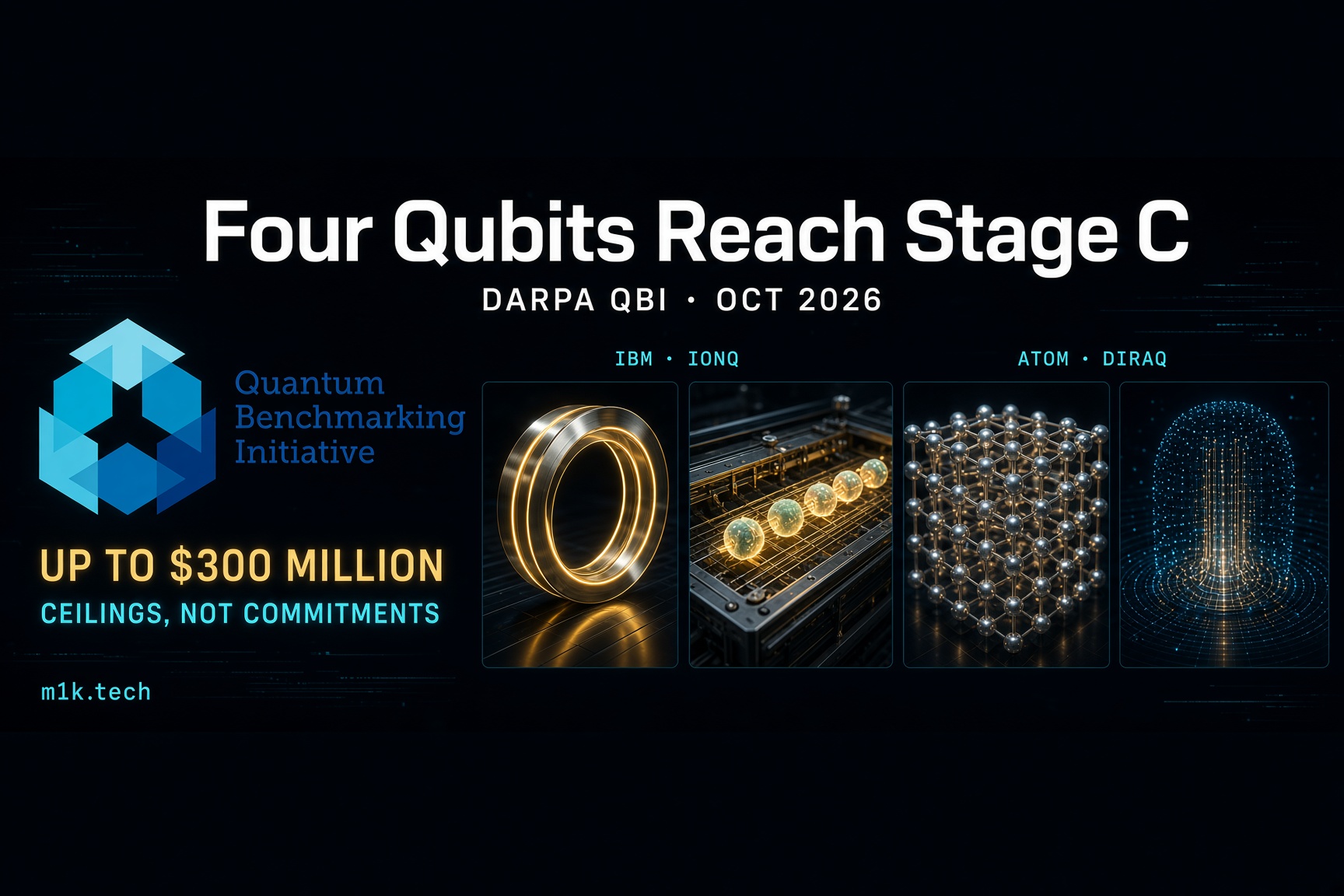
The DARPA Quantum Benchmarking Initiative moved IBM, IonQ, Atom Computing, and Diraq into Stage C on Wednesday, October 7, joining Microsoft and PsiQuantum, which reached it earlier through a pilot program that preceded QBI. The four are betting on four different qubits: modular superconducting processors at IBM, trapped ions at IonQ, neutral atoms at Atom and silicon spin qubits at Diraq.
Two dollar figures came out of it, and I would read both as ceilings. IonQ says its Stage C agreement is worth up to $300 million and runs through 2029, with anything beyond the initial obligation dependent on future appropriations and DARPA funding decisions. Atom Computing also cites potential funding of up to $300 million. The coverage I read gives no amount for IBM or Diraq, and neither IonQ nor Atom says how much is committed today.
Stage C is not a repeat of Stage B, which spent a year reviewing plans, risks, and prototype goals. QBI managing director Micah Stoutimore describes this one as the point where the program starts “moving from plans to proof”: a government evaluation team checks whether each utility-scale design can be built as drawn and works as planned. IBM names its target as Quantum Starling, its first fault-tolerant machine, due in 2029, and IonQ says DARPA will test several generations of its Superion systems against its own roadmap. Those are the company’s descriptions of the testing, and DARPA hasn’t said what a failed check looks like.
The detail that stopped me is in Atom Computing’s announcement: Microsoft has agreed to provide algorithmic support and error correction codes to Atom as part of the program. Microsoft is itself in Stage C on a different bet, and I wrote about Microsoft letting DARPA near its most contested qubit only two weeks ago. Helping a neutral-atom company while competing with it is either confidence or hedging, and I can’t tell which from a press release.
QBI says it does not pick winners. It asks whether any approach can reach utility scale by 2033, meaning the point where a machine’s computational value exceeds its cost, and Stoutimore says DARPA increasingly expects someone to get there without knowing who. That is DARPA’s stated expectation, not a finding. My piece on quantum computing’s reproducibility problem was about how few independent checks this field’s claims get, and a government team with hardware access is a real step toward one, though I haven’t seen a commitment to publish what it finds. IBM’s recent quantum advantage claims got a second opinion from two rivals, which is a smaller and friendlier version of the same idea.
The public money around this keeps stacking up: DOE’s Quantum Genesis Q put $215 million on fault tolerance, and Germany wrote its third big quantum check in three weeks. Promotions get announced loudly. I will be watching for the first Stage C company that quietly stops being mentioned.
Sources
- GovConWire, DARPA Adds 4 Companies to Quantum Benchmarking Initiative’s Final Stage, October 8, 2026
- The Quantum Insider (Atom Computing press release), Atom Computing Advances to Final Stage of DARPA Quantum Program, October 8, 2026
- IonQ, IonQ Advances to DARPA QBI Stage C in $300M Agreement (company announcement), October 7, 2026
- IBM Newsroom, IBM Stage C announcement (linked from GovConWire), October 7, 2026
- DARPA, Four more teams enter QBI final stage (linked from GovConWire), October 7, 2026