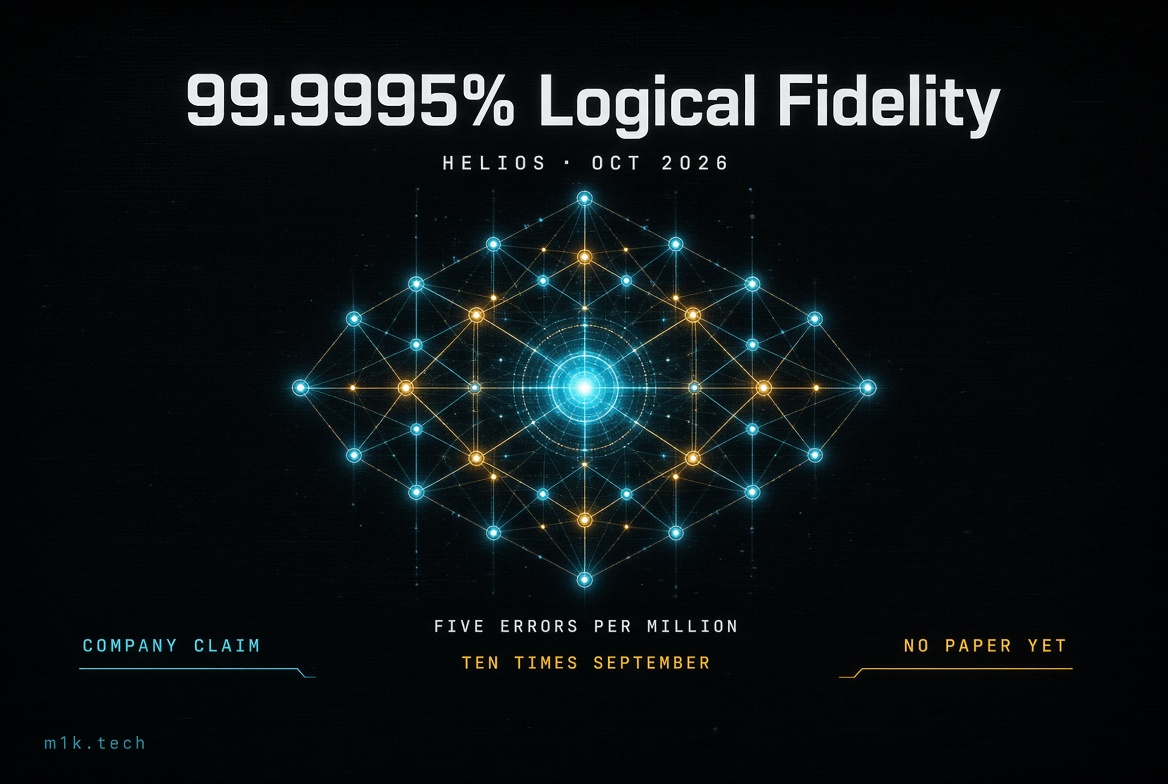
Quantinuum Helios reached 99.9995% logical fidelity on Monday, according to the company, which puts that at five errors per million operations. Quantinuum says it is ten times better than its own record from September and a hundred times better than the best published result on any other kind of hardware, a Google Quantum AI superconducting experiment.
What changed between the two records is the code, not the machine. In September the company ran its Helix code on Helios and used 10 physical qubits per logical qubit. This time it used a color code, which needed up to 37 physical qubits per logical qubit and delivered the lower error rate, so the trade is accuracy against qubit cost on identical commercial hardware. The part I care about more than the headline fidelity is the scaling: Quantinuum says each step up in code distance cut the remaining logical errors by a factor of 12. A single good number can come out of a small, lucky code. Errors that keep shrinking by a fixed multiple as the code grows are what working below threshold looks like, and that is what the machine has to do before anyone can talk sensibly about scaling it. Robin Blume-Kohout of Sandia, who was not involved in the study, described a logical qubit nearly 100 times better than its component physical qubits and said a scaled-up version could reach useful reliability with fewer than a million physical qubits. That is an outside voice, and it is the most useful sentence in the release.
That is the claim. I have read the release and the coverage built on it, not the paper.
In August I wrote about the Regensburg study that found only about nine percent of quantum computing papers could be reproduced, and a record announced by the company that holds it is exactly the kind of result that study was worried about. Helios is at least a commercial machine. Oracle is putting one inside its own cloud, so outside groups may get a chance to test this, though I don’t know whether the color code is exposed to customers.
The hundred-fold gap over Google depends on what counts as published, since it compares across hardware types and rests on one paper Quantinuum chose as the yardstick. Quantinuum has played the neutral party before: when IBM’s advantage claims needed a second opinion, one of the cross-checks ran on Quantinuum’s trapped ions and matched. And the claim that trapped ions reach fault tolerance with fewer qubits than other approaches has to live alongside estimates that move a lot with tooling alone. Iceberg Quantum, running Diraq’s spin-qubit design through NVIDIA’s software, landed on 150,000 physical qubits for 1,000 logical ones, about a tenth of Diraq’s own earlier figure.
Apollo, the fault-tolerant machine Quantinuum promises by 2029, is the date to hold them to, and the color code run is the first thing I would want an outside lab to repeat.
Sources
- Quantinuum, Quantinuum Breaks Error-Correction World Record by 10x, Validating its Leading Path to Fault-Tolerant Quantum Computing by 2029, October 19, 2026
- The Quantum Insider, Quantinuum Reports a 10x Reduction in Logical Error Rate on Helios, October 19, 2026
- Nature, Google Quantum AI superconducting error-correction result, the paper Quantinuum cites as the best published comparison, 2024