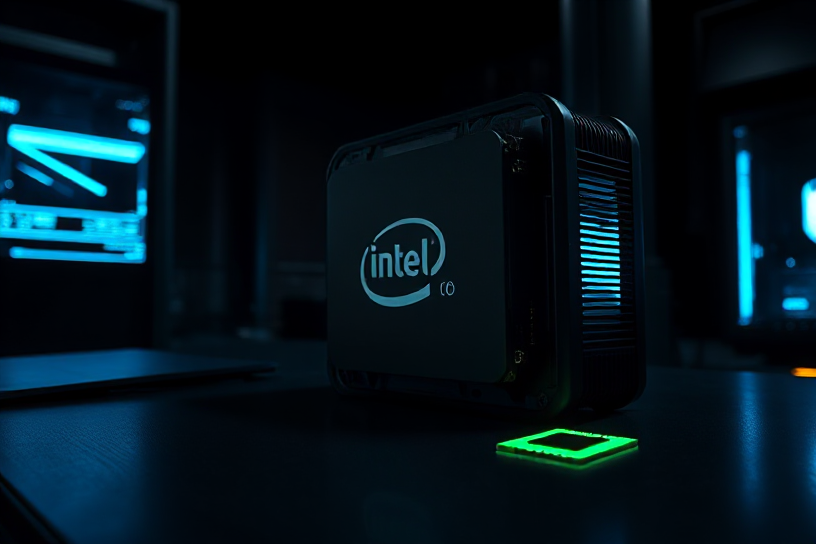
Intel unveiled the Xeon 6+ chip at Computex, built on its 18A process node, positioning it for agentic AI orchestration rather than training or inference. Featuring 288 E-cores, Foveros Direct 3D packaging, 12-channel DDR5-8000 memory, and 96 PCIe 5.0 lanes, it targets memory bandwidth and multi-GPU coordination, competing with Nvidia’s ARM-based Vera CPU approach.
Separately, MIT introduced a code reasoning AI model using a hybrid architecture trained on open-source repositories to understand program state and cross-file dependencies, rather than just generating syntactically correct code. Both developments highlight that production AI systems depend as much on underlying infrastructure and integration as on model or chip specifications, with real-world adoption serving as the key indicator of success.
The AI chip war is not won by the loudest GPU launch. It is won by the infrastructure nobody talks about: the CPUs running the orchestration layer and the models smart enough to actually ship production code. Two announcements this week prove that point, and neither generated the headline attention they deserved.
Intel Xeon 6+ at Computex: the boring chip that matters
Intel announced Xeon 6+ at Computex yesterday in Taipei, built on the Intel 18A process node with up to 288 E-cores and Foveros Direct 3D packaging. The headline spec that matters is not the core count. It is the architectural positioning: Intel is explicitly framing this chip for the agentic AI orchestration layer, not for training and not for primary inference. The CPU that manages memory, handles I/O, coordinates multi-GPU workloads, and runs the non-AI portions of your application stack.
That is territory Nvidia has never tried to own. The Vera CPU benchmarks I covered last week showed Nvidia entering this space with an ARM-based design. Intel is responding with its own foundry process, which is the more interesting competitive signal. If Intel 18A works at scale, Intel has both the chip and the manufacturing capacity. If it does not, this is another generation of ambitious specs that underdeliver in production. I have watched that cycle play out before with Intel, and I am not yet ready to call it either way.
The 12-channel DDR5-8000 memory support and 96 PCIe 5.0 lanes are the practical details that system architects care about. More memory bandwidth means less time waiting for data to move between the CPU and the GPU. More PCIe lanes means more headroom for multi-GPU configurations without bandwidth starvation. These are incremental improvements, but they are incremental improvements to the part of the stack that determines whether your GPU investment actually delivers ROI.
MIT’s code reasoning model
MIT’s new AI model for code reasoning was not the week’s flashiest announcement, but it is the one I found more technically interesting. The model uses a hybrid architecture trained on open-source code repositories with a focus on program state understanding: not just generating syntactically correct code but reasoning about what the code does, where it breaks, and how dependencies propagate across a multi-file codebase.
That is a meaningfully different problem than autocomplete. Most AI coding assistants today fail on architecture-level tasks: refactoring across modules, debugging logic errors in complex state machines, understanding how a change in one function propagates through a system. They excel at isolated function generation and stumble on anything that requires holding a mental model of a larger system. MIT’s approach addresses those gaps by training on real repositories with real architectural patterns rather than curated code snippet datasets.
The practical benchmark that matters is not MMLU or HumanEval. It is whether the model works in an actual development workflow without constant correction. Andrew Ng’s unbiggen thesis applies here: a smaller model trained on higher-quality domain-specific data often outperforms a larger general-purpose model on the specific tasks that matter. I am watching for whether this shows up in a real product rather than staying a research paper.
Why these two belong in the same piece
Production AI systems require both better models and better infrastructure, and the bottleneck shifts between them depending on the workload. MIT’s code model is only as useful as the infrastructure that can serve it reliably. Intel’s Xeon chip is only as valuable as the models running on it can solve real problems. The companies winning at AI deployment have figured out the integration layer: how to serve models with predictable latency, how to manage inference costs at scale, how to handle the 90% of system complexity that is not the model itself.
I am watching two signals. Whether MIT’s model ends up in GitHub Copilot, Cursor, or another coding tool with real daily usage. And whether Intel’s Xeon 6+ pricing convinces hyperscalers to diversify their CPU procurement away from AMD EPYC, which has been winning data center share for the last three years. Those adoption signals are more informative than any benchmark number either company publishes.