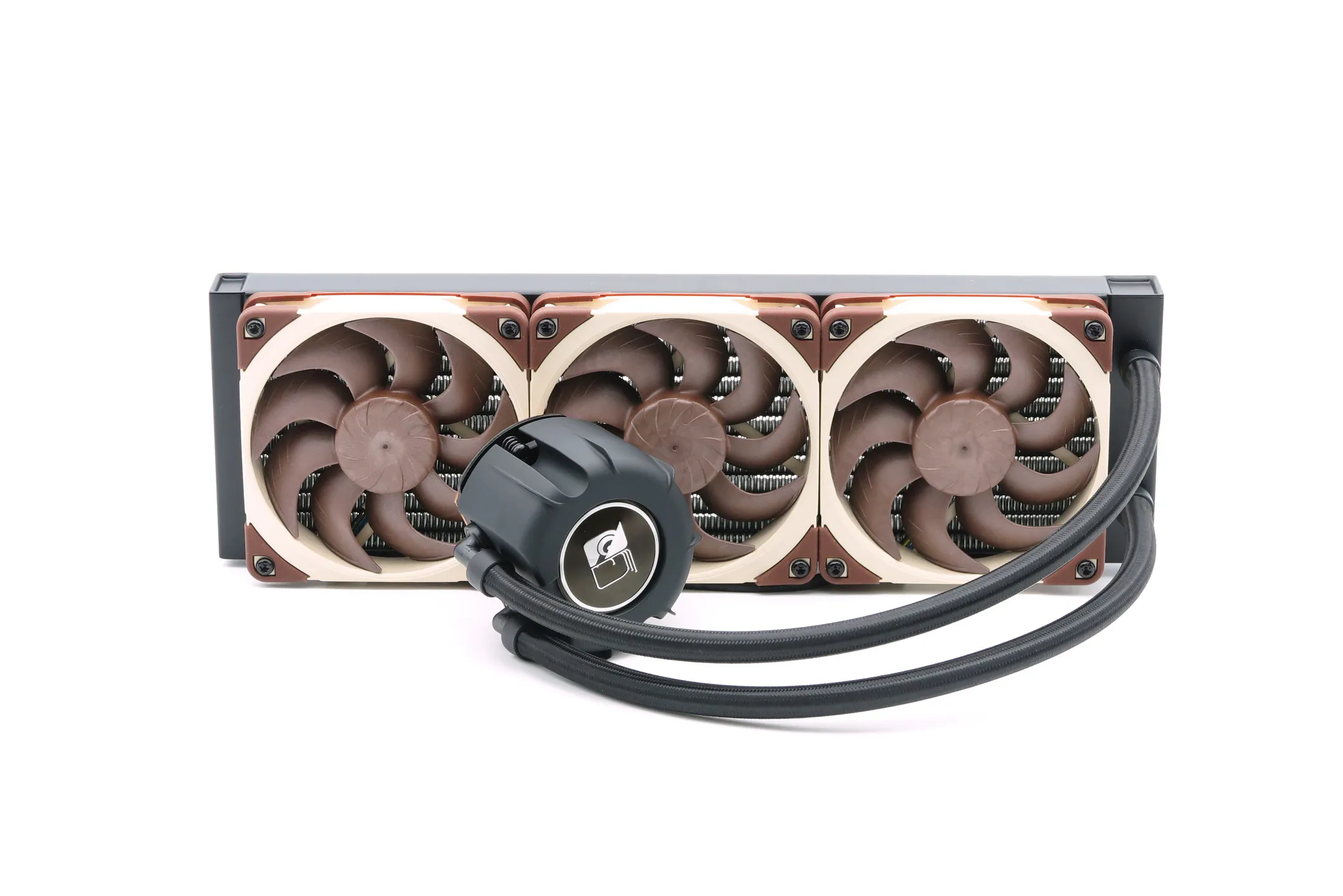
Noctua, long known exclusively for air coolers, has announced its first liquid cooler, the NL-LC1, unveiled at Computex 2026 and shipping June 16. Available in 240mm, 360mm, and 420mm radiator sizes priced between 219.90 and 279.90 euros, it uses Asetek’s proven Emma V2 pump platform paired with Noctua’s own noise-reduction engineering and flagship fans.
The cooler’s key innovation is the NL-PNA1, a triple-layer pump noise absorber with vibration damping, alongside three selectable pump speed profiles and slight fan speed offsets to reduce humming. An optional NL-ACF1 auxiliary fan addresses VRM, RAM, and M.2 cooling typically lost when switching from air to liquid cooling. The product carries a six-year warranty and was delayed from Q1 to Q2 2026 due to a quality issue with the noise-damping component.
Noctua makes air coolers. That has been the whole point of Noctua for twenty years (and I have used their products since the beginning; one is still mounted on one of my computers). Brown and beige fans, gigantic tower heatsinks that look like industrial HVAC equipment, and a near-religious refusal to chase trends. While the rest of the cooling industry pivoted hard to all-in-one liquid coolers with RGB pumps and LCD screens, Noctua sat there selling the NH-D15 and quietly being better at the boring stuff than anyone else. So the NL-LC1, officially unveiled at Computex 2026 and shipping June 16, is a real surprise: Noctua’s first-ever liquid cooler. The company that resisted AIOs the longest finally built one.
And of course, they did it the Noctua way, which is to say slowly, carefully, a year late, and obsessed with noise.
The Lineup and the Price
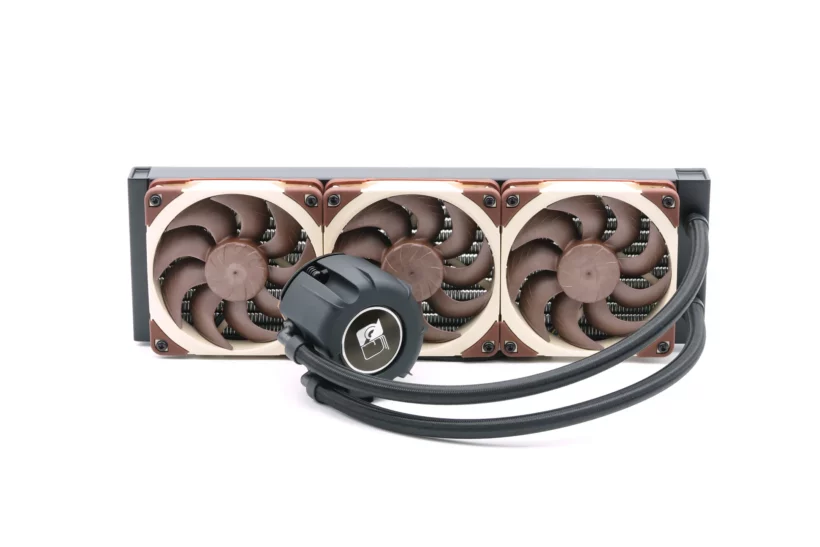
The NL-LC1 series comes in three sizes: the NL-LC1-24 with a 240mm radiator, the NL-LC1-36 with a 360mm radiator, and the NL-LC1-42 with a 420mm radiator. They launch June 16, 2026, at 11 a.m. CEST, priced at 219.90 euros for the 240mm, 249.90 euros for the 360mm, and 279.90 euros for the 420mm. In US terms, that puts the entry model around $250 and the largest around $325. There is also an optional accessory, the NL-ACF1 auxiliary fan, at 19.90 euros, which I will come back to because it is actually one of the more thoughtful parts of this launch.
The whole range carries a six-year warranty, which is standard Noctua and worth noting because most AIO warranties top out at five or six years, and the pump is usually the first thing to fail. Noctua putting its name and its warranty length on a liquid cooler tells you they intend to support it the way they support their fans.
It Is an Asetek Cooler Underneath, and That Is Fine
Here is the part the spec-sheet crowd will fixate on: Noctua did not build its own pump. The NL-LC1 is based on Asetek’s Emma V2 platform, also known as the G8 V2. Asetek is the company that quietly makes the pump and cold plate for a huge slice of the premium AIO market, so a great many coolers you already know are Asetek designs with someone else’s fans and shroud bolted on. Noctua took the same route.
I do not see this as a problem, and neither should you. Designing a reliable pump from scratch is hard to get right, and the failure rate of first-generation in-house pumps across the industry is not pretty. Noctua building its first liquid cooler on the most proven pump platform available is the conservative, sensible engineering choice, and conservative, sensible engineering is the entire Noctua brand. The Asetek Emma V2 pump runs at a nominal speed of roughly 3,600 RPM, give or take 300, and it has years of field reliability behind it.
What makes it a Noctua product is everything Noctua added on top.
The Noise Obsession, Quantified
The single biggest complaint about AIOs versus air coolers is pump noise. A good air cooler has exactly one type of moving part: fans. An AIO adds a pump, and pumps whine, buzz, and transmit vibration into the chassis in ways that drive quiet-PC people up the wall. This is precisely the problem Noctua exists to solve, so it is no surprise that the NL-LC1’s headline engineering is all about silencing the pump.
Noctua developed a custom part called the NL-PNA1, a Pump Noise Absorber. It is a triple-layer cover that wraps the pump with three layers of soundproofing, combined with an integrated tuned-mass damper that cancels vibration before it reaches the rest of the system. Noctua claims that, in psychoacoustic terms, loudness, sharpness, roughness, and overall annoyance all improve across most of the pump’s speed range. That is a more honest way to talk about noise than a single dBA number, because two coolers can measure the same decibel level while one sounds like a soft hum and the other sounds like a mosquito in your ear. Noctua is targeting the quality of the noise, not just the quantity.
There are three pump profiles. Quiet, the default, caps the pump at 2,100 RPM. Balanced lets it reach 2,600 RPM and kicks in automatically once the coolant temperature crosses 30 degrees Celsius. The manual gives you the full range, from a 750 RPM floor up to 3,400 RPM, for people who want to tune it themselves. Defaulting to Quiet rather than Balanced or full speed is a very Noctua decision: out of the box, it prioritizes silence and only ramps when the liquid actually heats up.
The fans are, predictably, excellent. The 240mm and 360mm models ship with NF-A12x25 G2 fans, and the 420mm model gets the larger NF-A14x25 G2. These are Noctua’s current flagship fans and among the best made by anyone. There is a clever detail here, too: Noctua applies a slight speed offset between the fans, plus or minus 50 RPM on the 360mm and plus or minus 25 RPM on the 420mm, specifically to break up the periodic humming and beat frequencies you get when identical fans spin at identical speeds next to each other. That is the kind of detail almost nobody else bothers with.
Mounting, Clearance, and the Boring Stuff That Matters
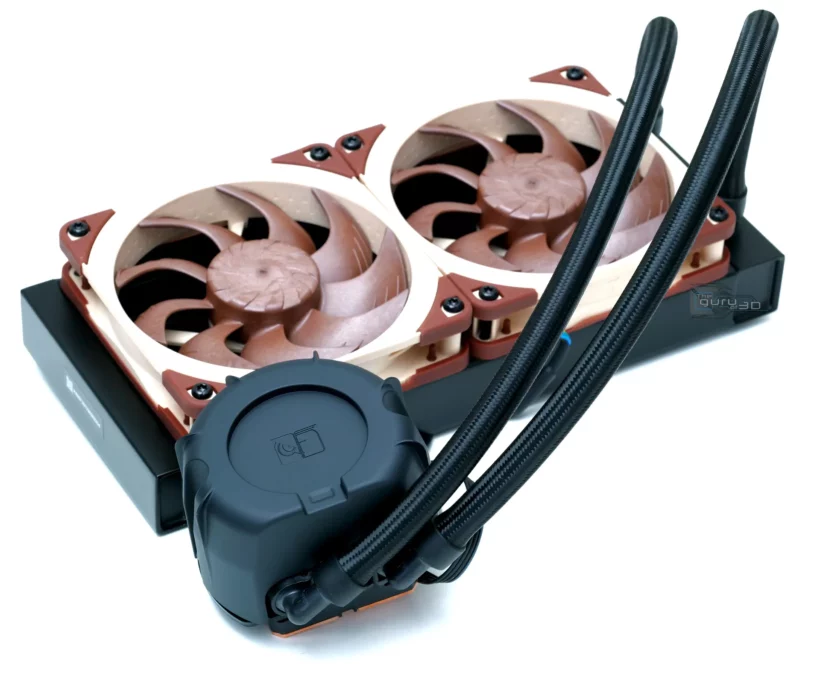
The NL-LC1 uses Noctua’s SecuFirm2+ mounting system, which supports AM4, AM5, LGA 1700, and LGA 1851. If you are already running a recent Noctua air cooler, you can keep your existing mounting bracket and just swap the cold plate over, which is a nice touch for existing customers and the kind of cross-compatibility most brands deliberately avoid to sell you new hardware.
The radiators are the industry-standard 30mm thick, with a total thickness of 59mm including fans, anti-vibration mounts, and screw heads. There is 35mm of RAM clearance, enough for most DDR5 modules without fighting the cold plate. And the base uses what Noctua calls LBC convexity, a slightly convex contact surface tuned for proper contact on AM5 and AM4 without the offset mounting brackets some coolers require. The coolers are manufactured by Asetek and then assembled, tested, and packaged in Taiwan, with each unit undergoing a final acoustic inspection after the NL-PNA1 is installed. An acoustic inspection on every single unit is not something the rest of the industry does.
The NL-ACF1 Auxiliary Fan Is the Sleeper Feature
This is the part I find most interesting, and it speaks to Noctua actually understanding the downside of liquid cooling rather than just selling into the trend. When you switch from a big air tower to an AIO, you lose something you may not have thought about: the air cooler’s fan was also blowing air across the area around the CPU socket, cooling your VRMs, your RAM, and your M.2 drives. An AIO cold plate cools the CPU and nothing else, so those surrounding components often run hotter in a liquid-cooled build than they did under a tower.
The NL-ACF1 solves exactly that. It is a small 80mm NF-A8 PWM fan that snaps onto the cooler magnetically and blows air across the socket area to cool the VRMs, RAM, and M.2 slots that the AIO no longer reaches. The frame uses the Coanda effect to guide the airflow outward across those components. At 19.90 euros, it is an afterthought price for something that addresses a real, often-overlooked weakness in liquid cooling. Most AIO makers would never point out that their product cools your motherboard worse than the air cooler it replaced. Noctua built and sells the fix.
Why It Was Late, and What Else Is Coming
The NL-LC1 was originally meant to launch in Q1 2026. It slipped to Q2 because of a quality problem in the manufacture of the vibration dampers in the pump unit, the very NL-PNA1 component that is the cooler’s whole reason for existing. That is an extremely Noctua reason for a delay: they held the launch rather than ship a noise absorber that did not meet their noise-absorption standard. Annoying for anyone who was waiting, but exactly the behavior that earned the brand its reputation.
Noctua also used Computex to tease the rest of its roadmap, and it is a busy one. Next-generation heatsinks, including a dual-tower seven-heatpipe monster aimed at upcoming AMD Threadripper and Zen 6 workstation CPUs. A PRIME TX power supply with OptiGuard. Ryzen-ready Carbice thermal pads. And, still, the long-promised and perpetually elusive Thermosiphon, the passive cooling project Noctua has been showing prototypes of for years without ever shipping. At this point, the Thermosiphon is basically the Noctua equivalent of a concept car that lives forever at the auto show.
The NL-LC1 is not going to win raw thermal benchmarks against the most aggressive 420mm AIOs from Arctic or the price-per-performance champions. It is an Asetek platform with Noctua fans and a Noctua noise-suppression system, sold at a Noctua price, which is to say not cheap. If you only care about degrees per dollar, there are better numbers elsewhere.
But that was never what Noctua was selling. The pitch here is the quietest pump on the market, the best fans on the market, mounting that works with your existing Noctua bracket, an auxiliary fan that fixes a real problem nobody else acknowledges, a six-year warranty, and an acoustic inspection on every unit. For the specific person who has been holding onto an NH-D15 for years because every AIO they tried was too loud, this is the first liquid cooler built for them. After twenty years of saying air cooling was enough, Noctua finally made the liquid cooler it would actually use itself. That took a while, and it shows.
Sources: Tom’s Hardware, VideoCardz, PCGamesHardware.de, Guru3D, OC3D, WCCFtech, Overclocking.com, partofstyle, hardwarecooking.fr. Reported from Computex 2026, Taipei, June 4, 2026.