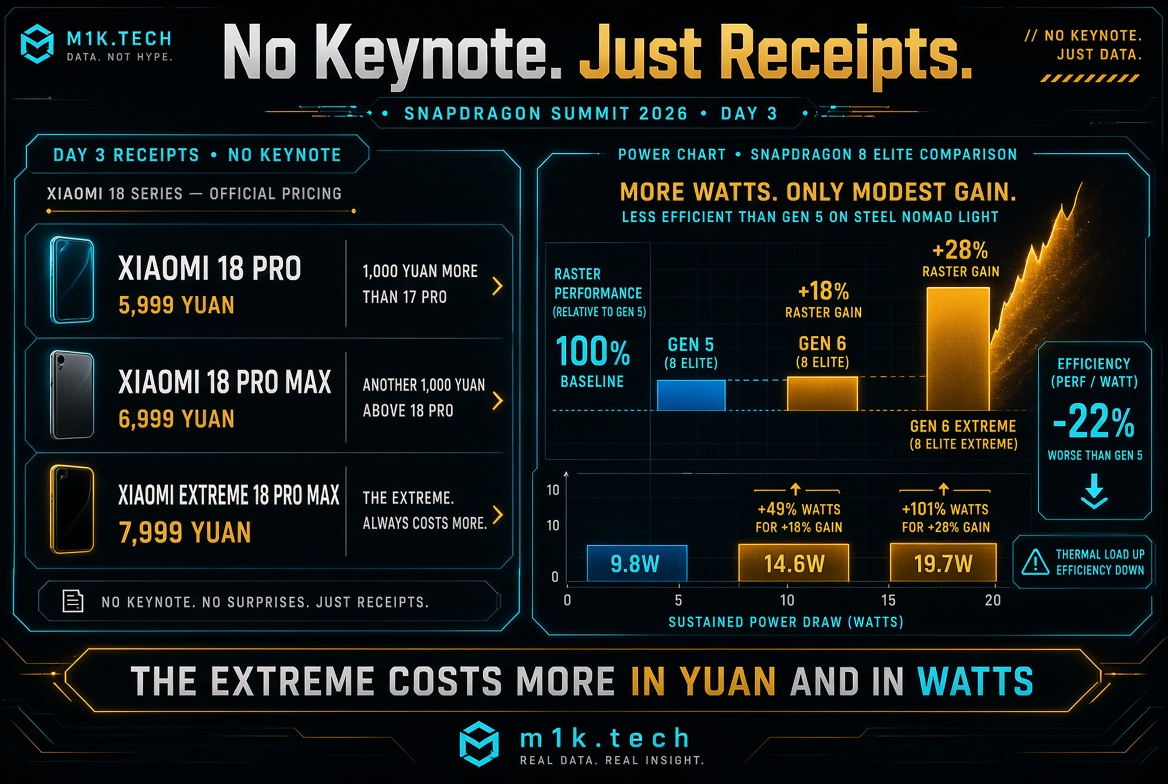
The most useful number from Snapdragon Summit 2026 was never said on the Maui stage. It’s one thousand yuan, the gap between the 4,999 yuan Xiaomi charged for a 12GB/256GB Xiaomi 17 Pro last September and the 5,999 yuan it’s asking for the same configuration of the Xiaomi 18 Pro, the first phone on the plain Snapdragon 8 Elite Gen 6, which opened for orders in Beijing on Wednesday evening. Roughly 20 percent more, for the volume chip, on day one.
Day 3 is the part of the Summit Qualcomm doesn’t put on the livestream: breakout sessions, architecture briefings, reference phones chained to tables, executives doing one-on-ones in the shade. So the news today mostly came from outside the ballroom, from a price poster in Beijing, Honor’s CEO on Weibo, and a benchmark chart with power figures that a Chinese leaker dropped overnight. Together, they answer more of my Day 1 questions than two days of keynotes did, and not all the answers are the ones Qualcomm wanted.
I closed my Day 1 piece on the two-tier flagship split by complaining that Qualcomm never said what an Extreme costs compared with a Gen 6, and that Xiaomi’s price tags would be the first real clue. Here it is. The 18 Pro Max, on the Extreme, starts at 6,999 yuan for the same 12GB/256GB, exactly 1,000 yuan above the 18 Pro. That gap also buys a 6.9-inch screen instead of 6.4 and an 8,500mAh battery instead of 7,000mAh, so the chip itself is only some slice of about $150 at retail. I expected a bigger halo tax, and I was wrong. The tier split turns out to be cheap at the counter. The generation is what got expensive. For context, the Xiaomi 15 Pro launched at 5,299 yuan in October 2024, the 17 Pro dropped to 4,999 last year, and now we’re at 5,999, with the Pro Max climbing to 9,999 yuan for 16GB and a terabyte, and 10,999 for the transparent special edition.
Lu Weibing didn’t pretend it was about the Leica cameras. Xiaomi’s president told the launch audience that memory prices have been rising for about a year and a half and that the industry expects them to keep rising through 2027, which is the same argument I made about why the Poco F9 Ultra skipped a Snapdragon generation a few weeks ago, now said out loud by the man who runs the company. My Day 1 bet was that at least one major OEM would ship a Gen 6 phone cheaper than its Gen 5 predecessor to prove the split was worth it. The very first Gen 6 phone went the other direction by a fifth. I’m not withdrawing the bet yet; there are a dozen launches coming, but I’m less comfortable with it than I was on Tuesday.
Honor’s version of the same problem arrived today, China time. CEO Li Jian posted Magic 9 pricing four days before the September 28 launch: 6,499 yuan list for 16GB/512GB, a 5,999 yuan tenth-anniversary price, and 5,499 yuan after China’s national subsidy. Three prices for one phone is its own kind of confession about how hard it is to sell a flagship this year. The leaks don’t even agree on whether the base Magic 9 runs the Gen 6 or last year’s Gen 5, and if it’s the Gen 5, that’s the Poco move again with a bigger logo. Counterpoint expects global smartphone shipments to fall 14 percent in 2026, and every price I saw today reads like a company planning for that number.
The benchmark picture got clearer and less flattering at the same time. Across every reference-device session this week, the pattern held: Apple’s A20 Pro keeps single-core by something like 9 to 15 percent depending on who ran it and which Geekbench version, the Extreme ties or edges ahead in multi-core, and the GPU result depends entirely on which test you trust. Kyle Barr at Gizmodo had the Extreme about 20 percent ahead of the A20 Pro in 3DMark and 8 percent ahead in multi-core Geekbench, and then ran AnTuTu and watched the reference phone get uncomfortably hot and lose nearly 9 percent of its battery in a few minutes, which he said was worse than what he saw from last year’s chips. Reference phones run with generous cooling and maxed-out memory, so that’s close to a best case for heat, not a worst case.
What I can’t stop looking at is the chart Digital Chat Station posted, because it includes power draw, which none of the Maui sessions gave us. Here’s the 3DMark Steel Nomad Light slice, with points per watt worked out from the posted figures:
| Chip | Process | Steel Nomad Light | Power | Points per watt |
|---|---|---|---|---|
| Xiaomi XRING O3 | 3nm | 4,604 | 18W | ~256 |
| Apple A20 Pro | 2nm | 4,255 | 14W | ~304 |
| MediaTek Dimensity 9600 Pro | 2nm | 4,238 | 16W | ~265 |
| Snapdragon 8 Elite Extreme Gen 6 | 2nm | 3,688 | 17W | ~217 |
| Snapdragon 8 Elite Gen 6 | 2nm | 3,579 | 14W | ~256 |
| Snapdragon 8 Elite Gen 5 | 3nm | 3,015 | 13W | ~232 |
Qualcomm claimed 44 percent more GPU performance and 40 percent better efficiency than Gen 5 for the Extreme. On this test, it’s about 22 percent faster (the same 22 percent that showed up in Tuesday’s reference-device runs, which I noted at the time) while drawing roughly 31 percent more power, making it slightly less efficient than the chip it replaces. And the plain Gen 6 sits just 3 percent behind the Extreme on score while pulling 3W less, landing at the best efficiency of any Snapdragon on the chart. In raw rasterization, the Extreme is the Gen 6 with the power limit turned up. Whatever its GPU is worth has to come from the Matrix Cores and Neural Fusion, the Extreme-only features I was already skeptical about when Qualcomm previewed them, and this chart doesn’t test either one.
The game runs on the same chart, telling a gentler version of the story. In Genshin Impact, every chip landed between 59.2 and 59.8fps, and the Extreme used the least power of the lot at 3.8W, which is a real point in its favor, and I want to be fair about it. In Honor of Kings, everything sat at 120fps, and the plain Gen 6 drew the least at 2.7W. Wuthering Waves is the one that stings: the Extreme hit 57.2fps at 5.6W, while last year’s Gen 5 hit the identical 57.2fps at 5.4W. A new chip on a new node, a full generation later, matching its predecessor’s frame rate for slightly more power in a demanding game is not the leap anybody in Maui described.
Then there’s Xiaomi’s own chip sitting at the top of the table. The XRING O3, the ten-core design with no efficiency cores that I dug into in August, tops the multi-core Geekbench 7 result at 12,259 against the Extreme’s 11,155, and wins Steel Nomad Light outright, on a 3nm process, tested with LPDDR6. It pays for that at 18W, the hungriest figure on the chart, and its single-core score of 3,034 is the lowest in the comparison, below even last year’s Gen 5. So it’s not a clean win. But Xiaomi launched a Pro Max on Qualcomm’s premium chip the same week a chart shows its in-house silicon out-scoring it from a node behind, and I find that more interesting than any keynote slide. Xiaomi’s chips still hedge the Qualcomm relationship; they’re just hedging from a stronger position than I assumed. MediaTek’s Dimensity 9600 Pro, which beat Qualcomm to 2nm by a week, quietly posts better efficiency than any Snapdragon on the chart, and it also led Wuthering Waves at 58.3fps on 5.3W. The caveat matters: the leaker didn’t say which phones ran these tests, and I’d treat every number here as directional until retail units exist.
Qualcomm’s own Day 3 briefings mostly restated the Day 1 spec sheet with more confidence: 32,000-token context windows on the Hexagon NPU, mixture-of-experts models past 30 billion parameters, and the Sensing Hub’s twin micro-NPUs building Personal Scribe’s private knowledge graph from your messages and email. One new description caught me. The Spectra ISP is now being called a 20-bit architecture, the first to support three 64MP cameras, and I can’t square that with the 16 bits of data per pixel Qualcomm quoted for Intelligent Pixel Control on Tuesday. My guess is pipeline bit depth versus per-pixel metadata, but it’s a guess, and nobody I’ve seen explained the difference. I still haven’t seen a tokens-per-second figure for a 30B model paging experts in from flash, which remains the only number that decides whether that feature is a product or a demo. What I understand better after this week’s heat reports is why Qualcomm put a heat slug directly on the Extreme’s die and keeps saying it doubles how long the chip holds peak performance.
High Bandwidth Compute, the co-processor Amon announced on Tuesday with no specs at all, got a partial answer, though not from Qualcomm’s stage. The Elec reports that Qualcomm will design only the compute die and the through-silicon-via layout, that Samsung and SK hynix will stack the low-power DRAM on top of it, and that TSMC will handle integration and packaging. Amon’s justification, per the same report, is that some future agentic devices will run all day and chew through as many as a million tokens daily on the device. The data center flavor of HBC is quoted at hundreds of terabytes per second; for the phone version, we still have nothing. And I keep coming back to the irony that the part meant to get on-device AI off the DRAM treadmill is itself a stack of LPDDR, built by the exact two companies whose pricing Lu Weibing blamed for the 18 Pro’s price tag. MWC in March is still where the real details land.
A few smaller things from the corridors. Don McGuire told an interviewer this week that Microsoft’s consumer Surface lineup is now 100 percent Snapdragon, which is a brand win and also means the $350 Surface price jump I wrote about yesterday lands on Qualcomm’s reputation as much as Microsoft’s. Qualcomm’s follow-up post on the Mastercard shopping demo coined the phrase “bounded proactivity” for an agent that engages selectively and asks for consent before it acts. I like the phrase. It doesn’t fix Tuesday’s demo agent recommending its sponsor’s processors, but it’s the right instinct. And a correction on my own Day 2 post: the eyewear startup is Awear, not Aware, and its founder is Ash Saulsbury. I’ve fixed both. Meta Connect ran at the same time as the Summit with a pile of glasses news, and I’m deliberately leaving it out here because it deserves more than a paragraph squeezed into someone else’s recap.
The launch calendar from here is lumpy. Xiaomi’s 18 Pro pair goes on sale September 28, the same day Honor launches the Magic 9 series with a Magic9 Pro Max on the Extreme. iQOO 16 follows on September 29. OnePlus has confirmed the OnePlus 16 on the Extreme but has no date, and RedMagic says October for the 12 Pro+. Motorola’s Signature 27 is still “coming to the US” with no price and no date; Xiaomi promises a global launch later this year, and after that it’s a long quiet stretch until reviewers get retail units and run sustained tests, which is the only thing that settles any of the above. Samsung decides about the Galaxy S27 whenever Samsung decides.
Three days in, the Extreme looks like a chip you pay for twice, once in yuan and again in watts, and the features that are supposed to justify it, Neural Fusion and the 30B model streaming from flash, are exactly the ones nobody could independently test this week. If I were buying in China next month, I’d pick the plain Gen 6 phone and enjoy the battery. What I still don’t know is whether a retail cooling system like Motorola’s ArcticMesh turns the Extreme into the chip Qualcomm described on Tuesday, or whether 17 watts in a pocket is just 17 watts in a pocket. Ask me after the first thirty-minute Wuthering Waves run on a shipping 18 Pro Max.
Sources
- Gizmochina, Snapdragon 8 Elite Extreme Gen 6 vs A20 Pro vs XRING O3 vs Dimensity 9600 Pro: All chips compared (Digital Chat Station charts), 24 September 2026
- Gizmodo, Qualcomm’s iPhone Killer Chip Is a Performance Monster Built for Supersized Phones, 23 September 2026
- BigGo Finance, Xiaomi Launches 18 Pro Series; Lu Weibing Says Memory Prices May Keep Rising Through 2027, 23 September 2026
- Technology.org, Xiaomi 18 Pro Adds Privacy Screen, Huge Battery, 25 September 2026
- Techgenyz, HONOR Magic 9 Price Revealed Ahead of September 28 Launch, 24 September 2026
- Gizmochina, Upcoming phones with Snapdragon 8 Elite Extreme Gen 6 chip, 24 September 2026
- The Elec, Qualcomm Brings Data Center HBC Technology to Smartphone Chips, September 2026
- The Next Web, Snapdragon Summit: Qualcomm’s 5GHz phone chips, AI earbuds and Linux PCs, September 2026
- IDC, Snapdragon Summit 2026: Qualcomm’s Bid to Be the Silicon Behind Every Agent on Every Device, 24 September 2026
- Qualcomm OnQ, Agentic commerce: Enabling AI agents to understand, discover and transact, September 2026
- Yahoo Finance, Qualcomm’s CMO reveals the secret behind Snapdragon’s rise, September 2026
- PR Newswire, Emerging from Stealth, Awear Introduces a New Platform for Personal AI, 23 September 2026