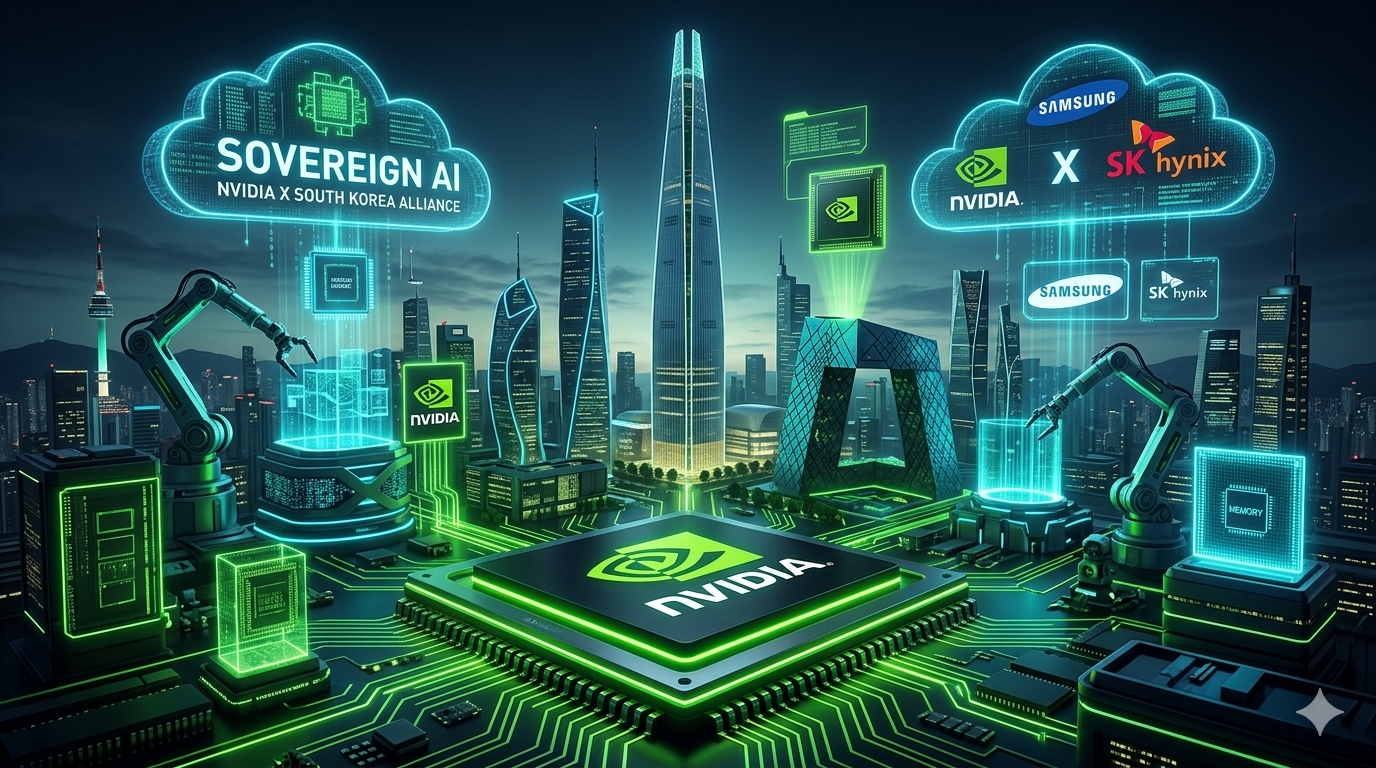
NVIDIA’s Korea deals, announced June 8 during a Jensen Huang roadshow through Seoul, just wired the company into an entire country’s AI stack. NVIDIA signed a cluster of agreements with SK Hynix, Naver, and Doosan to build AI data centers and run them on NVIDIA technology. No deal values were disclosed by anyone, which is its own tell, but the shape of it matters more than the numbers. This is not a chip sale. This is Nvidia embedding itself into the memory, the cloud, the data centers, and even the robots of one of the most important manufacturing nations on earth.
The roadshow, because the theater is part of the point
Huang arrived in South Korea on Friday and spent the weekend doing the things that make headlines: eating fried chicken with Korea’s top corporate bosses, meeting a famous esports gamer, and throwing a ceremonial baseball pitch. It reads like a charm offensive because it is one. And it landed at a useful moment. Korean equities had been wobbling under a global chip selloff, the market even tripped a 5 percent downward circuit breaker, and Jensen showing up with a fistful of partnership announcements handed Seoul a reason to exhale. When the head of the most valuable chip company on the planet flies in personally and starts signing deals with your national champions, that is not just business, it is a statement about where the AI buildout is going to physically happen.
The three deals, and what each one actually does
SK Hynix is the big one. NVIDIA and SK Hynix signed a multi-year technology partnership to co-develop next-generation memory for AI data centers. In concrete terms, SK Hynix will build memory for Nvidia’s Vera Rubin AI supercomputers, Vera CPUs, RTX Spark PCs, and Jetson Thor robotics platform. That is not a narrow agreement; it spans Nvidia’s entire product ladder from the giant training clusters down to the robot brains. And it matters because SK Hynix has reportedly already sold out its planned 2026 memory supply. When the supplier is sold out a year ahead, locking in a co-development partnership is less about buying chips and more about guaranteeing you get to the front of the queue. Memory, specifically high-bandwidth memory, has quietly become one of the tightest chokepoints in the whole AI stack, and Nvidia just secured its position in it.
There is a kicker here, too: SK Hynix’s sister company, SK Telecom, will stand up a new gigawatt-scale AI cloud in South Korea, powered by Nvidia chips, with the first data center expected to go online early next year. Gigawatt-scale is the new unit of ambition, and a year ago, that phrase would have sounded absurd attached to a single national cloud.
Naver is the cloud-and-capacity play. NVIDIA is cooperating with the Korean internet giant, starting at Naver’s existing Gak Sejong data center, where Naver already runs AI infrastructure. The plan is to expand that facility’s capacity first, then build additional gigawatt-scale AI factories later. I appreciate that the reporting is honest about the catch: those bigger plans depend on Naver’s future capacity procurement and, tellingly, on the availability of power. That power caveat keeps showing up in every one of these mega-buildout stories, and it is the constraint nobody has fully solved. You can sign all the chip deals you want; you still need the electricity to run them.
Doosan is the one I find most interesting, because it is the least obvious. Doosan is a conglomerate developing robotics, and it already makes materials used in Nvidia’s most powerful Blackwell chips. Under this deal, Doosan expects its energy solutions to be integrated directly into Nvidia’s data center platforms, and it will use Nvidia’s physical AI technology for its robotics work. So Doosan is simultaneously a supplier of Nvidia’s chips, a customer of Nvidia’s robotics software, and a partner on the power side of the data center. That is not a vendor relationship; that is entanglement.
The thread nobody should miss: physical AI
Look across all three deals, and the same phrase keeps surfacing: physical AI. SK Hynix talks about moving into personal AI and physical AI. Doosan is building robots on Nvidia’s physical AI platform. The Jetson Thor robotics platform is baked into the memory deal. This is the part worth slowing down on, because it signals where Nvidia thinks the next frontier is. Generative AI, the chatbots and image models, is the wave we are riding now. Physical AI, machines that understand space, motion, and the real world well enough to act in it, is the wave Nvidia is positioning for next, and it wants the robotics-and-manufacturing muscle of South Korea on its side to build it. Korea makes the chips, electronics, cars, and ships. If physical AI is going to happen anywhere on an industrial scale, it’s going to happen in a country like that.
What it actually means
Here is my read, and it connects to something I wrote about just days ago. We are watching AI infrastructure become a matter of national strategy, not just corporate procurement. When I covered the Quantinuum IPO and its US-person-only board covenant, the theme was governments pulling frontier compute onshore and treating it as sovereign territory. This Korea deal is the same theme from the opposite direction: Nvidia, a US company, is weaving its platform so deeply into Korea’s national tech champions that the line between American technology and Korean infrastructure basically dissolves. Both stories are about the same thing: the era of borderless, neutral compute is closing, and the map of who controls the AI buildout is being redrawn deal by deal.
For Nvidia specifically, this is the demand side of the story I keep tracking. The 91-billion-dollar revenue forecast does not materialize out of thin air; it emerges from exactly these deals: gigawatt clouds in Korea, memory locked in years ahead, robotics platforms seeded into conglomerates. And it is the same global capex surge driving Alphabet to raise 84.75 billion dollars to build faster. NVIDIA is not waiting for that demand to find it. Jensen is flying to Seoul, eating the fried chicken, throwing the pitch, and signing the deals in person.
The honest caveat: no values were disclosed, and much of this is framed as partnership and intent rather than as committed gigawatts with delivery dates. The power-availability hedge in the Naver deal is a reminder that announcements are cheaper than electricity and concrete. But even discounting for the theater, the direction is unmistakable. NVIDIA is no longer selling chips in Korea. It is becoming part of Korea’s AI nervous system. That is what it looks like when one company’s platform becomes the default substrate for an entire nation’s ambitions.