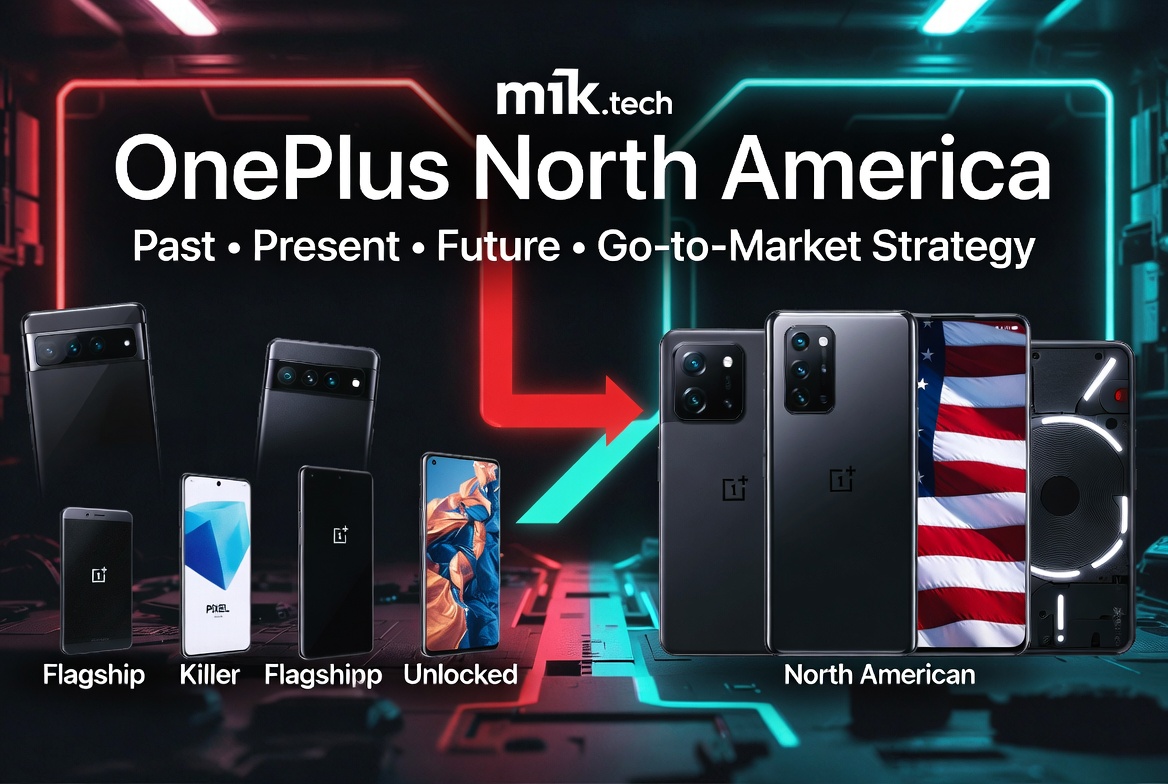
OnePlus has operated in North America since 2014 but has not achieved mainstream market penetration. Its T-Mobile partnership beginning with the OnePlus 6T provided retail distribution but compromised OxygenOS update speed and software quality, the brand’s core competitive advantages. Budget Nord devices through MetroPCS further diluted the brand’s identity.
A realistic North America strategy involves accepting a smaller, more defensible market position targeting premium unlocked Android buyers in the $500–$700 range, competing with Google Pixel and Nothing. Direct-to-consumer sales and tech media partnerships, rather than carrier deals, are identified as the appropriate channels. Whether that focused approach receives internal funding remains unresolved.
June 14, 2026. OnePlus has been present in North America since 2014 and has not cracked the US market in any way that satisfies the definition of cracking it. The OnePlus One found an audience in the US through Amazon and the OnePlus website. The buyers it was designed for: unlocked-device purchasers, tech enthusiasts, immigrants from markets where OnePlus was already established, and a small segment of American consumers who buy phones without carrier subsidies and care more about specifications and software quality than about retail availability. That audience exists and is real. It has never been large enough to produce mainstream US market penetration, and the strategies OnePlus has tried to change that have each created new problems while partially addressing the original one.
This post is my full North America accounting: what OnePlus has tried, what has worked, what has not, and what a realistic North America strategy looks like from where the brand stands today.
The T-Mobile era: distribution with product costs
The T-Mobile partnership for the OnePlus 6T in 2018 gave OnePlus mainstream retail distribution in the US for the first time. T-Mobile’s stores, website, advertising, and plan bundling allowed OnePlus to reach American consumers who had never heard of the brand. For OnePlus, this looked like a breakthrough. For the existing US community, it was a mixed experience that created the structural problem that persists today: the T-Mobile variant runs a modified OxygenOS under T-Mobile’s update approval timeline, making it a meaningfully different product from the global variant. The gap between US T-Mobile OxygenOS and global OxygenOS has been two to six weeks for major updates as standard, which is relevant given that OxygenOS’s primary competitive advantage has always been update speed.
The Nord N10 and N100, released in 2020 and exclusively through T-Mobile and MetroPCS, extended the problem to a new tier. Budget devices built to carrier specifications with MediaTek chips, update commitments below the global standard, and OxygenOS builds further from the global standard than anything OnePlus has shipped in other markets. A Nord N100 buyer at MetroPCS, encountering “OnePlus” for the first time, is forming an impression that is accurate for the product they bought but completely inaccurate for what the brand means to the global community. That impression gap is expensive to close, and OnePlus has not invested in closing it.
Why carrier distribution is structurally difficult for OnePlus
Less than 20% of US smartphone purchases are unlocked. The 80% who buy through carriers are not in OnePlus’s addressable market unless OnePlus accepts the constraints of the carrier relationship on its product and software. Those constraints, carrier bloatware, carrier update approval timelines, and carrier-influenced hardware design directly contradict the software quality and update speed arguments that have always been OnePlus’s primary competitive advantage. The T-Mobile partnership is the clearest example of what happens when OnePlus tries to serve two audiences simultaneously: the premium unlocked enthusiast buyer who wants clean OxygenOS and the prepaid carrier buyer who wants a budget Android. Serving both requires compromises that satisfy neither.
What a realistic North America strategy looks like right now
The recommendation is not to double down on carrier distribution. The recommendation is to accept a smaller but more defensible position: the premium-unlocked Android alternative for American buyers who care about software quality, specifications, and price, in that order. That audience has not disappeared. It has mostly moved to Google Pixel and Nothing, because those brands are executing the OnePlus thesis more faithfully than OnePlus currently is. Winning it back requires OxygenOS quality restoration sustained over multiple product cycles, US-specific software not modified by carrier requirements, and product marketing that speaks to tech media and the enthusiast community rather than the mass carrier market.
The go-to-market for that approach: direct-to-consumer online sales with meaningful investment in US tech media relationships and YouTube creator partnerships, the same channels that drove the OnePlus One’s initial US discovery in 2014. A product line positioned as the Google Pixel alternative for buyers who want flagship hardware at a price that does not require a carrier contract. That positioning was vacated when OnePlus reached $899 with the 8 Pro. It is available again now that Nothing has established the higher-design-premium end and Pixel has established the software-first end, leaving a hardware-quality-at-honest-price position in the $500-$700 range that OnePlus’s current lineup could fill if the software quality commitment holds.
Whether the unified Realme product center funds that strategy, the smaller, more focused North America play rather than the high-unit-count carrier deal, is the question that will determine whether OnePlus has a genuine future in North America or continues to have a presence without a position. The answer to that question is being made in Shenzhen right now, and we are not yet in a position to know what it is.
Part of my ongoing OnePlus coverage at m1k.tech, tracking the brand from founding to the Realme merger.