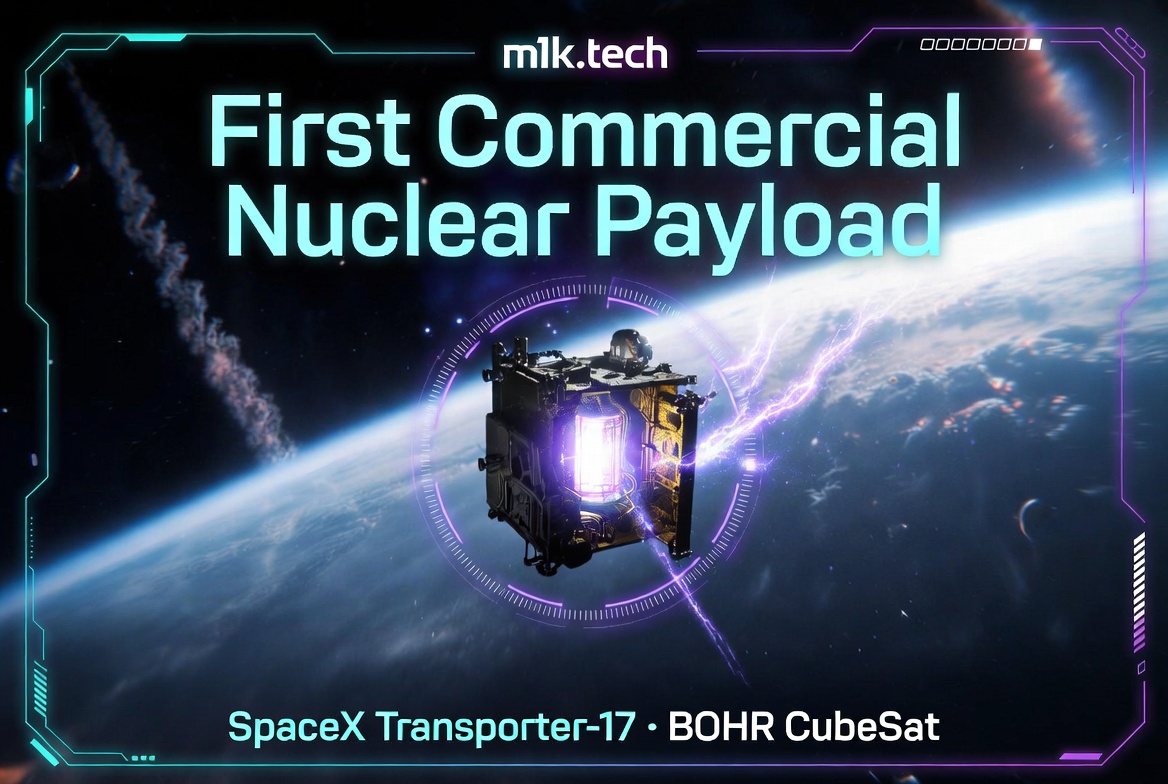
Eighty-one payloads went up on a Falcon 9 out of Vandenberg on the morning of July 7, 2026, riding SpaceX’s Transporter-17. Eighty were the usual smallsat traffic. The eighty-first was a 1U CubeSat about the size of a softball, built by a Miami startup called City Labs and named BOHR, for Betavoltaic Orbital High-Reliability. It became the first commercial nuclear payload in orbit, the first spacecraft ever cleared to carry a nuclear power source under the FAA’s launch approval process.
That sentence needs unpacking, because “nuclear-powered satellite” is doing a lot of misleading work. BOHR runs on solar panels. The nuclear bit is a tritium betavoltaic battery about the size of a pencil eraser, and it is the payload being tested, not the thing keeping the lights on. CEO Peter Cabauy has never pretended otherwise. This is a technology demonstration whose entire job is to shove the betavoltaic device into real low Earth orbit and phone home about whether it survives.
The distinction matters the moment you compare this to NASA’s deep-space hardware. A Multi-Mission Radioisotope Thermoelectric Generator on a Mars rover pulls roughly 110 watts of electrical power out of decaying plutonium-238. BOHR’s tritium battery produces nanowatts to microwatts. Not a typo. It is a different physical mechanism aimed at a different problem, and reading it as a feeble RTG misses the point.
A betavoltaic battery converts the kinetic energy of beta particles, electrons kicked out during radioactive decay, straight into current through a semiconductor junction. Think of a solar cell where the incoming stream is electrons from nuclear decay instead of photons from the sun. City Labs runs it on tritium, a radioactive isotope of hydrogen with a half-life around 12.3 years. Tritium decays by spitting out a beta particle capped at about 18.6 keV, which puts it among the feeblest beta emitters you can buy, and that feebleness is the whole trick. Those particles cannot get through human skin or the wall of a shipping container, and they die in a few millimeters of nearly any solid. The NRC treats tritium devices at City Labs’ power levels as safe enough to mail to a house. Sandia National Laboratories signed off on the safety analysis for BOHR independently before the FAA would authorize anything.
The nanowatt-to-microwatt output falls straight out of that low decay energy. Each individual decay carries very little punch, so even a physically small source has only modest activity. What you buy with that anemic output is time. After ten years, a tritium betavoltaic still holds around 57% of its original activity, and City Labs rates BOHR’s battery for roughly a decade with no moving parts, no refueling, and total indifference to sunlight or how cold it gets.
That indifference to sunlight is exactly why the Department of Defense paid for this, along with the Air Force Research Laboratory and SpaceWERX. A satellite in a high-inclination orbit, or buried in eclipse, or carrying a classified sensor that has to run no matter where it sits in its orbit, all hit the same wall: solar panels are intermittent, and batteries that cycle charge and discharge wear out. A source that trickles a stable current for ten years and does none of that is a real asset for low-power persistent sensors, oscillators, secure timing. Lockheed Martin saw it coming, running environmental tests on City Labs’ tritium devices starting in 2008, nearly two decades before BOHR ever flew, and those units are reportedly still running. That accumulated longevity data is part of what made the regulatory case defensible in the first place.
That regulatory case is really the product here. The FAA issued BOHR’s payload authorization on September 30, 2025, about nine months ahead of launch, the first ever granted to a commercial spacecraft carrying a nuclear power source. None of it would have been possible without National Security Presidential Memorandum-20, signed August 20, 2019. Before NSPM-20, the whole approval pathway for nuclear-carrying launches assumed a government entity was the responsible party, built around NASA probes and military satellites and their interagency review. NSPM-20 rebuilt that review to fit commercial operators, giving the FAA a framework to authorize nuclear payloads once an independent safety validation cleared. City Labs, with Kevin Makinson running the safety analysis, walked that framework end to end for the first time.
The battery produces microwatts. The template it left behind is worth vastly more. What the FAA demanded, what the safety analysis looked like, how long it took, all of it is now documented and sitting there for whoever wants to fly a nuclear payload next, and it works the same whether you are a small Miami startup or Northrop Grumman. The civilian framing and the defense money were never at odds. They were the design.
NASA is now working with City Labs on tritium power for instruments headed to the permanently shadowed craters near the lunar poles. Those craters keep their water ice precisely because sunlight never reaches them, which also means solar panels are dead weight and temperatures drop low enough to freeze ordinary battery chemistry. A power source that ignores both light and heat fits anything that has to survive down there. City Labs is also building heat-producing versions capable of tens of watts of thermal output, a different animal from BOHR’s microwatt electrical trickle, aimed squarely at keeping hardware above its minimum operating temperature through a 14-day lunar night.
At the other extreme, NASA is funding full-fission surface reactors for the Moon, targeted for around 2030, in the kilowatt-to-tens-of-kilowatt range to support crewed operations. BOHR’s battery sits at the very bottom of a spectrum that stretches from microwatts to tens of kilowatts, and the middle is where it gets interesting and empty. Robotic surface systems, instrument suites, communications nodes all live in the watts-to-hundreds-of-watts band, too hungry for a betavoltaic and too small and remote to justify hauling a reactor. Nobody has an obvious answer for that gap yet.
Telemetry from BOHR should come back within weeks to months of launch, and the questions are blunt. Did the device survive the launch vibration? Did it survive the thermal whiplash of a roughly 90-minute LEO orbit swinging in and out of eclipse? Did the LEO radiation environment, nastier than the ground but nowhere near the Van Allen belts or deep space, chew measurably into the semiconductor junction or the tritium source over that first stretch? Favorable answers hand City Labs a flight-validated device and a documented path through the FAA.
One launch is a proof of concept. The threshold I am actually watching is the second flight, because a second commercial nuclear payload through the same FAA process, from anybody, is the moment the pathway stops being a novelty and starts being routine. If BOHR is still the only one in a few years, the “commercial nuclear era” will have been a headline and nothing more.
For City Labs, the real next step is thermal variants at tens of watts, where betavoltaics start solving problems that solar panels and chemical batteries simply cannot, rather than nibbling at the margins.
For now, a pencil-eraser of tritium is orbiting Earth, emitting a current too weak to power a radio, bolted to a softball-sized satellite that runs on solar panels, having cleared a regulatory process that took most of a decade to complete. The wattage is trivial. I would not bet against the precedent.