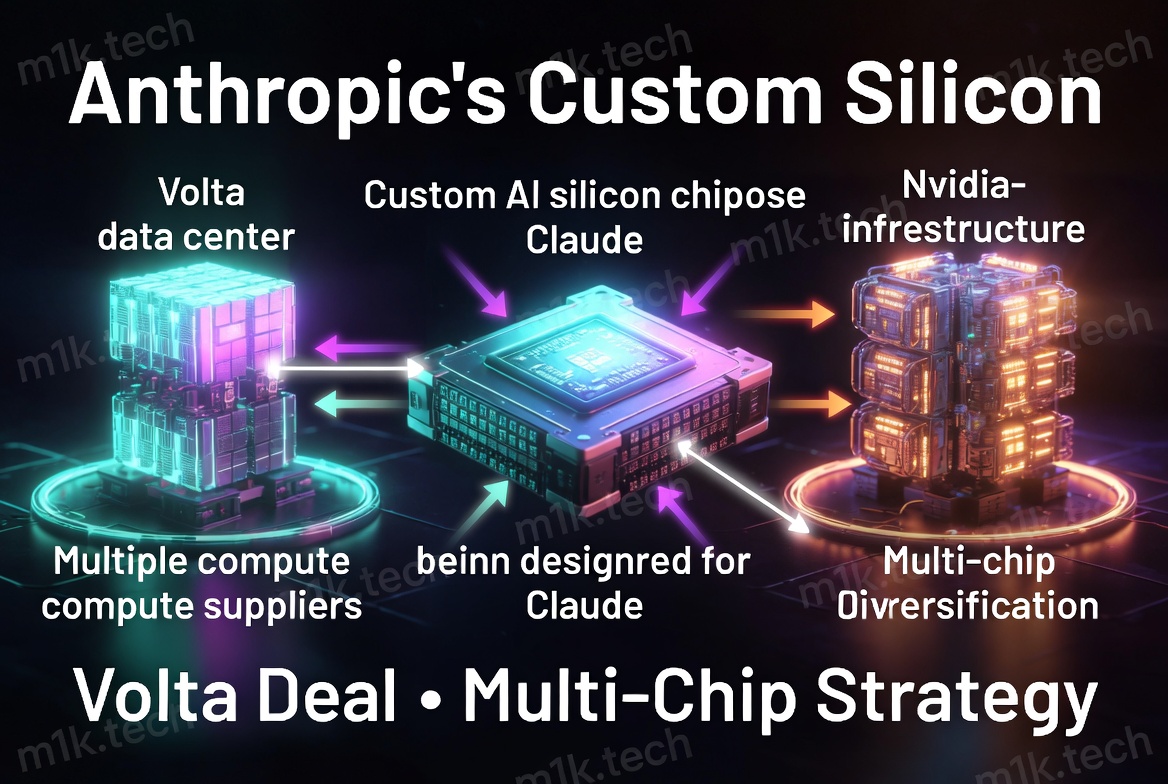
Anthropic’s custom silicon team has exactly one job listing to its name so far, salary band $320,000 to $485,000, and one sentence in that posting told me more than the number did: the company wants someone who has “shipped silicon” and is “comfortable making consequential calls without a large organization behind them.” That’s not a research-lab hire. That’s the first employee on a team that doesn’t really exist yet.
A spokesperson confirmed to Business Insider that this is real: Anthropic is building an in-house team to design custom chips for Claude, its first public admission of what Reuters had already reported it was exploring and what The Information said involved talks with Samsung Electronics as a possible manufacturing partner. The company insists it isn’t walking away from anyone. Its stated plan is a “multi-chip approach,” hardware from AWS, Google, Nvidia, and AMD staying central to how it scales, with custom silicon layered on top and co-designed with the models themselves. I believe that part. Nobody swaps four suppliers for zero suppliers on purpose.
Then, the same week, Anthropic signed a $10 billion, six-year compute deal with Volta, a cloud startup that barely existed as a named company a month ago. Volta is valued at $2.4 billion, backed by Andreessen Horowitz, Altimeter, Michael Dell, and Nvidia itself, and it plans to deliver Anthropic’s capacity through a 133 megawatt site in Norway built with the bitcoin miner Bitdeer and run on Nvidia’s next-generation Vera Rubin chips. Bloomberg broke the deal first. Volta is also a member of Nvidia’s own Cloud Partner program, which tells you roughly where the relationship actually sits.
I already wrote about a bitcoin miner signing a $9.8 billion data center lease and never once mentioning bitcoin. Bitdeer is the same trade with a bigger anchor tenant: a mining operation that discovered its rigs and its power contracts are worth more hosting GPUs than mining coins. Anthropic gets a new supplier out of it. Volta gets the credibility and the cash flow that come from landing a marquee customer weeks into existing.
Volta isn’t even Anthropic’s only fresh nine-figure commitment this summer. Amazon has put up to $25 billion into the company and supplies much of its compute. Google and Broadcom landed the biggest deal yet as Anthropic’s run rate hit $30 billion, on top of heavy use of Google’s TPUs. AMD’s Helios GPUs went into production this summer backed by a $5 billion Anthropic commitment. CoreWeave, Akamai, and SpaceX are all in the mix too, and Anthropic is reportedly in talks with Meta over a compute deal the same size as Volta’s. Spreading a book like that across a dozen names is supposed to be insurance, no single vendor can hold you hostage, and a lab that can shift load between Amazon, Google, AMD, and a Norwegian bitcoin-miner-turned-data-center gets leverage on price that nobody gets by staying loyal to one.
Here’s the part that bothers me. Almost every name on that list either takes Nvidia’s money, buys Nvidia’s chips, or both. Axios reported this week that Nvidia is weighing more than $750 billion in AI investments, financing deals, and partnerships, on the theory that it wins no matter which of its customers ends up on top. That’s the same dynamic I wrote about when Nvidia’s GPU monopoly kept getting stronger with every generation, and it’s still true even as everyone insists they’re diversifying away from it. A custom Claude chip, whenever it actually ships, is the one item on this list Nvidia didn’t fund and can’t easily route around. Everything else, a $10 billion deal with a month-old company included, still runs through the same casino.
The pressure behind the chip team is real too. DeepSeek’s V4-Flash undercutting Claude on price by roughly a hundred times is exactly the kind of math that makes a lab want to own its silicon stack instead of renting someone else’s margin forever. Whether Anthropic’s new team ever ships something Claude actually runs on, or just becomes leverage in the next round of pricing talks with Nvidia and AMD, isn’t something a job listing tells you. I’d bet on leverage first and shipped silicon a distant second. Ask me again once that $485,000 hire has been on the job for a year.
Sources
- Business Insider, “Anthropic confirms it’s building an in-house chip team for Claude”, August 4, 2026
- The Next Web, “Anthropic signs a $10bn compute deal with a week-old cloud startup”, August 4, 2026
- Zamin.uz, “Anthropic and Volta Sign $10 Billion Contract for AI Infrastructure”, August 5, 2026
- Axios, “Why Nvidia bankrolls its rivals”, August 5, 2026