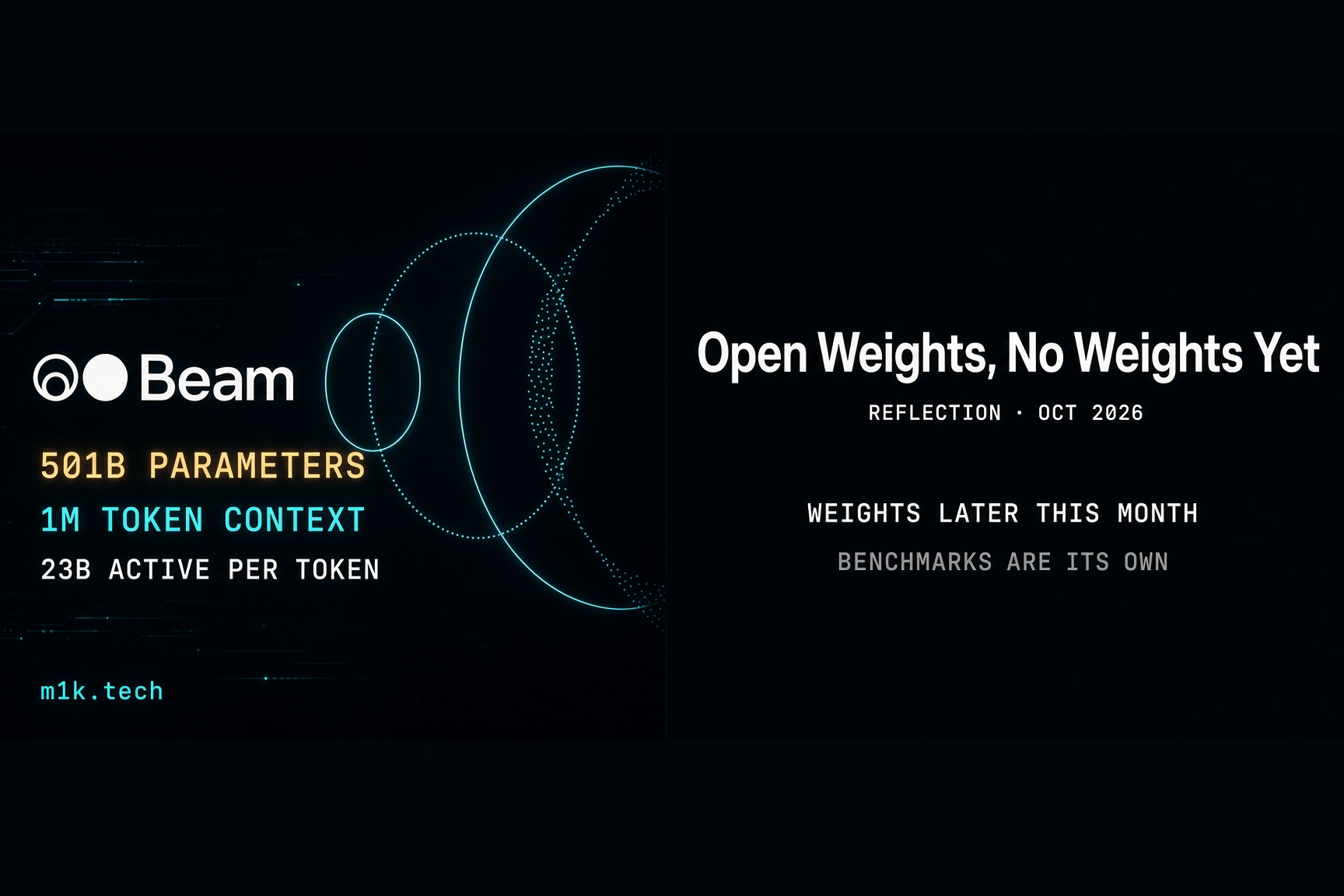
Reflection AI Beam is a 501-billion-parameter model with a one-million-token context window, and as of Monday, the only way to touch it is via a waitlist. Reflection unveiled it as the company’s first open-weight model and says the weights, a technical report, and tooling will arrive later this month under an Apache 2.0 license, once final red-teaming and evaluations finish.
Beam is a mixture-of-experts design that wakes 23 billion of those parameters per token. Reflection says it pretrained the model on 23.8 trillion tokens in under four weeks on 6,144 Nvidia GB300 GPUs, then ran a four-week reinforcement learning stage on 10,500 of them, more than 100 million task attempts in all, which the company believes is one of the largest such runs by any open lab. Nothing outside Reflection’s own blog post backs that up yet.
The scores are Reflection’s too. It puts Beam level with Z.ai’s GLM-5.2 on coding and agentic work and approaching Alibaba’s Qwen 3.8-Max, with Moonshot’s Kimi K3 still ahead: 80.1 on Terminal Bench v2.1 against 88.3 for Kimi, and 80.9 on SWE-bench Verified against 77.6 for Thinking Machines’ Inkling. The efficiency claim carries the pitch, since Reflection says Beam matches GLM-5.2 on advanced reasoning with three to four times less inference compute, a figure it describes as an approximate comparison and not a measured cost. I’d hold that number loosely until somebody runs it on their own hardware, which can’t happen before the weights ship.
The money behind it interests me more than the benchmarks. Nvidia backs Reflection, the lab confirmed a round at a $25 billion pre-money valuation in June, and this summer it signed compute deals worth $6.3 billion with SpaceX and $1 billion with Nebius. When I wrote about the open weights letter and its GPU-selling sponsor in July, Reflection was one of four signatories already inside Nvidia’s funding orbit, and Beam is what that orbit looks like once it ships a model. An open license on weights trained on GB300s is still open, but the dependency sits one layer below where the license can reach.
The comparison set is almost entirely Chinese. Fortune frames Beam as America’s bid against open models like Kimi K3 and DeepSeek’s V4, yet the yardstick Reflection picked is a July release from Z.ai that Z.ai replaced with GLM-5.3 in August. Matching last quarter’s Chinese model is a respectable first step and also a fair map of where open weights stand. DeepSeek’s V4-Flash already made the price argument, and Mistral hosts Chinese weights outright, as I found when I read the Mistral Large 3 config file, so I doubt that parity with a Chinese model from last quarter is what moves sovereignty-minded buyers, whatever the “DeepSeek of the West” label suggests.
On safety, Reflection says it trained a second model from the same base for alignment and merged the two, and CEO Misha Laskin told Semafor that the US Center for Advancing Innovation and Standards for Super Intelligence and the UK’s AI Safety Institute are both assessing it. Co-founder Ioannis Antonoglou allowed on a podcast that a model could reach a capability level where open release calls for more care. I would like to see that sentence tested against an actual release decision, and the first one is due within weeks.
Until the weights land, Beam is a press release with a waitlist, and I’m filing it that way. The date to watch is the end of October, when Reflection says the download appears.
Sources
- Fortune, Nvidia-backed Reflection AI unveils its first open model, Beam. Could it be America’s best chance to compete with China?, October 5, 2026
- The Next Web, Reflection’s first open-weight model, Beam, aims at China’s GLM-5.2, October 5, 2026
- Business Insider, What Is Beam? the US AI Model Being Called the ‘DeepSeek of the West’, October 6, 2026